

7 Resilience of Coastal Cities in Facing Climate Change: Reclamation …
143
of marine economic sector, (d) to preserve marine resources, (e) to build capacity
development of knowledge and technology and enhancing national maritime culture
(Warsilah 2015).
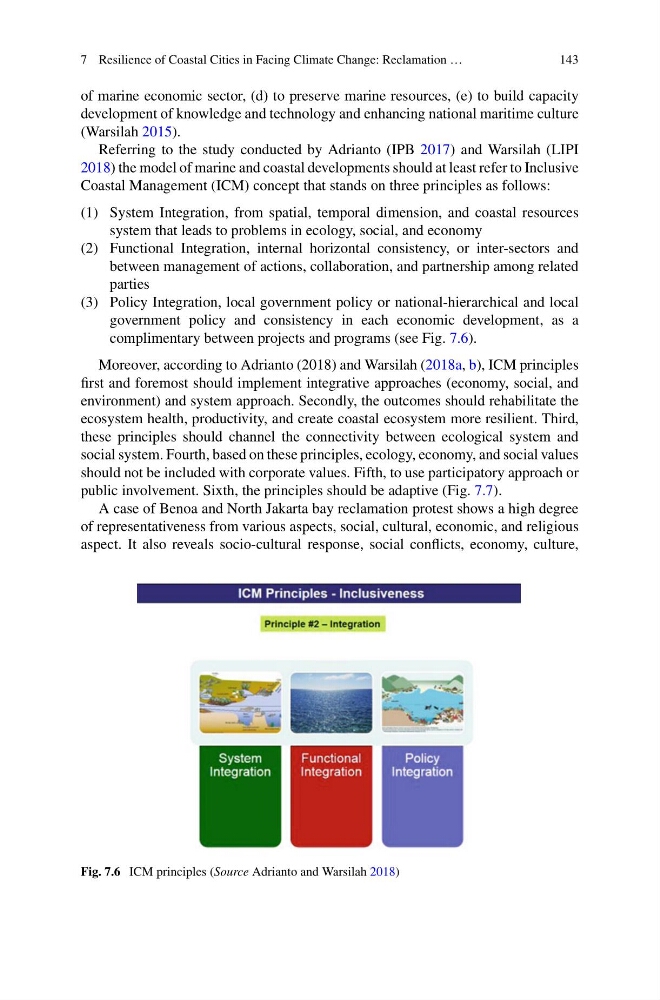
Referring to the study conducted by Adrianto (IPB 2017) and Warsilah (LIPI
2018) the model of marine and coastal developments should at least refer to Inclusive
Coastal Management (ICM) concept that stands on three principles as follows:
(1) System Integration, from spatial, temporal dimension, and coastal resources
system that leads to problems in ecology, social, and economy
(2) Functional Integration, internal horizontal consistency, or inter-sectors and
between management of actions, collaboration, and partnership among related
parties
(3) Policy Integration, local government policy or national-hierarchical and local
government policy and consistency in each economic development, as a
complimentary between projects and programs (see Fig. 7.6).
Moreover, according to Adrianto (2018) and Warsilah (2018a, b), ICM principles
first and foremost should implement integrative approaches (economy, social, and
environment) and system approach. Secondly, the outcomes should rehabilitate the
ecosystem health, productivity, and create coastal ecosystem more resilient. Third,
these principles should channel the connectivity between ecological system and
social system. Fourth, based on these principles, ecology, economy, and social values
should not be included with corporate values. Fifth, to use participatory approach or
public involvement. Sixth, the principles should be adaptive (Fig. 7.7).
A case of Benoa and North Jakarta bay reclamation protest shows a high degree
of representativeness from various aspects, social, cultural, economic, and religious
aspect. It also reveals socio-cultural response, social conflicts, economy, culture,
Fig. 7.6 ICM principles (Source Adrianto and Warsilah 2018)
143
of marine economic sector, (d) to preserve marine resources, (e) to build capacity
development of knowledge and technology and enhancing national maritime culture
(Warsilah 2015).
Referring to the study conducted by Adrianto (IPB 2017) and Warsilah (LIPI
2018) the model of marine and coastal developments should at least refer to Inclusive
Coastal Management (ICM) concept that stands on three principles as follows:
(1) System Integration, from spatial, temporal dimension, and coastal resources
system that leads to problems in ecology, social, and economy
(2) Functional Integration, internal horizontal consistency, or inter-sectors and
between management of actions, collaboration, and partnership among related
parties
(3) Policy Integration, local government policy or national-hierarchical and local
government policy and consistency in each economic development, as a
complimentary between projects and programs (see Fig. 7.6).
Moreover, according to Adrianto (2018) and Warsilah (2018a, b), ICM principles
first and foremost should implement integrative approaches (economy, social, and
environment) and system approach. Secondly, the outcomes should rehabilitate the
ecosystem health, productivity, and create coastal ecosystem more resilient. Third,
these principles should channel the connectivity between ecological system and
social system. Fourth, based on these principles, ecology, economy, and social values
should not be included with corporate values. Fifth, to use participatory approach or
public involvement. Sixth, the principles should be adaptive (Fig. 7.7).
A case of Benoa and North Jakarta bay reclamation protest shows a high degree
of representativeness from various aspects, social, cultural, economic, and religious
aspect. It also reveals socio-cultural response, social conflicts, economy, culture,
Fig. 7.6 ICM principles (Source Adrianto and Warsilah 2018)