

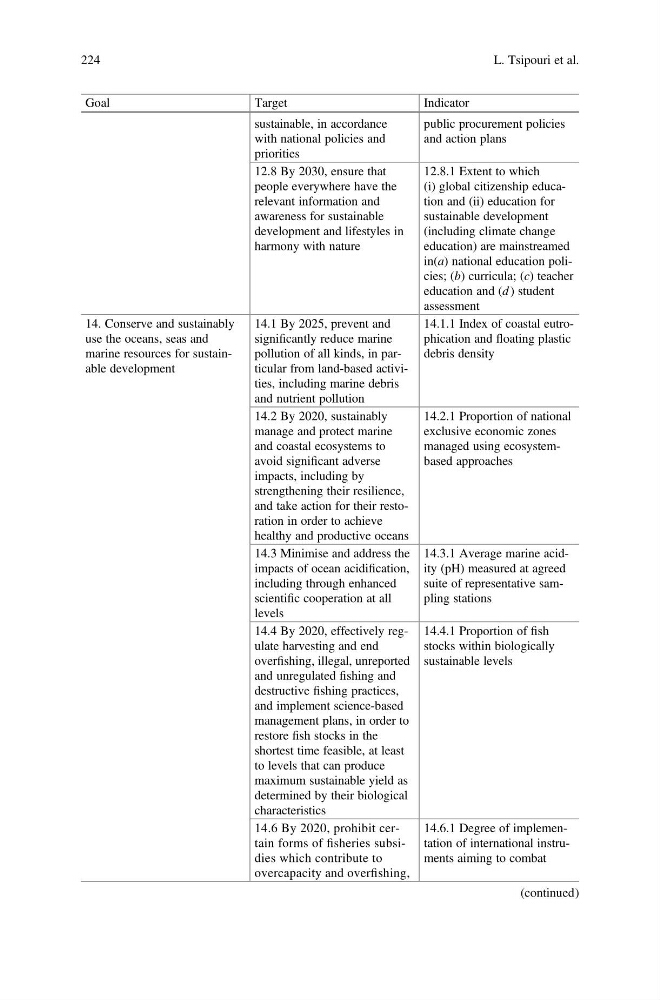
Goal
Target
Indicator
sustainable, in accordance
with national policies and
priorities
public procurement policies
and action plans
12.8 By 2030, ensure that
people everywhere have the
relevant information and
awareness for sustainable
development and lifestyles in
harmony with nature
12.8.1 Extent to which
(i) global citizenship education and (ii) education for
sustainable development
(including climate change
education) are mainstreamed
in(a) national education policies; (b) curricula; (c) teacher
education and (d ) student
assessment
14. Conserve and sustainably
use the oceans, seas and
marine resources for sustainable development
14.1 By 2025, prevent and
significantly reduce marine
pollution of all kinds, in particular from land-based activities, including marine debris
and nutrient pollution
14.1.1 Index of coastal eutrophication and floating plastic
debris density
14.2 By 2020, sustainably
manage and protect marine
and coastal ecosystems to
avoid significant adverse
impacts, including by
strengthening their resilience,
and take action for their restoration in order to achieve
healthy and productive oceans
14.2.1 Proportion of national
exclusive economic zones
managed using ecosystembased approaches
14.3 Minimise and address the
impacts of ocean acidification,
including through enhanced
scientific cooperation at all
levels
14.3.1 Average marine acidity (pH) measured at agreed
suite of representative sampling stations
14.4 By 2020, effectively regulate harvesting and end
overfishing, illegal, unreported
and unregulated fishing and
destructive fishing practices,
and implement science-based
management plans, in order to
restore fish stocks in the
shortest time feasible, at least
to levels that can produce
maximum sustainable yield as
determined by their biological
characteristics
14.4.1 Proportion of fish
stocks within biologically
sustainable levels
14.6 By 2020, prohibit certain forms of fisheries subsidies which contribute to
overcapacity and overfishing,
14.6.1 Degree of implementation of international instruments aiming to combat
(continued)
224
L. Tsipouri et al.
Target
Indicator
sustainable, in accordance
with national policies and
priorities
public procurement policies
and action plans
12.8 By 2030, ensure that
people everywhere have the
relevant information and
awareness for sustainable
development and lifestyles in
harmony with nature
12.8.1 Extent to which
(i) global citizenship education and (ii) education for
sustainable development
(including climate change
education) are mainstreamed
in(a) national education policies; (b) curricula; (c) teacher
education and (d ) student
assessment
14. Conserve and sustainably
use the oceans, seas and
marine resources for sustainable development
14.1 By 2025, prevent and
significantly reduce marine
pollution of all kinds, in particular from land-based activities, including marine debris
and nutrient pollution
14.1.1 Index of coastal eutrophication and floating plastic
debris density
14.2 By 2020, sustainably
manage and protect marine
and coastal ecosystems to
avoid significant adverse
impacts, including by
strengthening their resilience,
and take action for their restoration in order to achieve
healthy and productive oceans
14.2.1 Proportion of national
exclusive economic zones
managed using ecosystembased approaches
14.3 Minimise and address the
impacts of ocean acidification,
including through enhanced
scientific cooperation at all
levels
14.3.1 Average marine acidity (pH) measured at agreed
suite of representative sampling stations
14.4 By 2020, effectively regulate harvesting and end
overfishing, illegal, unreported
and unregulated fishing and
destructive fishing practices,
and implement science-based
management plans, in order to
restore fish stocks in the
shortest time feasible, at least
to levels that can produce
maximum sustainable yield as
determined by their biological
characteristics
14.4.1 Proportion of fish
stocks within biologically
sustainable levels
14.6 By 2020, prohibit certain forms of fisheries subsidies which contribute to
overcapacity and overfishing,
14.6.1 Degree of implementation of international instruments aiming to combat
(continued)
224
L. Tsipouri et al.