

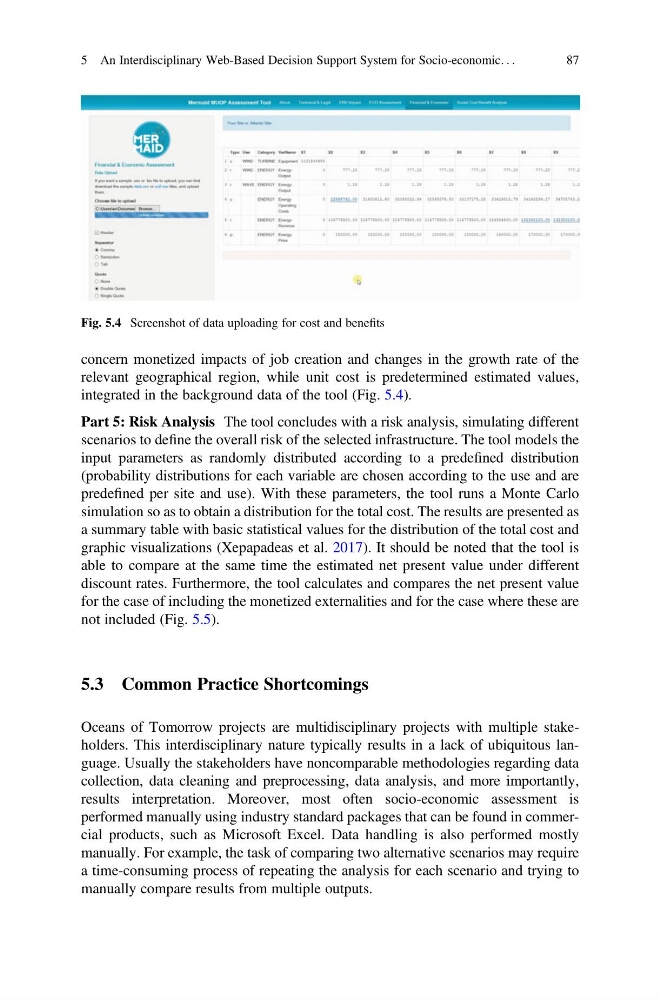
concern monetized impacts of job creation and changes in the growth rate of the
relevant geographical region, while unit cost is predetermined estimated values,
integrated in the background data of the tool (Fig. 5.4).
Part 5: Risk Analysis The tool concludes with a risk analysis, simulating different
scenarios to define the overall risk of the selected infrastructure. The tool models the
input parameters as randomly distributed according to a predefined distribution
(probability distributions for each variable are chosen according to the use and are
predefined per site and use). With these parameters, the tool runs a Monte Carlo
simulation so as to obtain a distribution for the total cost. The results are presented as
a summary table with basic statistical values for the distribution of the total cost and
graphic visualizations (Xepapadeas et al. 2017). It should be noted that the tool is
able to compare at the same time the estimated net present value under different
discount rates. Furthermore, the tool calculates and compares the net present value
for the case of including the monetized externalities and for the case where these are
not included (Fig. 5.5).
5.3 Common Practice Shortcomings
Oceans of Tomorrow projects are multidisciplinary projects with multiple stakeholders. This interdisciplinary nature typically results in a lack of ubiquitous language. Usually the stakeholders have noncomparable methodologies regarding data
collection, data cleaning and preprocessing, data analysis, and more importantly,
results interpretation. Moreover, most often socio-economic assessment is
performed manually using industry standard packages that can be found in commercial products, such as Microsoft Excel. Data handling is also performed mostly
manually. For example, the task of comparing two alternative scenarios may require
a time-consuming process of repeating the analysis for each scenario and trying to
manually compare results from multiple outputs.
Fig. 5.4 Screenshot of data uploading for cost and benefits
5 An Interdisciplinary Web-Based Decision Support System for Socio-economic. . .
87
relevant geographical region, while unit cost is predetermined estimated values,
integrated in the background data of the tool (Fig. 5.4).
Part 5: Risk Analysis The tool concludes with a risk analysis, simulating different
scenarios to define the overall risk of the selected infrastructure. The tool models the
input parameters as randomly distributed according to a predefined distribution
(probability distributions for each variable are chosen according to the use and are
predefined per site and use). With these parameters, the tool runs a Monte Carlo
simulation so as to obtain a distribution for the total cost. The results are presented as
a summary table with basic statistical values for the distribution of the total cost and
graphic visualizations (Xepapadeas et al. 2017). It should be noted that the tool is
able to compare at the same time the estimated net present value under different
discount rates. Furthermore, the tool calculates and compares the net present value
for the case of including the monetized externalities and for the case where these are
not included (Fig. 5.5).
5.3 Common Practice Shortcomings
Oceans of Tomorrow projects are multidisciplinary projects with multiple stakeholders. This interdisciplinary nature typically results in a lack of ubiquitous language. Usually the stakeholders have noncomparable methodologies regarding data
collection, data cleaning and preprocessing, data analysis, and more importantly,
results interpretation. Moreover, most often socio-economic assessment is
performed manually using industry standard packages that can be found in commercial products, such as Microsoft Excel. Data handling is also performed mostly
manually. For example, the task of comparing two alternative scenarios may require
a time-consuming process of repeating the analysis for each scenario and trying to
manually compare results from multiple outputs.
Fig. 5.4 Screenshot of data uploading for cost and benefits
5 An Interdisciplinary Web-Based Decision Support System for Socio-economic. . .
87