

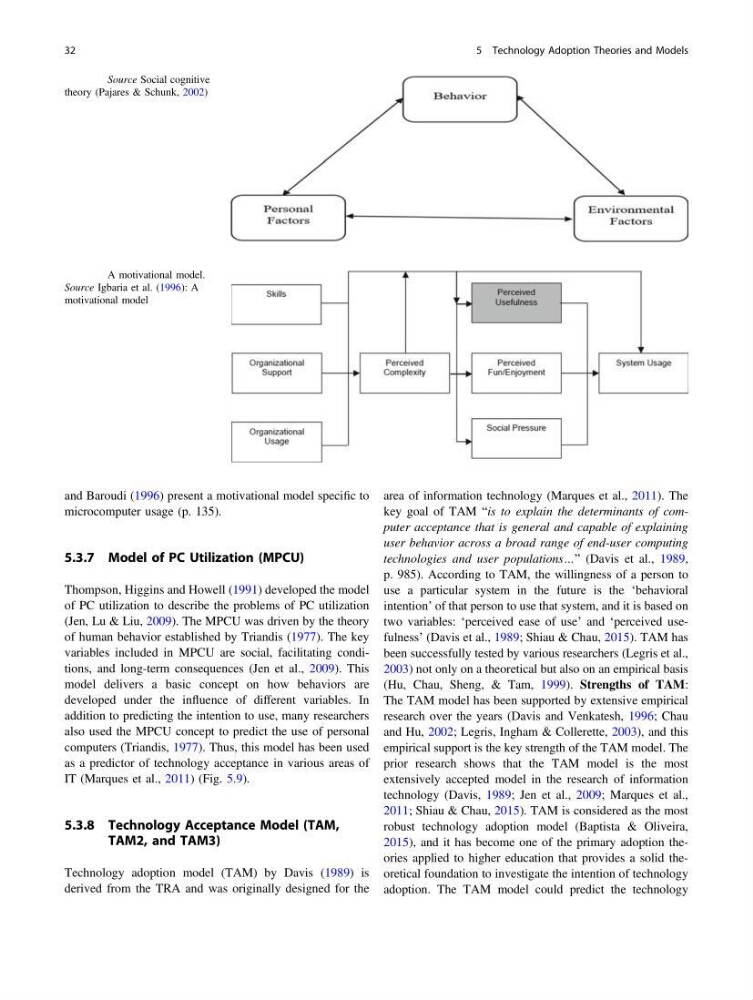
and Baroudi (1996) present a motivational model specific to
microcomputer usage (p. 135).
5.3.7 Model of PC Utilization (MPCU)
Thompson, Higgins and Howell (1991) developed the model
of PC utilization to describe the problems of PC utilization
(Jen, Lu & Liu, 2009). The MPCU was driven by the theory
of human behavior established by Triandis (1977). The key
variables included in MPCU are social, facilitating conditions, and long-term consequences (Jen et al., 2009). This
model delivers a basic concept on how behaviors are
developed under the influence of different variables. In
addition to predicting the intention to use, many researchers
also used the MPCU concept to predict the use of personal
computers (Triandis, 1977). Thus, this model has been used
as a predictor of technology acceptance in various areas of
IT (Marques et al., 2011) (Fig. 5.9).
5.3.8 Technology Acceptance Model (TAM,
TAM2, and TAM3)
Technology adoption model (TAM) by Davis (1989) is
derived from the TRA and was originally designed for the
area of information technology (Marques et al., 2011). The
key goal of TAM “is to explain the determinants of computer acceptance that is general and capable of explaining
user behavior across a broad range of end-user computing
technologies and user populations…” (Davis et al., 1989,
p. 985). According to TAM, the willingness of a person to
use a particular system in the future is the ‘behavioral
intention’ of that person to use that system, and it is based on
two variables: ‘perceived ease of use’ and ‘perceived usefulness’ (Davis et al., 1989; Shiau & Chau, 2015). TAM has
been successfully tested by various researchers (Legris et al.,
2003) not only on a theoretical but also on an empirical basis
(Hu, Chau, Sheng, & Tam, 1999). Strengths of TAM:
The TAM model has been supported by extensive empirical
research over the years (Davis and Venkatesh, 1996; Chau
and Hu, 2002; Legris, Ingham & Collerette, 2003), and this
empirical support is the key strength of the TAM model. The
prior research shows that the TAM model is the most
extensively accepted model in the research of information
technology (Davis, 1989; Jen et al., 2009; Marques et al.,
2011; Shiau & Chau, 2015). TAM is considered as the most
robust technology adoption model (Baptista & Oliveira,
2015), and it has become one of the primary adoption theories applied to higher education that provides a solid theoretical foundation to investigate the intention of technology
adoption. The TAM model could predict the technology
Fig. 5.7 Source Social cognitive
theory (Pajares & Schunk, 2002)
Fig. 5.8 A motivational model.
Source Igbaria et al. (1996): A
motivational model
32
5 Technology Adoption Theories and Models
microcomputer usage (p. 135).
5.3.7 Model of PC Utilization (MPCU)
Thompson, Higgins and Howell (1991) developed the model
of PC utilization to describe the problems of PC utilization
(Jen, Lu & Liu, 2009). The MPCU was driven by the theory
of human behavior established by Triandis (1977). The key
variables included in MPCU are social, facilitating conditions, and long-term consequences (Jen et al., 2009). This
model delivers a basic concept on how behaviors are
developed under the influence of different variables. In
addition to predicting the intention to use, many researchers
also used the MPCU concept to predict the use of personal
computers (Triandis, 1977). Thus, this model has been used
as a predictor of technology acceptance in various areas of
IT (Marques et al., 2011) (Fig. 5.9).
5.3.8 Technology Acceptance Model (TAM,
TAM2, and TAM3)
Technology adoption model (TAM) by Davis (1989) is
derived from the TRA and was originally designed for the
area of information technology (Marques et al., 2011). The
key goal of TAM “is to explain the determinants of computer acceptance that is general and capable of explaining
user behavior across a broad range of end-user computing
technologies and user populations…” (Davis et al., 1989,
p. 985). According to TAM, the willingness of a person to
use a particular system in the future is the ‘behavioral
intention’ of that person to use that system, and it is based on
two variables: ‘perceived ease of use’ and ‘perceived usefulness’ (Davis et al., 1989; Shiau & Chau, 2015). TAM has
been successfully tested by various researchers (Legris et al.,
2003) not only on a theoretical but also on an empirical basis
(Hu, Chau, Sheng, & Tam, 1999). Strengths of TAM:
The TAM model has been supported by extensive empirical
research over the years (Davis and Venkatesh, 1996; Chau
and Hu, 2002; Legris, Ingham & Collerette, 2003), and this
empirical support is the key strength of the TAM model. The
prior research shows that the TAM model is the most
extensively accepted model in the research of information
technology (Davis, 1989; Jen et al., 2009; Marques et al.,
2011; Shiau & Chau, 2015). TAM is considered as the most
robust technology adoption model (Baptista & Oliveira,
2015), and it has become one of the primary adoption theories applied to higher education that provides a solid theoretical foundation to investigate the intention of technology
adoption. The TAM model could predict the technology
Fig. 5.7 Source Social cognitive
theory (Pajares & Schunk, 2002)
Fig. 5.8 A motivational model.
Source Igbaria et al. (1996): A
motivational model
32
5 Technology Adoption Theories and Models