

relative advantage, and trialability) from Rogers and a fourth
characteristic (ease of use) that is also similar to Rogers’
complexity.
It is the prediction about the probability of adoption of an
innovation. According to Rogers (1983), “Rate of adoption
is the relative speed with which an innovation is adopted by
members of a social system. It is generally measured as the
number of individuals who adopt a new idea in a specified
period, such as a year. So the rate of adoption is a
numerical indicator of the steepness of the adoption curve
for an innovation”. Based on the unique psychographic
characteristics of each group, the adoption/rejection curve by
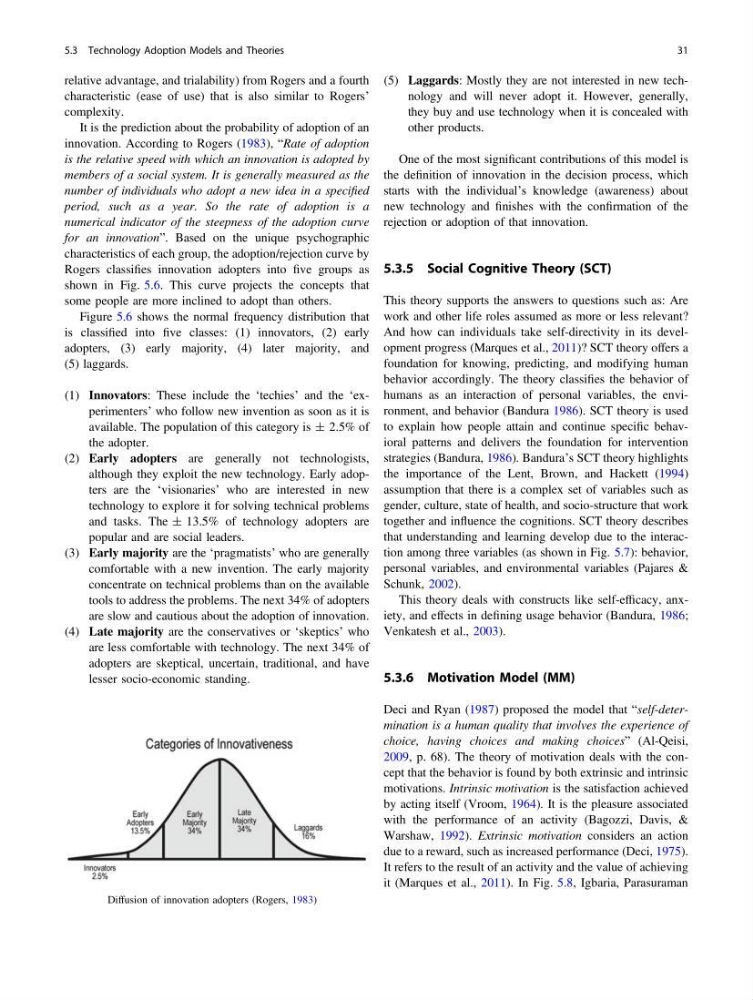
Rogers classifies innovation adopters into five groups as
shown in Fig. 5.6. This curve projects the concepts that
some people are more inclined to adopt than others.
Figure 5.6 shows the normal frequency distribution that
is classified into five classes: (1) innovators, (2) early
adopters, (3) early majority, (4) later majority, and
(5) laggards.
(1) Innovators: These include the ‘techies’ and the ‘experimenters’ who follow new invention as soon as it is
available. The population of this category is ± 2.5% of
the adopter.
(2) Early adopters are generally not technologists,
although they exploit the new technology. Early adopters are the ‘visionaries’ who are interested in new
technology to explore it for solving technical problems
and tasks. The ± 13.5% of technology adopters are
popular and are social leaders.
(3) Early majority are the ‘pragmatists’ who are generally
comfortable with a new invention. The early majority
concentrate on technical problems than on the available
tools to address the problems. The next 34% of adopters
are slow and cautious about the adoption of innovation.
(4) Late majority are the conservatives or ‘skeptics’ who
are less comfortable with technology. The next 34% of
adopters are skeptical, uncertain, traditional, and have
lesser socio-economic standing.
(5) Laggards: Mostly they are not interested in new technology and will never adopt it. However, generally,
they buy and use technology when it is concealed with
other products.
One of the most significant contributions of this model is
the definition of innovation in the decision process, which
starts with the individual’s knowledge (awareness) about
new technology and finishes with the confirmation of the
rejection or adoption of that innovation.
5.3.5 Social Cognitive Theory (SCT)
This theory supports the answers to questions such as: Are
work and other life roles assumed as more or less relevant?
And how can individuals take self-directivity in its development progress (Marques et al., 2011)? SCT theory offers a
foundation for knowing, predicting, and modifying human
behavior accordingly. The theory classifies the behavior of
humans as an interaction of personal variables, the environment, and behavior (Bandura 1986). SCT theory is used
to explain how people attain and continue specific behavioral patterns and delivers the foundation for intervention
strategies (Bandura, 1986). Bandura’s SCT theory highlights
the importance of the Lent, Brown, and Hackett (1994)
assumption that there is a complex set of variables such as
gender, culture, state of health, and socio-structure that work
together and influence the cognitions. SCT theory describes
that understanding and learning develop due to the interaction among three variables (as shown in Fig. 5.7): behavior,
personal variables, and environmental variables (Pajares &
Schunk, 2002).
This theory deals with constructs like self-efficacy, anxiety, and effects in defining usage behavior (Bandura, 1986;
Venkatesh et al., 2003).
5.3.6 Motivation Model (MM)
Deci and Ryan (1987) proposed the model that “self-determination is a human quality that involves the experience of
choice, having choices and making choices” (Al-Qeisi,
2009, p. 68). The theory of motivation deals with the concept that the behavior is found by both extrinsic and intrinsic
motivations. Intrinsic motivation is the satisfaction achieved
by acting itself (Vroom, 1964). It is the pleasure associated
with the performance of an activity (Bagozzi, Davis, &
Warshaw, 1992). Extrinsic motivation considers an action
due to a reward, such as increased performance (Deci, 1975).
It refers to the result of an activity and the value of achieving
it (Marques et al., 2011). In Fig. 5.8, Igbaria, Parasuraman
Fig. 5.6 Diffusion of innovation adopters (Rogers, 1983)
5.3 Technology Adoption Models and Theories
31
characteristic (ease of use) that is also similar to Rogers’
complexity.
It is the prediction about the probability of adoption of an
innovation. According to Rogers (1983), “Rate of adoption
is the relative speed with which an innovation is adopted by
members of a social system. It is generally measured as the
number of individuals who adopt a new idea in a specified
period, such as a year. So the rate of adoption is a
numerical indicator of the steepness of the adoption curve
for an innovation”. Based on the unique psychographic
characteristics of each group, the adoption/rejection curve by
Rogers classifies innovation adopters into five groups as
shown in Fig. 5.6. This curve projects the concepts that
some people are more inclined to adopt than others.
Figure 5.6 shows the normal frequency distribution that
is classified into five classes: (1) innovators, (2) early
adopters, (3) early majority, (4) later majority, and
(5) laggards.
(1) Innovators: These include the ‘techies’ and the ‘experimenters’ who follow new invention as soon as it is
available. The population of this category is ± 2.5% of
the adopter.
(2) Early adopters are generally not technologists,
although they exploit the new technology. Early adopters are the ‘visionaries’ who are interested in new
technology to explore it for solving technical problems
and tasks. The ± 13.5% of technology adopters are
popular and are social leaders.
(3) Early majority are the ‘pragmatists’ who are generally
comfortable with a new invention. The early majority
concentrate on technical problems than on the available
tools to address the problems. The next 34% of adopters
are slow and cautious about the adoption of innovation.
(4) Late majority are the conservatives or ‘skeptics’ who
are less comfortable with technology. The next 34% of
adopters are skeptical, uncertain, traditional, and have
lesser socio-economic standing.
(5) Laggards: Mostly they are not interested in new technology and will never adopt it. However, generally,
they buy and use technology when it is concealed with
other products.
One of the most significant contributions of this model is
the definition of innovation in the decision process, which
starts with the individual’s knowledge (awareness) about
new technology and finishes with the confirmation of the
rejection or adoption of that innovation.
5.3.5 Social Cognitive Theory (SCT)
This theory supports the answers to questions such as: Are
work and other life roles assumed as more or less relevant?
And how can individuals take self-directivity in its development progress (Marques et al., 2011)? SCT theory offers a
foundation for knowing, predicting, and modifying human
behavior accordingly. The theory classifies the behavior of
humans as an interaction of personal variables, the environment, and behavior (Bandura 1986). SCT theory is used
to explain how people attain and continue specific behavioral patterns and delivers the foundation for intervention
strategies (Bandura, 1986). Bandura’s SCT theory highlights
the importance of the Lent, Brown, and Hackett (1994)
assumption that there is a complex set of variables such as
gender, culture, state of health, and socio-structure that work
together and influence the cognitions. SCT theory describes
that understanding and learning develop due to the interaction among three variables (as shown in Fig. 5.7): behavior,
personal variables, and environmental variables (Pajares &
Schunk, 2002).
This theory deals with constructs like self-efficacy, anxiety, and effects in defining usage behavior (Bandura, 1986;
Venkatesh et al., 2003).
5.3.6 Motivation Model (MM)
Deci and Ryan (1987) proposed the model that “self-determination is a human quality that involves the experience of
choice, having choices and making choices” (Al-Qeisi,
2009, p. 68). The theory of motivation deals with the concept that the behavior is found by both extrinsic and intrinsic
motivations. Intrinsic motivation is the satisfaction achieved
by acting itself (Vroom, 1964). It is the pleasure associated
with the performance of an activity (Bagozzi, Davis, &
Warshaw, 1992). Extrinsic motivation considers an action
due to a reward, such as increased performance (Deci, 1975).
It refers to the result of an activity and the value of achieving
it (Marques et al., 2011). In Fig. 5.8, Igbaria, Parasuraman
Fig. 5.6 Diffusion of innovation adopters (Rogers, 1983)
5.3 Technology Adoption Models and Theories
31