

discover innovations that have been accepted or rejected.
Rogers (1983) defines DOI theory as “the process by which
innovation is communicated through certain channels over
time, among the members of a social system”. The diffusion
of innovation is the process of gathering information to
evaluate technology (Rogers, 1995). The innovation process
starts with a basic familiarity of invention that is shaped on
an attitude toward it and transitions through to a judgement
to either reject or adopt it (Rogers, 1983). Hence, diffusion
of technology is a gradual procedure through which new
technology is transferred by the associates of a social system
through different channels over time (Rogers, 1983). This
describes the decision process of acceptance of technology
and determines variables that impact the adoption rate of
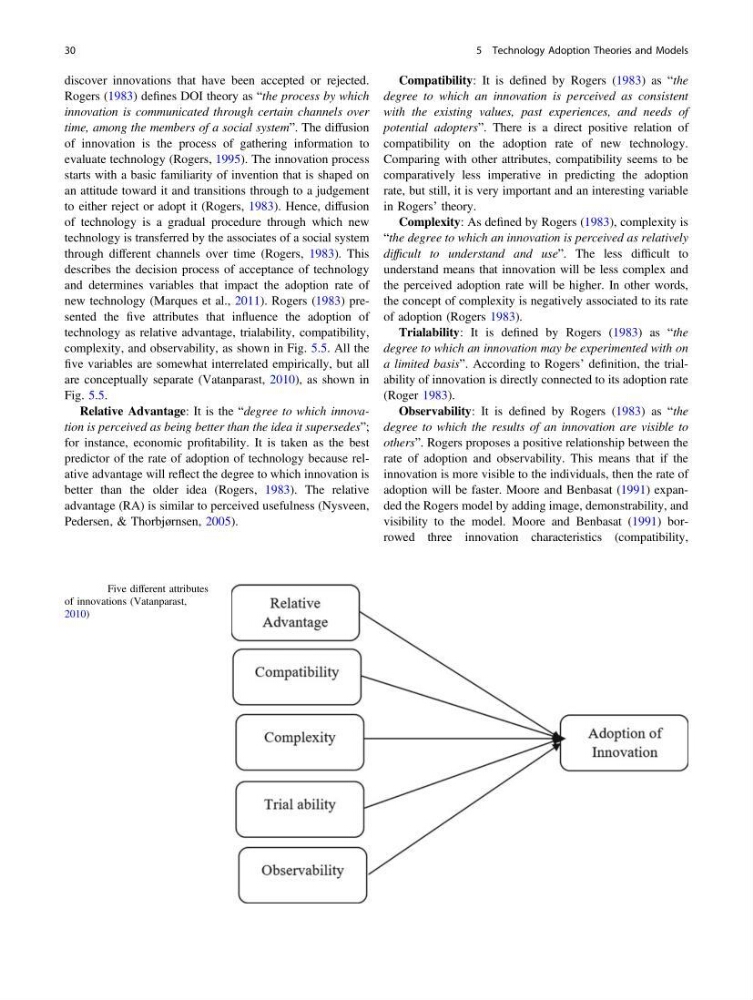
new technology (Marques et al., 2011). Rogers (1983) presented the five attributes that influence the adoption of
technology as relative advantage, trialability, compatibility,
complexity, and observability, as shown in Fig. 5.5. All the
five variables are somewhat interrelated empirically, but all
are conceptually separate (Vatanparast, 2010), as shown in
Fig. 5.5.
Relative Advantage: It is the “degree to which innovation is perceived as being better than the idea it supersedes”;
for instance, economic profitability. It is taken as the best
predictor of the rate of adoption of technology because relative advantage will reflect the degree to which innovation is
better than the older idea (Rogers, 1983). The relative
advantage (RA) is similar to perceived usefulness (Nysveen,
Pedersen, & Thorbjørnsen, 2005).
Compatibility: It is defined by Rogers (1983) as “the
degree to which an innovation is perceived as consistent
with the existing values, past experiences, and needs of
potential adopters”. There is a direct positive relation of
compatibility on the adoption rate of new technology.
Comparing with other attributes, compatibility seems to be
comparatively less imperative in predicting the adoption
rate, but still, it is very important and an interesting variable
in Rogers’ theory.
Complexity: As defined by Rogers (1983), complexity is
“the degree to which an innovation is perceived as relatively
difficult to understand and use”. The less difficult to
understand means that innovation will be less complex and
the perceived adoption rate will be higher. In other words,
the concept of complexity is negatively associated to its rate
of adoption (Rogers 1983).
Trialability: It is defined by Rogers (1983) as “the
degree to which an innovation may be experimented with on
a limited basis”. According to Rogers’ definition, the trialability of innovation is directly connected to its adoption rate
(Roger 1983).
Observability: It is defined by Rogers (1983) as “the
degree to which the results of an innovation are visible to
others”. Rogers proposes a positive relationship between the
rate of adoption and observability. This means that if the
innovation is more visible to the individuals, then the rate of
adoption will be faster. Moore and Benbasat (1991) expanded the Rogers model by adding image, demonstrability, and
visibility to the model. Moore and Benbasat (1991) borrowed three innovation characteristics (compatibility,
Fig. 5.5 Five different attributes
of innovations (Vatanparast,
2010)
30
5 Technology Adoption Theories and Models
Rogers (1983) defines DOI theory as “the process by which
innovation is communicated through certain channels over
time, among the members of a social system”. The diffusion
of innovation is the process of gathering information to
evaluate technology (Rogers, 1995). The innovation process
starts with a basic familiarity of invention that is shaped on
an attitude toward it and transitions through to a judgement
to either reject or adopt it (Rogers, 1983). Hence, diffusion
of technology is a gradual procedure through which new
technology is transferred by the associates of a social system
through different channels over time (Rogers, 1983). This
describes the decision process of acceptance of technology
and determines variables that impact the adoption rate of
new technology (Marques et al., 2011). Rogers (1983) presented the five attributes that influence the adoption of
technology as relative advantage, trialability, compatibility,
complexity, and observability, as shown in Fig. 5.5. All the
five variables are somewhat interrelated empirically, but all
are conceptually separate (Vatanparast, 2010), as shown in
Fig. 5.5.
Relative Advantage: It is the “degree to which innovation is perceived as being better than the idea it supersedes”;
for instance, economic profitability. It is taken as the best
predictor of the rate of adoption of technology because relative advantage will reflect the degree to which innovation is
better than the older idea (Rogers, 1983). The relative
advantage (RA) is similar to perceived usefulness (Nysveen,
Pedersen, & Thorbjørnsen, 2005).
Compatibility: It is defined by Rogers (1983) as “the
degree to which an innovation is perceived as consistent
with the existing values, past experiences, and needs of
potential adopters”. There is a direct positive relation of
compatibility on the adoption rate of new technology.
Comparing with other attributes, compatibility seems to be
comparatively less imperative in predicting the adoption
rate, but still, it is very important and an interesting variable
in Rogers’ theory.
Complexity: As defined by Rogers (1983), complexity is
“the degree to which an innovation is perceived as relatively
difficult to understand and use”. The less difficult to
understand means that innovation will be less complex and
the perceived adoption rate will be higher. In other words,
the concept of complexity is negatively associated to its rate
of adoption (Rogers 1983).
Trialability: It is defined by Rogers (1983) as “the
degree to which an innovation may be experimented with on
a limited basis”. According to Rogers’ definition, the trialability of innovation is directly connected to its adoption rate
(Roger 1983).
Observability: It is defined by Rogers (1983) as “the
degree to which the results of an innovation are visible to
others”. Rogers proposes a positive relationship between the
rate of adoption and observability. This means that if the
innovation is more visible to the individuals, then the rate of
adoption will be faster. Moore and Benbasat (1991) expanded the Rogers model by adding image, demonstrability, and
visibility to the model. Moore and Benbasat (1991) borrowed three innovation characteristics (compatibility,
Fig. 5.5 Five different attributes
of innovations (Vatanparast,
2010)
30
5 Technology Adoption Theories and Models