

acceptance in roughly 40% of the situations (Taylor & Todd,
1995; Venkatesh & Davis, 2000). The empirical testing of
TAM has also encouraged the researchers to extend the
model having a variety of the constructs, particularly ‘external constructs’, in this model. TAM has become one of
the fundamental and most adopted theoretical models in the
field of information security (Lee, 2004). It has provided
researchers with “valid, reliable, and easy to administer
scales for the key constructs” (Venkatesh, Davis, & Morris,
2007, p. 268). The TAM assists managers in explaining how
they can get employees to accept new technologies (Pearlson
& Sauders, 2003).
Limitations of TAM: TAM is limited to two determinants:
perceived usefulness and perceived ease of use in foreseeing
user behavior and fails to identify other adoptance determinants, as demonstrated by future models such as TAM2,
TAM3, and UTAUT. Another constraint of this model is that
TAM does not consider system and organization variables
such as system characteristics, training, the financial cost to
the individual, management, and technical support (Handy,
Whiddett, & Hunter, 2001). Van Biljon (2006) criticized the
TAM model for failing to cover cultural and social variables.
Another key criticism is that the TAM model does not recognize individual differences such as gender, age, and
experience which may impact a user’s attitude toward
adoption of that particular system (Agarwal & Prasad, 1999).
An important deficiency, pointed out by Davis et al. (1989),
is that a subjective norm (SN) or social influence is lacking
from the TAM model. Dishaw and Strong (1999) pointed out
TAM’s deficiency in that TAM lacks the inclusion of external
variables. It ignores the most important barriers such as cost,
time, and lack of expertise. TAM has failed to supply
information regarding user adoption of a specific technology
due to its generality; also, TAM neglects many important
sources of variance (Mathieson, Peacock, & Chin, 2001).
Major Constructs of TAM: TAM adapts the ‘belief ! attitude ! intention ! behavior’ relationship from
TRA. TAM suggests that two concepts, perceived ease of
use (PE) and perceived usefulness (PU), are the main elements for acceptance of IT. Figure 5.10 depicts the TAM
model and its constructs by Davis (1989).
• Perceived Usefulness (PU): It is the degree to which an
individual considers that utilizing a specific system would
improve his/her performance (Davis, 1989). PU is a significant determinant in Davis’s TAM model that explains
the use of technology by concentrating on the users’ attitudes toward the technology, and their subsequent intention
to use it. Perceived usefulness has various dimensions, such
as effectiveness, usefulness for job, and efficiency.
• Perceived Ease of Use (PEU) is the “degree to which a
person believes that using a particular system would be
free of effort” (Davis, 1989: 320). PEU is related to the
ease of learning, that is, physical as well as mental efforts
of using the technology. The study shows that PEU
influences attitude, intentions, and behavior. PEU also
influences the PU because if the technology is easy to use
then usefulness will be expected to be increased. Previous
research shows that PU is considered to be a more
important determinant than PEU, which is the determinant of PU.
5.3.9 Extended TAM (TAM 2)
To overcome the lack in TAM, numerous approaches to
improving TAM have been suggested (Van Biljon & Kotze,
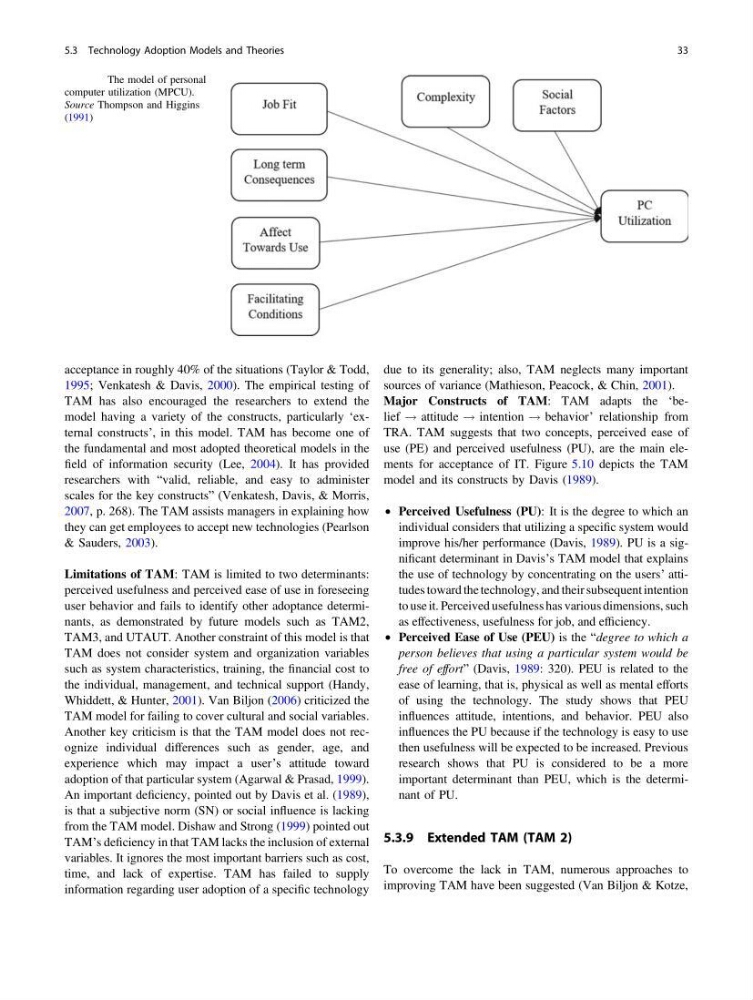
Fig. 5.9 The model of personal
computer utilization (MPCU).
Source Thompson and Higgins
(1991)
5.3 Technology Adoption Models and Theories
33
1995; Venkatesh & Davis, 2000). The empirical testing of
TAM has also encouraged the researchers to extend the
model having a variety of the constructs, particularly ‘external constructs’, in this model. TAM has become one of
the fundamental and most adopted theoretical models in the
field of information security (Lee, 2004). It has provided
researchers with “valid, reliable, and easy to administer
scales for the key constructs” (Venkatesh, Davis, & Morris,
2007, p. 268). The TAM assists managers in explaining how
they can get employees to accept new technologies (Pearlson
& Sauders, 2003).
Limitations of TAM: TAM is limited to two determinants:
perceived usefulness and perceived ease of use in foreseeing
user behavior and fails to identify other adoptance determinants, as demonstrated by future models such as TAM2,
TAM3, and UTAUT. Another constraint of this model is that
TAM does not consider system and organization variables
such as system characteristics, training, the financial cost to
the individual, management, and technical support (Handy,
Whiddett, & Hunter, 2001). Van Biljon (2006) criticized the
TAM model for failing to cover cultural and social variables.
Another key criticism is that the TAM model does not recognize individual differences such as gender, age, and
experience which may impact a user’s attitude toward
adoption of that particular system (Agarwal & Prasad, 1999).
An important deficiency, pointed out by Davis et al. (1989),
is that a subjective norm (SN) or social influence is lacking
from the TAM model. Dishaw and Strong (1999) pointed out
TAM’s deficiency in that TAM lacks the inclusion of external
variables. It ignores the most important barriers such as cost,
time, and lack of expertise. TAM has failed to supply
information regarding user adoption of a specific technology
due to its generality; also, TAM neglects many important
sources of variance (Mathieson, Peacock, & Chin, 2001).
Major Constructs of TAM: TAM adapts the ‘belief ! attitude ! intention ! behavior’ relationship from
TRA. TAM suggests that two concepts, perceived ease of
use (PE) and perceived usefulness (PU), are the main elements for acceptance of IT. Figure 5.10 depicts the TAM
model and its constructs by Davis (1989).
• Perceived Usefulness (PU): It is the degree to which an
individual considers that utilizing a specific system would
improve his/her performance (Davis, 1989). PU is a significant determinant in Davis’s TAM model that explains
the use of technology by concentrating on the users’ attitudes toward the technology, and their subsequent intention
to use it. Perceived usefulness has various dimensions, such
as effectiveness, usefulness for job, and efficiency.
• Perceived Ease of Use (PEU) is the “degree to which a
person believes that using a particular system would be
free of effort” (Davis, 1989: 320). PEU is related to the
ease of learning, that is, physical as well as mental efforts
of using the technology. The study shows that PEU
influences attitude, intentions, and behavior. PEU also
influences the PU because if the technology is easy to use
then usefulness will be expected to be increased. Previous
research shows that PU is considered to be a more
important determinant than PEU, which is the determinant of PU.
5.3.9 Extended TAM (TAM 2)
To overcome the lack in TAM, numerous approaches to
improving TAM have been suggested (Van Biljon & Kotze,
Fig. 5.9 The model of personal
computer utilization (MPCU).
Source Thompson and Higgins
(1991)
5.3 Technology Adoption Models and Theories
33