

2.6 Future Direction of E- and M-Learning
A blended approach is a hybrid of both online learning and
traditional F2F learning (Chen, Yong, & Yao 2016; Collis &
Moonen, 2002). In other words, a ‘blended’ environment
combines both traditional teaching methods of F2F classes
and e-teaching methods (Mortera-Gutierrez, 2006). The use
of e-technology does not mean removing traditional F2F
contact from the educational culture but improving and
supporting the teaching and learning process by using new
technologies. LMS is the future direction of e-learning
(Alghamdi, 2016; Weller, 2007). Wide acceptance of a VLE
(or LMS) highlighted the importance of the e-learning
approach. LMSs such as WebCT and Blackboard are the
components of digital e-learning and widely used for both
on-campus and off-campus students at major universities of
the world (Keegan, 2002; Murshitha & Wickramarachchi,
2016; Nagy, 2016).
2.7 Summary
The adoption of new technology plays an important role in
shaping the future of the educational sector of any country
(Mosa, Naz’ri bin Mahrin, & Ibrahim, 2016). Thus, it is
important to understand the concept of users’ adoption of
technology. The system of education is in the exploration
phase of this new learning system and is transforming from
the traditional model to distance learning (d-learning),
electronic-learning (e-learning), and mobile learning
(m-learning) models. Thus, this chapter describes the role of
d-learning, e-learning, and m-learning as learning platforms.
LMS has the potential of improving online learning and
creating a fully functional virtual classroom. Hence, an LMS
is the future direction of e-learning.
References
Alghamdi, S. R. (2016). Use and attitude towards Learning Management Systems (LMS) in Saudi Arabian universities. Eurasia
Journal of Mathematics, Science & Technology Education, 12(9),
2309–2330. https://doi.org/10.12973/eurasia.2016.1281a.
Bitter, G. G., & Legacy, J. M. (2008). Using technology in the
classroom (7th ed.). Pearson/Allyn and Bacon Publishers.
Buabeng-Andoh, C. (2012). Factors influencing teachers’ adoption and
integration of information and communication technology into
teaching: A review of the literature Charles Buabeng-Andoh.
International Journal of Education and Development Using Information and Communication Technology (IJEDICT), 8(1), 136–155.
Cantoni, V., Cellario, M., & Porta, M. (2003). Perspectives and
challenges in elearning: Towards natural interaction paradigms.
Journal of Visual Languages and Computing, 15, 333–345.
Chen, W. S., Yong, A., & Yao, T. (2016). An empirical evaluation of
critical factors influencing learner satisfaction in blended learning :
A pilot study. 4(7), 1667–1671. https://doi.org/10.13189/ujer.2016.
040719.
Collis, B., & Moonen, J. (2002). Flexible learning in a digital world.
Open learning. The Journal of Open and Distance Learning, 17(3),
217–230.
De Freitas, S., & Levene, M. (2003). Evaluating the development of
wearable devices, personal data assistants and the use of other
mobile devices in further and higher education institutions.
Retrieved
from
http://eprints.bbk.ac.uk/archive/00000176/01/
defreitas1.pdf.
Dillon, A., & Morris, M. G. (1996). Users acceptance of information
technology: Theories and models. Annual Review of Information
Science and Technology, 31, 3–32.
Doneva, R., Nikolaj, K., & Totkov, G. (2006). Towards mobile
university campuses. In International Conference on Computer
Systems and Technologies - CompSysTech’2006.
Ferguson, L., & Wijekumar, K. (2000). Effective design and use of
web-based distance learning environments. Professional Safety, 45
(12), 28–33.
Georgiev, T., Georgieva, E., & Smrikarov, A. (2004). M-learning-a
new stage of e-learning. In International Conference on Computer
Systems and Technologies-CompSysTech, 28. Retrieved from http://
scholar.google.com/scholar?hl=en&q=http://ldt.stanford.edu/
*educ39106/articles/m-learning.pdf&btnG=&as_sdt=1,5&as_
sdtp=#.
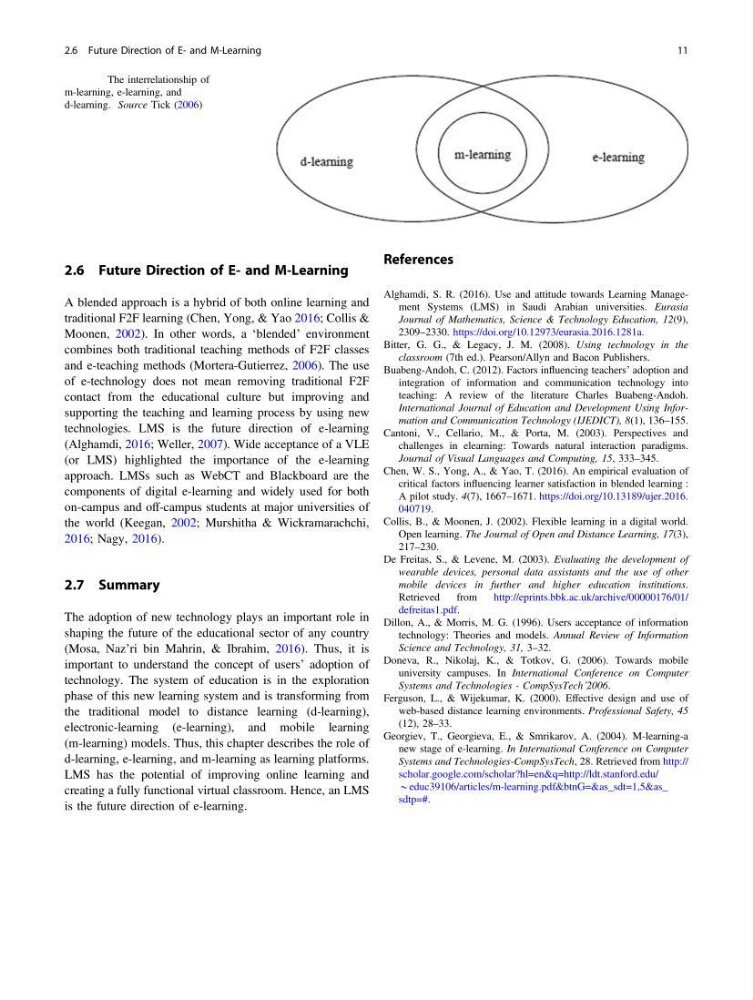
Fig. 2.2 The interrelationship of
m-learning, e-learning, and
d-learning. Source Tick (2006)
2.6 Future Direction of E- and M-Learning
11
A blended approach is a hybrid of both online learning and
traditional F2F learning (Chen, Yong, & Yao 2016; Collis &
Moonen, 2002). In other words, a ‘blended’ environment
combines both traditional teaching methods of F2F classes
and e-teaching methods (Mortera-Gutierrez, 2006). The use
of e-technology does not mean removing traditional F2F
contact from the educational culture but improving and
supporting the teaching and learning process by using new
technologies. LMS is the future direction of e-learning
(Alghamdi, 2016; Weller, 2007). Wide acceptance of a VLE
(or LMS) highlighted the importance of the e-learning
approach. LMSs such as WebCT and Blackboard are the
components of digital e-learning and widely used for both
on-campus and off-campus students at major universities of
the world (Keegan, 2002; Murshitha & Wickramarachchi,
2016; Nagy, 2016).
2.7 Summary
The adoption of new technology plays an important role in
shaping the future of the educational sector of any country
(Mosa, Naz’ri bin Mahrin, & Ibrahim, 2016). Thus, it is
important to understand the concept of users’ adoption of
technology. The system of education is in the exploration
phase of this new learning system and is transforming from
the traditional model to distance learning (d-learning),
electronic-learning (e-learning), and mobile learning
(m-learning) models. Thus, this chapter describes the role of
d-learning, e-learning, and m-learning as learning platforms.
LMS has the potential of improving online learning and
creating a fully functional virtual classroom. Hence, an LMS
is the future direction of e-learning.
References
Alghamdi, S. R. (2016). Use and attitude towards Learning Management Systems (LMS) in Saudi Arabian universities. Eurasia
Journal of Mathematics, Science & Technology Education, 12(9),
2309–2330. https://doi.org/10.12973/eurasia.2016.1281a.
Bitter, G. G., & Legacy, J. M. (2008). Using technology in the
classroom (7th ed.). Pearson/Allyn and Bacon Publishers.
Buabeng-Andoh, C. (2012). Factors influencing teachers’ adoption and
integration of information and communication technology into
teaching: A review of the literature Charles Buabeng-Andoh.
International Journal of Education and Development Using Information and Communication Technology (IJEDICT), 8(1), 136–155.
Cantoni, V., Cellario, M., & Porta, M. (2003). Perspectives and
challenges in elearning: Towards natural interaction paradigms.
Journal of Visual Languages and Computing, 15, 333–345.
Chen, W. S., Yong, A., & Yao, T. (2016). An empirical evaluation of
critical factors influencing learner satisfaction in blended learning :
A pilot study. 4(7), 1667–1671. https://doi.org/10.13189/ujer.2016.
040719.
Collis, B., & Moonen, J. (2002). Flexible learning in a digital world.
Open learning. The Journal of Open and Distance Learning, 17(3),
217–230.
De Freitas, S., & Levene, M. (2003). Evaluating the development of
wearable devices, personal data assistants and the use of other
mobile devices in further and higher education institutions.
Retrieved
from
http://eprints.bbk.ac.uk/archive/00000176/01/
defreitas1.pdf.
Dillon, A., & Morris, M. G. (1996). Users acceptance of information
technology: Theories and models. Annual Review of Information
Science and Technology, 31, 3–32.
Doneva, R., Nikolaj, K., & Totkov, G. (2006). Towards mobile
university campuses. In International Conference on Computer
Systems and Technologies - CompSysTech’2006.
Ferguson, L., & Wijekumar, K. (2000). Effective design and use of
web-based distance learning environments. Professional Safety, 45
(12), 28–33.
Georgiev, T., Georgieva, E., & Smrikarov, A. (2004). M-learning-a
new stage of e-learning. In International Conference on Computer
Systems and Technologies-CompSysTech, 28. Retrieved from http://
scholar.google.com/scholar?hl=en&q=http://ldt.stanford.edu/
*educ39106/articles/m-learning.pdf&btnG=&as_sdt=1,5&as_
sdtp=#.
Fig. 2.2 The interrelationship of
m-learning, e-learning, and
d-learning. Source Tick (2006)
2.6 Future Direction of E- and M-Learning
11