

lack of training, especially during its adoption process. With
appropriate and careful design, most of the shortcomings can
be overcome (Cantoni et al., 2003).
2.4.3 Mobile Learning (M-Learning)
M-learning is an extension of e-learning using portable and
mobile learning devices (Doneva, Nikolaj, & Totkov, 2006).
m-learning is a new phase of e-learning with learning
capability from everywhere at any time using mobile devices
(Georgiev et al., 2004). The point at which e-learning and
mobile computing intersect, an anytime, anywhere learning
experience is developed (Ismail, 2016; Kambourakis, Kontoni, & Sapounas, 2004). m-learning is a flexible learning
paradigm of anywhere and anytime (Wagner, 2005).
m-learning provides the learners with additional learning
provision, a broader channel of communication, and flexibility of access (McConatha, Matt, & Lynch, 2008). New
technologies linked with the m-revolution are influencing
and shaping the boundaries of economy and knowledge
domains (Wagner, 2005). M-technology has altered the use
and scale of m-learning. Unlike a book, thousands of books
can be stored on a palm device, interactive media can play in
a palm device, and the m-device can virtually take you into
the classroom. Smartphones, PDA, MP3 players, and GPS
devices are examples of such devices. m-learning has altered
the concept of the classroom by facilitating communication
between students and instructors (Wentzel et al., 2005).
Information technology is expanding the borders of teaching
and learning into ‘anywhere and anytime’. Mobile communication through smart mobile devices is not restricted by
location or time and provides access to teaching and learning. The students now have more control over their literacy
tools and educational needs. These new mobile technologies
have shaped new opportunities as well as challenges for
individuals, businesses, institutions, and governments (Gloria, 2016).
2.5 Difference Between D-Learning,
E-Learning, and M-Learning
It is important to note the difference between d-learning and
e-learning. The terms ‘e-learning’, ‘web-based learning’,
‘distance learning’, and ‘online learning’ are often used
interchangeably (Littlefield, 2016). However, there is a
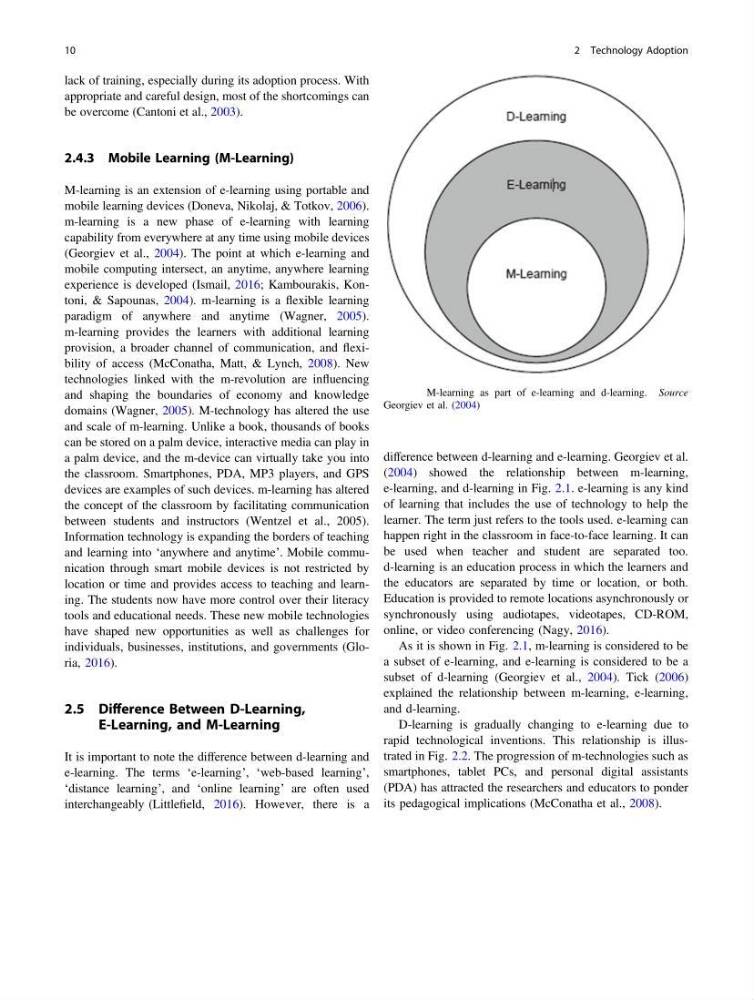
difference between d-learning and e-learning. Georgiev et al.
(2004) showed the relationship between m-learning,
e-learning, and d-learning in Fig. 2.1. e-learning is any kind
of learning that includes the use of technology to help the
learner. The term just refers to the tools used. e-learning can
happen right in the classroom in face-to-face learning. It can
be used when teacher and student are separated too.
d-learning is an education process in which the learners and
the educators are separated by time or location, or both.
Education is provided to remote locations asynchronously or
synchronously using audiotapes, videotapes, CD-ROM,
online, or video conferencing (Nagy, 2016).
As it is shown in Fig. 2.1, m-learning is considered to be
a subset of e-learning, and e-learning is considered to be a
subset of d-learning (Georgiev et al., 2004). Tick (2006)
explained the relationship between m-learning, e-learning,
and d-learning.
D-learning is gradually changing to e-learning due to
rapid technological inventions. This relationship is illustrated in Fig. 2.2. The progression of m-technologies such as
smartphones, tablet PCs, and personal digital assistants
(PDA) has attracted the researchers and educators to ponder
its pedagogical implications (McConatha et al., 2008).
Fig. 2.1 M-learning as part of e-learning and d-learning. Source
Georgiev et al. (2004)
10
2 Technology Adoption
appropriate and careful design, most of the shortcomings can
be overcome (Cantoni et al., 2003).
2.4.3 Mobile Learning (M-Learning)
M-learning is an extension of e-learning using portable and
mobile learning devices (Doneva, Nikolaj, & Totkov, 2006).
m-learning is a new phase of e-learning with learning
capability from everywhere at any time using mobile devices
(Georgiev et al., 2004). The point at which e-learning and
mobile computing intersect, an anytime, anywhere learning
experience is developed (Ismail, 2016; Kambourakis, Kontoni, & Sapounas, 2004). m-learning is a flexible learning
paradigm of anywhere and anytime (Wagner, 2005).
m-learning provides the learners with additional learning
provision, a broader channel of communication, and flexibility of access (McConatha, Matt, & Lynch, 2008). New
technologies linked with the m-revolution are influencing
and shaping the boundaries of economy and knowledge
domains (Wagner, 2005). M-technology has altered the use
and scale of m-learning. Unlike a book, thousands of books
can be stored on a palm device, interactive media can play in
a palm device, and the m-device can virtually take you into
the classroom. Smartphones, PDA, MP3 players, and GPS
devices are examples of such devices. m-learning has altered
the concept of the classroom by facilitating communication
between students and instructors (Wentzel et al., 2005).
Information technology is expanding the borders of teaching
and learning into ‘anywhere and anytime’. Mobile communication through smart mobile devices is not restricted by
location or time and provides access to teaching and learning. The students now have more control over their literacy
tools and educational needs. These new mobile technologies
have shaped new opportunities as well as challenges for
individuals, businesses, institutions, and governments (Gloria, 2016).
2.5 Difference Between D-Learning,
E-Learning, and M-Learning
It is important to note the difference between d-learning and
e-learning. The terms ‘e-learning’, ‘web-based learning’,
‘distance learning’, and ‘online learning’ are often used
interchangeably (Littlefield, 2016). However, there is a
difference between d-learning and e-learning. Georgiev et al.
(2004) showed the relationship between m-learning,
e-learning, and d-learning in Fig. 2.1. e-learning is any kind
of learning that includes the use of technology to help the
learner. The term just refers to the tools used. e-learning can
happen right in the classroom in face-to-face learning. It can
be used when teacher and student are separated too.
d-learning is an education process in which the learners and
the educators are separated by time or location, or both.
Education is provided to remote locations asynchronously or
synchronously using audiotapes, videotapes, CD-ROM,
online, or video conferencing (Nagy, 2016).
As it is shown in Fig. 2.1, m-learning is considered to be
a subset of e-learning, and e-learning is considered to be a
subset of d-learning (Georgiev et al., 2004). Tick (2006)
explained the relationship between m-learning, e-learning,
and d-learning.
D-learning is gradually changing to e-learning due to
rapid technological inventions. This relationship is illustrated in Fig. 2.2. The progression of m-technologies such as
smartphones, tablet PCs, and personal digital assistants
(PDA) has attracted the researchers and educators to ponder
its pedagogical implications (McConatha et al., 2008).
Fig. 2.1 M-learning as part of e-learning and d-learning. Source
Georgiev et al. (2004)
10
2 Technology Adoption