

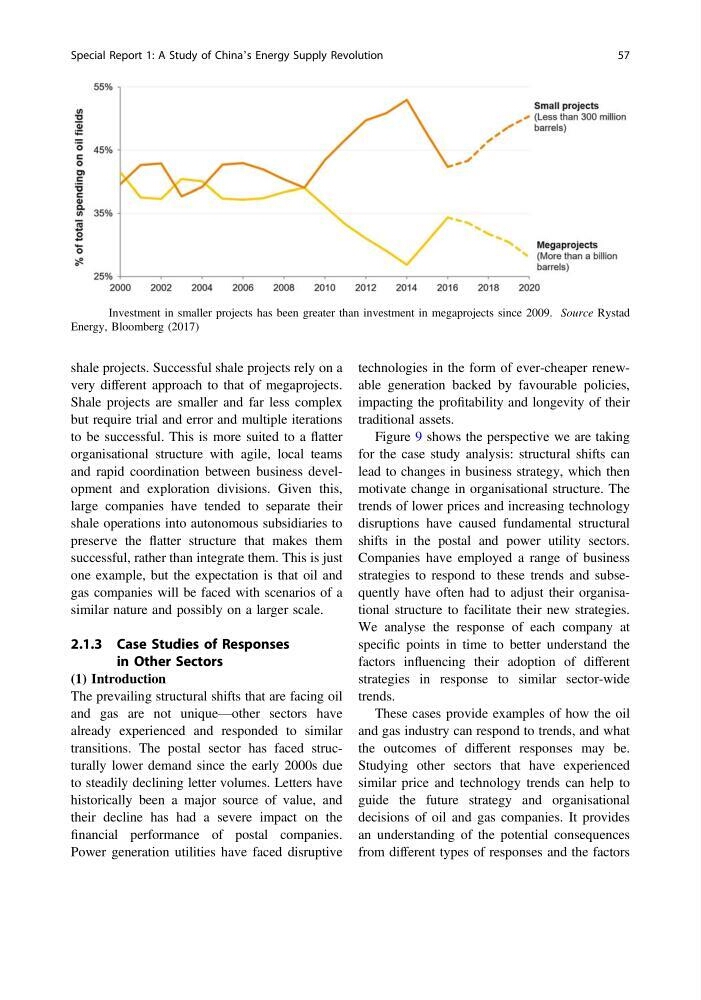
shale projects. Successful shale projects rely on a
very different approach to that of megaprojects.
Shale projects are smaller and far less complex
but require trial and error and multiple iterations
to be successful. This is more suited to a flatter
organisational structure with agile, local teams
and rapid coordination between business development and exploration divisions. Given this,
large companies have tended to separate their
shale operations into autonomous subsidiaries to
preserve the flatter structure that makes them
successful, rather than integrate them. This is just
one example, but the expectation is that oil and
gas companies will be faced with scenarios of a
similar nature and possibly on a larger scale.
2.1.3 Case Studies of Responses
in Other Sectors
(1) Introduction
The prevailing structural shifts that are facing oil
and gas are not unique—other sectors have
already experienced and responded to similar
transitions. The postal sector has faced structurally lower demand since the early 2000s due
to steadily declining letter volumes. Letters have
historically been a major source of value, and
their decline has had a severe impact on the
financial performance of postal companies.
Power generation utilities have faced disruptive
technologies in the form of ever-cheaper renewable generation backed by favourable policies,
impacting the profitability and longevity of their
traditional assets.
Figure 9 shows the perspective we are taking
for the case study analysis: structural shifts can
lead to changes in business strategy, which then
motivate change in organisational structure. The
trends of lower prices and increasing technology
disruptions have caused fundamental structural
shifts in the postal and power utility sectors.
Companies have employed a range of business
strategies to respond to these trends and subsequently have often had to adjust their organisational structure to facilitate their new strategies.
We analyse the response of each company at
specific points in time to better understand the
factors influencing their adoption of different
strategies in response to similar sector-wide
trends.
These cases provide examples of how the oil
and gas industry can respond to trends, and what
the outcomes of different responses may be.
Studying other sectors that have experienced
similar price and technology trends can help to
guide the future strategy and organisational
decisions of oil and gas companies. It provides
an understanding of the potential consequences
from different types of responses and the factors
Fig. 8 Investment in smaller projects has been greater than investment in megaprojects since 2009. Source Rystad
Energy, Bloomberg (2017)
Special Report 1: A Study of China’s Energy Supply Revolution
57
very different approach to that of megaprojects.
Shale projects are smaller and far less complex
but require trial and error and multiple iterations
to be successful. This is more suited to a flatter
organisational structure with agile, local teams
and rapid coordination between business development and exploration divisions. Given this,
large companies have tended to separate their
shale operations into autonomous subsidiaries to
preserve the flatter structure that makes them
successful, rather than integrate them. This is just
one example, but the expectation is that oil and
gas companies will be faced with scenarios of a
similar nature and possibly on a larger scale.
2.1.3 Case Studies of Responses
in Other Sectors
(1) Introduction
The prevailing structural shifts that are facing oil
and gas are not unique—other sectors have
already experienced and responded to similar
transitions. The postal sector has faced structurally lower demand since the early 2000s due
to steadily declining letter volumes. Letters have
historically been a major source of value, and
their decline has had a severe impact on the
financial performance of postal companies.
Power generation utilities have faced disruptive
technologies in the form of ever-cheaper renewable generation backed by favourable policies,
impacting the profitability and longevity of their
traditional assets.
Figure 9 shows the perspective we are taking
for the case study analysis: structural shifts can
lead to changes in business strategy, which then
motivate change in organisational structure. The
trends of lower prices and increasing technology
disruptions have caused fundamental structural
shifts in the postal and power utility sectors.
Companies have employed a range of business
strategies to respond to these trends and subsequently have often had to adjust their organisational structure to facilitate their new strategies.
We analyse the response of each company at
specific points in time to better understand the
factors influencing their adoption of different
strategies in response to similar sector-wide
trends.
These cases provide examples of how the oil
and gas industry can respond to trends, and what
the outcomes of different responses may be.
Studying other sectors that have experienced
similar price and technology trends can help to
guide the future strategy and organisational
decisions of oil and gas companies. It provides
an understanding of the potential consequences
from different types of responses and the factors
Fig. 8 Investment in smaller projects has been greater than investment in megaprojects since 2009. Source Rystad
Energy, Bloomberg (2017)
Special Report 1: A Study of China’s Energy Supply Revolution
57