

that motivate these responses, particularly when
there is no clear dominant strategy for adapting
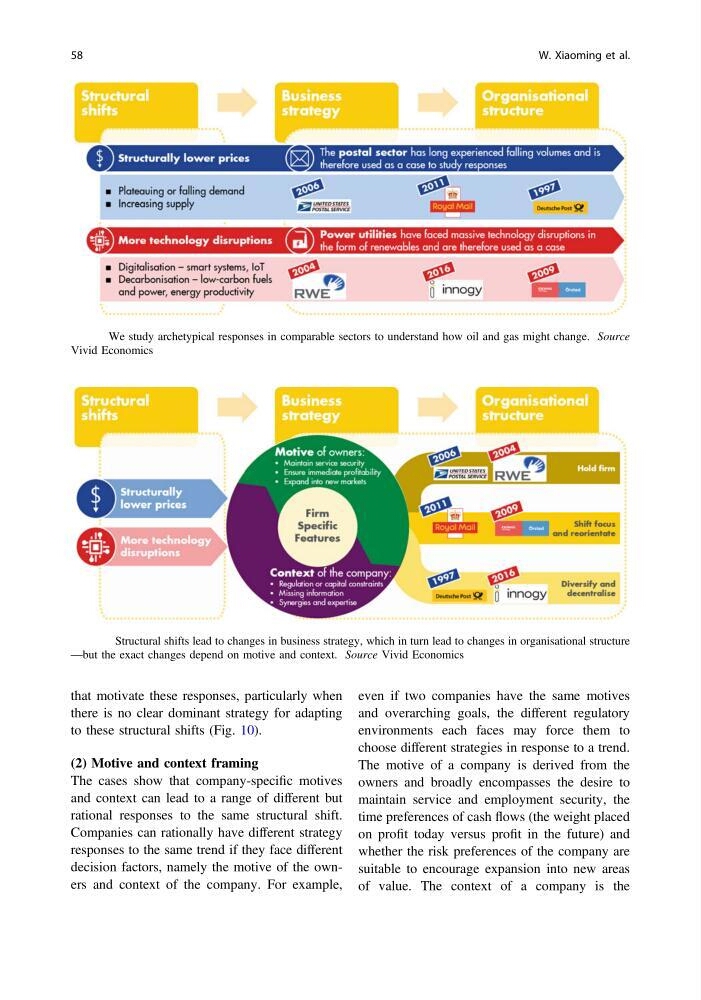
to these structural shifts (Fig. 10).
(2) Motive and context framing
The cases show that company-specific motives
and context can lead to a range of different but
rational responses to the same structural shift.
Companies can rationally have different strategy
responses to the same trend if they face different
decision factors, namely the motive of the owners and context of the company. For example,
even if two companies have the same motives
and overarching goals, the different regulatory
environments each faces may force them to
choose different strategies in response to a trend.
The motive of a company is derived from the
owners and broadly encompasses the desire to
maintain service and employment security, the
time preferences of cash flows (the weight placed
on profit today versus profit in the future) and
whether the risk preferences of the company are
suitable to encourage expansion into new areas
of value. The context of a company is the
Fig. 9 We study archetypical responses in comparable sectors to understand how oil and gas might change. Source
Vivid Economics
Fig. 10 Structural shifts lead to changes in business strategy, which in turn lead to changes in organisational structure
—but the exact changes depend on motive and context. Source Vivid Economics
58
W. Xiaoming et al.
there is no clear dominant strategy for adapting
to these structural shifts (Fig. 10).
(2) Motive and context framing
The cases show that company-specific motives
and context can lead to a range of different but
rational responses to the same structural shift.
Companies can rationally have different strategy
responses to the same trend if they face different
decision factors, namely the motive of the owners and context of the company. For example,
even if two companies have the same motives
and overarching goals, the different regulatory
environments each faces may force them to
choose different strategies in response to a trend.
The motive of a company is derived from the
owners and broadly encompasses the desire to
maintain service and employment security, the
time preferences of cash flows (the weight placed
on profit today versus profit in the future) and
whether the risk preferences of the company are
suitable to encourage expansion into new areas
of value. The context of a company is the
Fig. 9 We study archetypical responses in comparable sectors to understand how oil and gas might change. Source
Vivid Economics
Fig. 10 Structural shifts lead to changes in business strategy, which in turn lead to changes in organisational structure
—but the exact changes depend on motive and context. Source Vivid Economics
58
W. Xiaoming et al.