

will send a strong signal—stimulating
implementation.
Ultimately, incorporating transition risks into
the cost of investment capital will help allocate
investments to where they are needed to provide
energy security through the transition, though
further development of the recommendations
across diverse jurisdictions and sectors is
required to mitigate unintended negative consequences of disclosures.
Carbon pricing can also help, by providing a
market signal through demand for energy products and services; it is the most efficient economic mechanism to deliver decarbonisation.
The failure to implement carbon pricing regimes
and increase their global coverage will significantly hinder the achievement of national climate
policy and international commitments under the
Paris Agreement—to the detriment of all countries. The slowdown in momentum to expand
carbon pricing, either as a trading system or as a
tax, has recently taken off again. The Carbon
Pricing Leadership Coalition (CPLC) represents
21 countries, five Canadian and US states, and
almost 140 global corporations. In January 2016
the CPLC challenged global governments to
double carbon pricing coverage by 2020 and
double again by 2030. The Republican-led Climate Leadership Council recently proposed
establishing a $40/tonne carbon tax and dividend
scheme within the USA.
Early emissions trading system (ETS) adopters
have lessons to offer on the impacts of conflicting
policies and poor adoption strategies on establishing stable and effective pricing. For instance,
the cost-effectiveness of an ETS and achieving an
effective price can be undermined by policymakers inadequately attempting to balance the
trade-off of reduced industrial competitiveness by
introducing competing policies or reducing sectorial coverage. If these lessons can be leveraged
through lesson sharing—along with designing for
compatibility and robust monitoring, reporting
and verification procedures—the likelihood of
success of China’s ETS and others will increase.
Carbon leakage may undermine the effectiveness of carbon pricing (carbon leakage is
where the restructuring of high-carbon industries,
for example, encourages an outflow of capital
and technologies beyond national borders).
Regional and international coordination to link
carbon markets, through mechanisms such as
Article 6 of the Paris Agreement on transferable
allowances, could minimise carbon leakage.
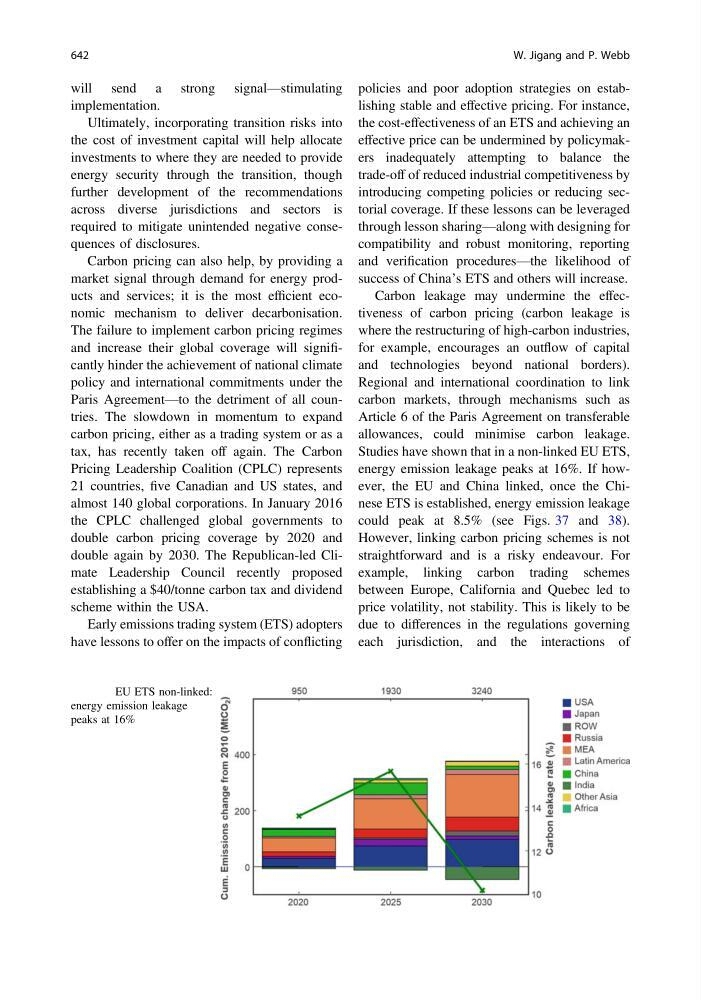
Studies have shown that in a non-linked EU ETS,
energy emission leakage peaks at 16%. If however, the EU and China linked, once the Chinese ETS is established, energy emission leakage
could peak at 8.5% (see Figs. 37 and 38).
However, linking carbon pricing schemes is not
straightforward and is a risky endeavour. For
example, linking carbon trading schemes
between Europe, California and Quebec led to
price volatility, not stability. This is likely to be
due to differences in the regulations governing
each jurisdiction, and the interactions of
Fig. 37 EU ETS non-linked:
energy emission leakage
peaks at 16%
642
W. Jigang and P. Webb