

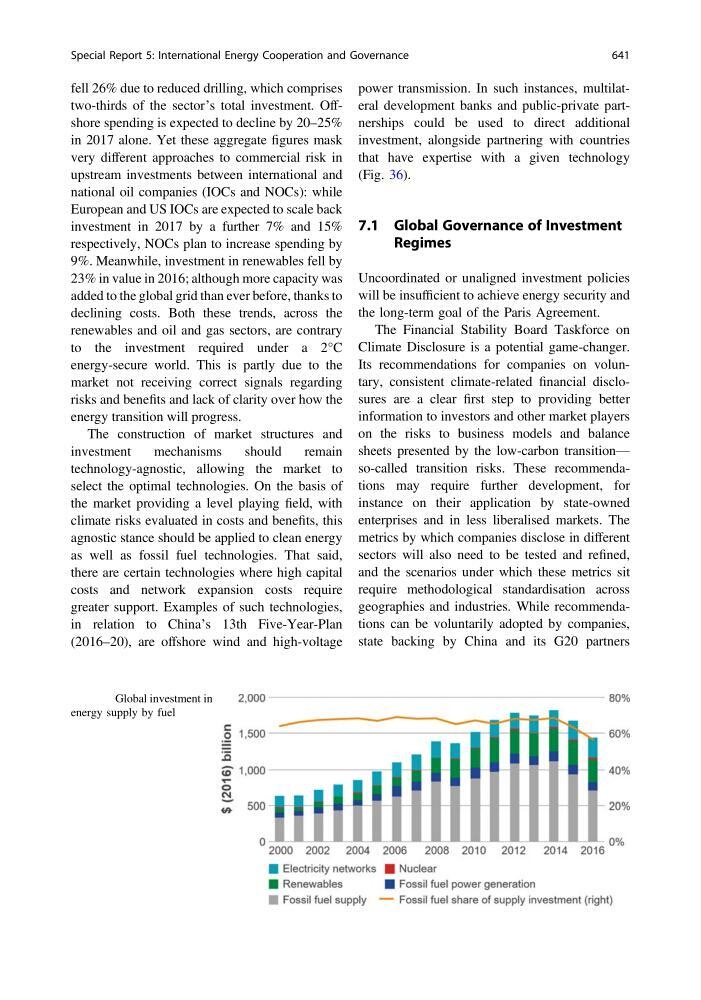
fell 26% due to reduced drilling, which comprises
two-thirds of the sector’s total investment. Offshore spending is expected to decline by 20–25%
in 2017 alone. Yet these aggregate figures mask
very different approaches to commercial risk in
upstream investments between international and
national oil companies (IOCs and NOCs): while
European and US IOCs are expected to scale back
investment in 2017 by a further 7% and 15%
respectively, NOCs plan to increase spending by
9%. Meanwhile, investment in renewables fell by
23% in value in 2016; although more capacity was
added to the global grid than ever before, thanks to
declining costs. Both these trends, across the
renewables and oil and gas sectors, are contrary
to the investment required under a 2°C
energy-secure world. This is partly due to the
market not receiving correct signals regarding
risks and benefits and lack of clarity over how the
energy transition will progress.
The construction of market structures and
investment
mechanisms
should
remain
technology-agnostic, allowing the market to
select the optimal technologies. On the basis of
the market providing a level playing field, with
climate risks evaluated in costs and benefits, this
agnostic stance should be applied to clean energy
as well as fossil fuel technologies. That said,
there are certain technologies where high capital
costs and network expansion costs require
greater support. Examples of such technologies,
in relation to China’s 13th Five-Year-Plan
(2016–20), are offshore wind and high-voltage
power transmission. In such instances, multilateral development banks and public-private partnerships could be used to direct additional
investment, alongside partnering with countries
that have expertise with a given technology
(Fig. 36).
7.1 Global Governance of Investment
Regimes
Uncoordinated or unaligned investment policies
will be insufficient to achieve energy security and
the long-term goal of the Paris Agreement.
The Financial Stability Board Taskforce on
Climate Disclosure is a potential game-changer.
Its recommendations for companies on voluntary, consistent climate-related financial disclosures are a clear first step to providing better
information to investors and other market players
on the risks to business models and balance
sheets presented by the low-carbon transition—
so-called transition risks. These recommendations may require further development, for
instance on their application by state-owned
enterprises and in less liberalised markets. The
metrics by which companies disclose in different
sectors will also need to be tested and refined,
and the scenarios under which these metrics sit
require methodological standardisation across
geographies and industries. While recommendations can be voluntarily adopted by companies,
state backing by China and its G20 partners
Fig. 36 Global investment in
energy supply by fuel
Special Report 5: International Energy Cooperation and Governance
641