

The G20’s lack of a supporting institutional
infrastructure and its fluctuating agenda present
an obstacle to the forum acting as a leadership
and oversight mechanism for the energy transition. This could be addressed directly through
reforms to build a distributed secretariat function
and initiate an energy ministerial track to facilitate such a function. However, formalising the
G20 to this extent is likely to be met with caution
from governments reluctant to accept further
international obligations.
7 Investment Regimes
for Low-Carbon, Energy-Secure
Transition
Attention regarding the risks of the rapidly
accelerating energy transition is growing among
policymakers, central banks, regulators, institutional investors and financiers. Allocating
investment during a swift energy transition,
while maintaining oil and gas supply security and
reliability of electricity networks, requires clear
market signals and a level playing field.
Several investment mechanisms, finance sector
rules and market structures could provide this
clarity, given the correct reforms. These mechanisms, rules and structures fall roughly into two
categories: first, international governance
arrangements to help optimise global capital
allocation; and second, engagement within countries to improve national governance of the energy
sector and access to finance and technologies.
Box 16: The challenge of optimal
capital investment across the energy
system
Ensuring the appropriate level of investment in the oil and gas sectors is achieved
—in parallel to investment in the growing
renewable, electric vehicle and battery
storage markets—is a fine balancing act.
The Energy Transitions Commission, and
New Climate Economy, anticipate that a
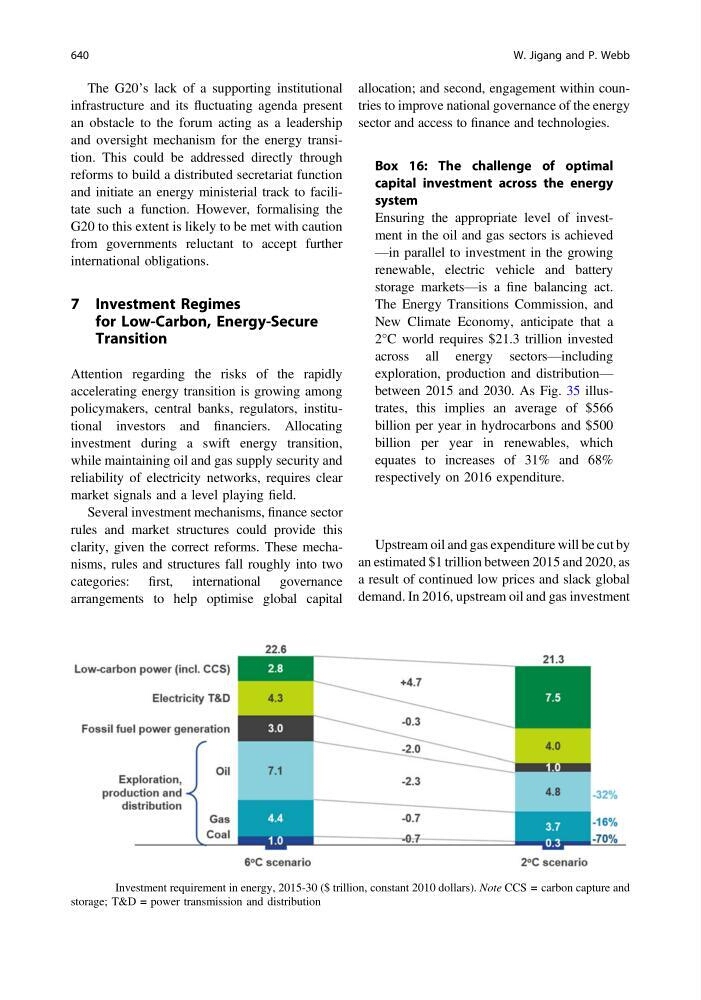
2°C world requires $21.3 trillion invested
across all energy sectors—including
exploration, production and distribution—
between 2015 and 2030. As Fig. 35 illustrates, this implies an average of $566
billion per year in hydrocarbons and $500
billion per year in renewables, which
equates to increases of 31% and 68%
respectively on 2016 expenditure.
Upstream oil and gas expenditure will be cut by
an estimated $1 trillion between 2015 and 2020, as
a result of continued low prices and slack global
demand. In 2016, upstream oil and gas investment
Fig. 35 Investment requirement in energy, 2015-30 ($ trillion, constant 2010 dollars). Note CCS = carbon capture and
storage; T&D = power transmission and distribution
640
W. Jigang and P. Webb