

As the largest emitter in the world, China
will be critical to any credible global effort to
increase NDC ambition. Chinese ambition
(alongside that of the USA) was similarly
crucial to setting expectations in the run-up
to Paris in 2015. Although it would be
unrealistic to suppose that a similar
US-China dynamic can be recreated with the
current US administration, China could seek
other developed country partners.
Importantly for China, leveraging its
own NDCs to increase the ambition of
other developed country NDCs makes
sound economic sense. The resultant
demand for low-carbon goods in developed economies could provide large export
opportunities for Chinese manufacturers.
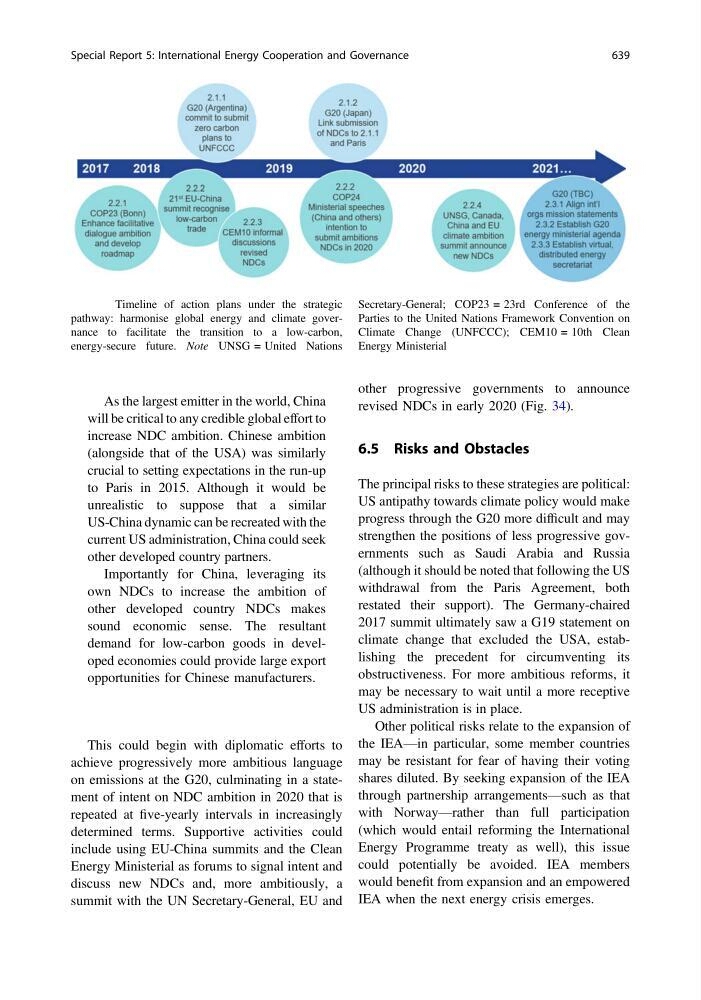
This could begin with diplomatic efforts to
achieve progressively more ambitious language
on emissions at the G20, culminating in a statement of intent on NDC ambition in 2020 that is
repeated at five-yearly intervals in increasingly
determined terms. Supportive activities could
include using EU-China summits and the Clean
Energy Ministerial as forums to signal intent and
discuss new NDCs and, more ambitiously, a
summit with the UN Secretary-General, EU and
other progressive governments to announce
revised NDCs in early 2020 (Fig. 34).
6.5 Risks and Obstacles
The principal risks to these strategies are political:
US antipathy towards climate policy would make
progress through the G20 more difficult and may
strengthen the positions of less progressive governments such as Saudi Arabia and Russia
(although it should be noted that following the US
withdrawal from the Paris Agreement, both
restated their support). The Germany-chaired
2017 summit ultimately saw a G19 statement on
climate change that excluded the USA, establishing the precedent for circumventing its
obstructiveness. For more ambitious reforms, it
may be necessary to wait until a more receptive
US administration is in place.
Other political risks relate to the expansion of
the IEA—in particular, some member countries
may be resistant for fear of having their voting
shares diluted. By seeking expansion of the IEA
through partnership arrangements—such as that
with Norway—rather than full participation
(which would entail reforming the International
Energy Programme treaty as well), this issue
could potentially be avoided. IEA members
would benefit from expansion and an empowered
IEA when the next energy crisis emerges.
Fig. 34 Timeline of action plans under the strategic
pathway: harmonise global energy and climate governance to facilitate the transition to a low-carbon,
energy-secure future. Note UNSG = United Nations
Secretary-General; COP23 = 23rd Conference of the
Parties to the United Nations Framework Convention on
Climate Change (UNFCCC); CEM10 = 10th Clean
Energy Ministerial
Special Report 5: International Energy Cooperation and Governance
639