

conflicting parallel climate policies between
jurisdictions.
Another way to promote carbon pricing and
mitigate leakage could be through the use of
border adjustment measures (BAMs). Countries
without (a sufficient) carbon price would experience a compensatory tax on their exports to
countries within the scheme, so would be
incentivised to apply a price themselves in order
to improve market access. The recent proposal by
the Climate Leadership Council on a US carbon
tax included a proposed border adjustment tax.
Legal opinion indicates that WTO rules do not
preclude the use of BAMs if carefully designed.
However, this does not mean that affected
countries would not launch dispute proceedings.
Fossil fuel subsidies undermine carbon pricing. Continued multilateral efforts to phase out
fossil fuel subsidies can help avoid the creation
or continuation of havens for high carbon capital.
Lower oil prices have given political and fiscal
breathing space for countries such as Indonesia,
which successfully phased down consumption
subsidies for citizens or industries as fossil fuel
prices collapsed. Of 157 countries, 84 either
reduced consumption subsidies or increased
petrol taxes. But as consumption has shifted
towards nations that have maintained subsidies
or lowered petrol taxes, subsidy reforms have
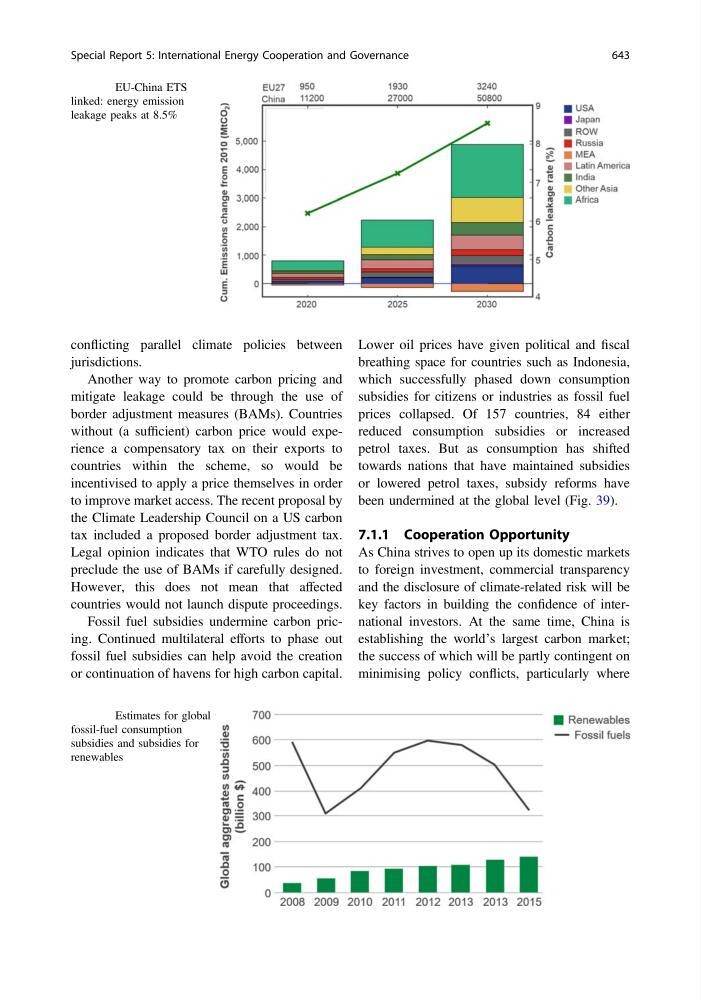
been undermined at the global level (Fig. 39).
7.1.1 Cooperation Opportunity
As China strives to open up its domestic markets
to foreign investment, commercial transparency
and the disclosure of climate-related risk will be
key factors in building the confidence of international investors. At the same time, China is
establishing the world’s largest carbon market;
the success of which will be partly contingent on
minimising policy conflicts, particularly where
Fig. 38 EU-China ETS
linked: energy emission
leakage peaks at 8.5%
Fig. 39 Estimates for global
fossil-fuel consumption
subsidies and subsidies for
renewables
Special Report 5: International Energy Cooperation and Governance
643