

heating systems warmed 45% of the urban
floor area (the world’s largest; 90% of this
heat was fuelled by coal). With rising
pressure on the Chinese government to
reduce local air pollution, it is no surprise
that the 13th FYP targets increased gas
consumption in the residential sector. In
the first quarter of 2016, a larger than
expected switch from coal to gas in the
heating sector pushed Chinese gas consumption to a record high.
This shift to gas should be viewed
within context—the IEA 2°C scenario
holds global primary consumption of gas
to a modest 14.1% increase between 2015
and 2040, equivalent to 0.5% annual
growth.
4.3 Transformation of the Electricity
Sector
Policy encouragement for lower-carbon, climate
friendly options has led to the rapid deployment
of renewable energy, especially wind and solar.
This has resulted in significant challenges for
existing utility business models and the need for
electricity market reform in countries that are
further down the curve of renewables deployment. Although electricity markets are primarily
the concern of national or subnational authorities,
there is growing appetite for technical cooperation and experience sharing in this area of energy
policy. In particular, how to learn from the successes and failures of countries in the vanguard,
while recognising the very different market
contexts and designing appropriate policy
responses accordingly.
In electricity markets where renewables have
significantly increased their share of production,
electricity prices have declined significantly. For
instance, in California, where solar photovoltaic
provides 13.2% of electricity, the productionweighted average price of utility-scale solar fell
by 38.1% between 2014 and 2015, causing a
25.5% decline in gas power prices. Falling power
prices are the result of the merit-order effect,
where relatively more expensive fossil fuel generators are displaced by renewable generators.
These structural declines in prices in power networks with a high penetration of renewables is
resulting in fossil fuel generators extracting value
during periods of low renewable generation,
when they can rapidly ramp up output.
Renewable energy prices keep falling, but
even in 2014 onshore wind was delivering electricity in Europe at $50 per megawatt-hour
(MWh) without subsidies, compared to
$45–140/MWh for fossil fuel power plants. In
August 2016, Chile witnessed power auctions in
which solar won contracts at half the price of
coal power, resulting in power prices collapsing
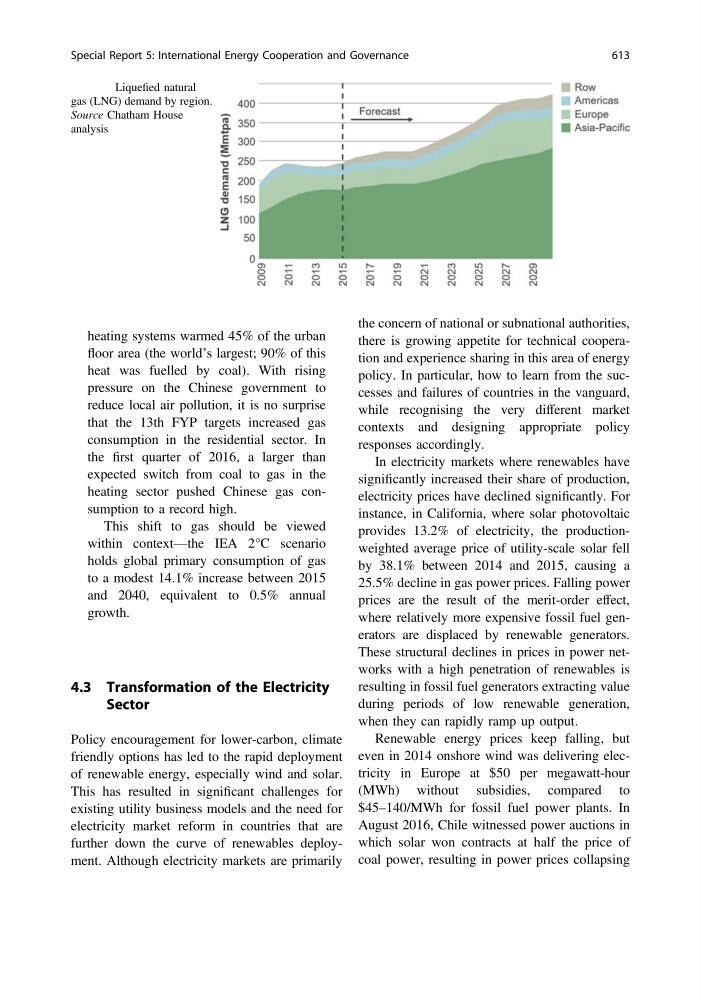
Fig. 13 Liquefied natural
gas (LNG) demand by region.
Source Chatham House
analysis
Special Report 5: International Energy Cooperation and Governance
613