

they typically align with broader strategies to
restructure domestic industries and drive prosperity through innovation. China’s coal consumption may have peaked as early as 2013
according to the IEA, and it is expected to plateau over the coming 5-10 years. China’s 13th
Five-Year Plan (2016–20) and nationally determined contributions (NDC) to the Paris Agreement have set it on course to reduce coal
production and consumption—China may even
be able to meet its NDC goals before the 2030
target.
Meanwhile, India’s coal demand is currently
growing slower than expected—this is important
since the IEA expects India to account for 50%
of global growth in coal-fired power to 2040.
Coal stockpiles have been growing, and domestic
producers have been asked to slow production.
India has introduced coal taxes, 40% of which
are earmarked to subsidise renewables. South
East Asia markets—where coal demand is
expected to triple to 2040, according to the IEA’s
New Policies Scenario—have also set ambitious
renewable energy targets in their NDC
submissions.
Box 4: The role of gas
Current global gas-fired power station
capacity factors are just below 40%, compared to 55% for coal-fired. As more
renewables are integrated into the grid, the
ability of gas-fired power stations to
respond quickly to variations in the
supply-demand balance will become
essential. In conditions of consistently
varying output, gas generators perform
better relative to coal, both in terms of
economic and emission performance
(Fig. 13).
Developments in China reflect those
globally, with regulators in the process of
reforming gas markets and the government
setting ambitious targets within the 13th
Five-Year Plan (2016–20) to almost double
consumption to 350–380 billion cubic
metres (bcm) by 2020. This would require
a 13–15% compound annual growth rate
which, given the 12% growth in the first
10 months of 2016, appears likely. In
2014, the power sector accounted for
around 14% of the 187 bcm of gas demand
in China, under the 13th FYP; this is set to
rise to 26–29% by 2020. Globally, gas
generation capacity has grown from 0.84
terrawatts (TW) in 2000 to 1.47 TW in
2015, an increase of 75%, but still below
the coal capacity of 1.85 TW.
The shift from coal to gas in the power
sector is likely to be accompanied by a
shift in the residential space heating sector.
In the 1980s, coal provided less than 1% of
space heating energy demand in the USA.
China is somewhat behind. In 2012, in the
urban regions of northern China, district
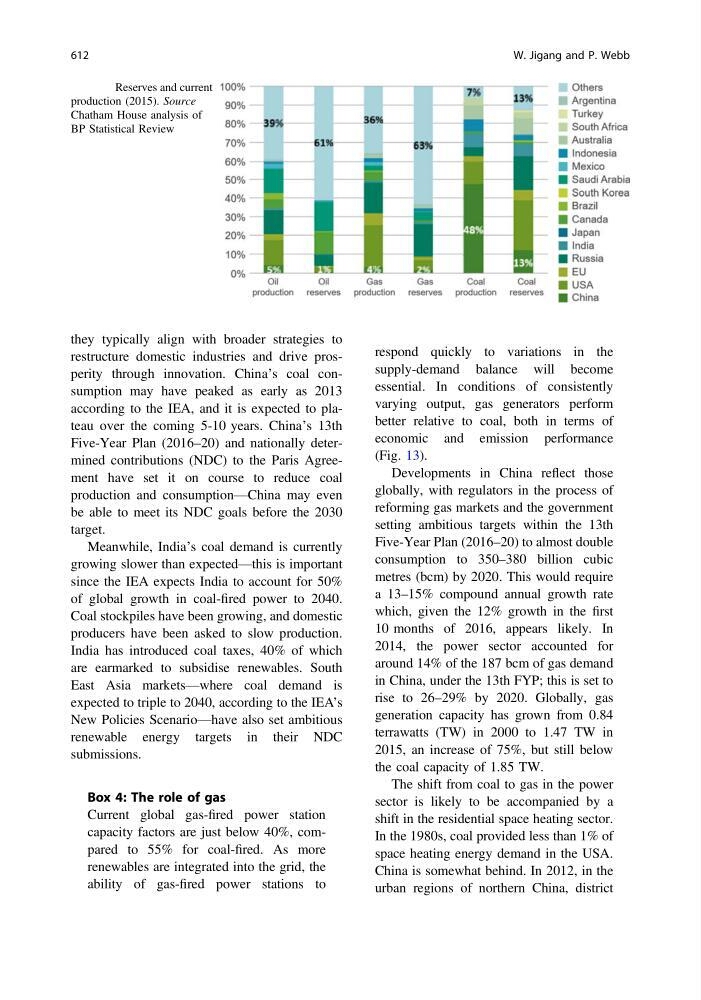
Fig. 12 Reserves and current
production (2015). Source
Chatham House analysis of
BP Statistical Review
612
W. Jigang and P. Webb