

in energy intensity is synonymous to the move
from industrial to service sector driven growth,
occurring in countries across South East Asia.
This trend of quantity to quality is exemplified by
electrification—the greater use of electrons rather
than molecules—alongside digitalisation and the
growing Internet of things.
Box 3: Critical areas for a 2°C world
and the energy transition
The aggregate of all nationally determined
contributions pledges far from meets the
CO 2 reductions required under the Intergovernmental Panel on Climate Change
mitigation pathways. Increased political
ambition and expansion of climate policies
and legislation are, therefore, required to
ensure the world doesn’t exceed 2°C,
which could result in runaway global
warming.
Turning to the International Energy
Agency’s New Policies Scenario (NPS),
which represents 2016 global climate
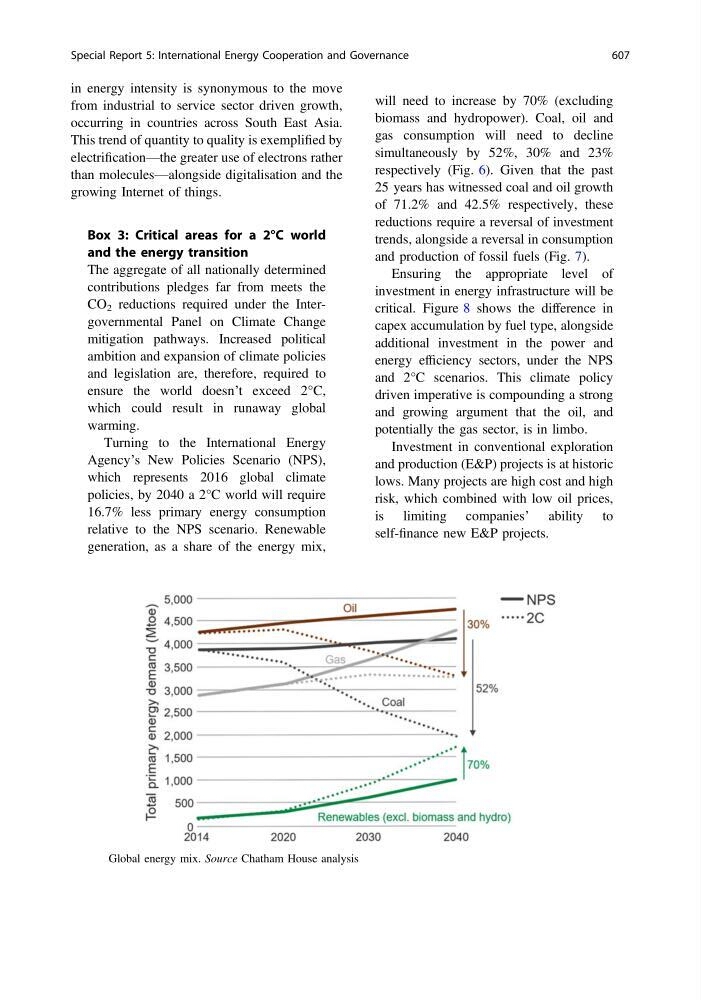
policies, by 2040 a 2°C world will require
16.7% less primary energy consumption
relative to the NPS scenario. Renewable
generation, as a share of the energy mix,
will need to increase by 70% (excluding
biomass and hydropower). Coal, oil and
gas consumption will need to decline
simultaneously by 52%, 30% and 23%
respectively (Fig. 6). Given that the past
25 years has witnessed coal and oil growth
of 71.2% and 42.5% respectively, these
reductions require a reversal of investment
trends, alongside a reversal in consumption
and production of fossil fuels (Fig. 7).
Ensuring the appropriate level of
investment in energy infrastructure will be
critical. Figure 8 shows the difference in
capex accumulation by fuel type, alongside
additional investment in the power and
energy efficiency sectors, under the NPS
and 2°C scenarios. This climate policy
driven imperative is compounding a strong
and growing argument that the oil, and
potentially the gas sector, is in limbo.
Investment in conventional exploration
and production (E&P) projects is at historic
lows. Many projects are high cost and high
risk, which combined with low oil prices,
is limiting companies’ ability to
self-finance new E&P projects.
Fig. 6 Global energy mix. Source Chatham House analysis
Special Report 5: International Energy Cooperation and Governance
607