

3.4 New Concepts of Energy Security
and Energy Cooperation
Traditional energy security dialogues and mechanisms, including those for oil and gas security,
will continue to play a key role in delivering
energy security, perhaps for several decades.
Today, these remain the focus of policymakers,
especially in countries where demand and
exports are rising. The challenge for policymakers will be how to adapt these instruments to
new market realities and shifts in the energy mix
in order to remain relevant and effective.
Meanwhile, the complex nature of these
shifting trends points to a need for mainstream
energy governance within a range of international processes, especially those related to
shifting finance at scale. Pressure to phase out
coal and reduce carbon liabilities in the global
financial structure, for instance, will have profound impacts on global energy systems.
Moreover, gaps in the existing structure could
be increasingly apparent given the shifts in
energy markets, technology and politics. Technical and policy support for energy efficiency and
clean technologies has become a core competency of institutions such as the IEA, and new
institutions focused solely on renewable energy,
such as the International Renewable Energy
Agency have emerged, as well as initiatives such
as Mission Innovation and Breakthrough Energy.
But until now, there has been a division between
traditional oil market security questions and the
wider conception of energy security, which is
arguably now essential.
It remains challenging to enhance the legitimacy and representativeness of current energy
governance structures through reform processes.
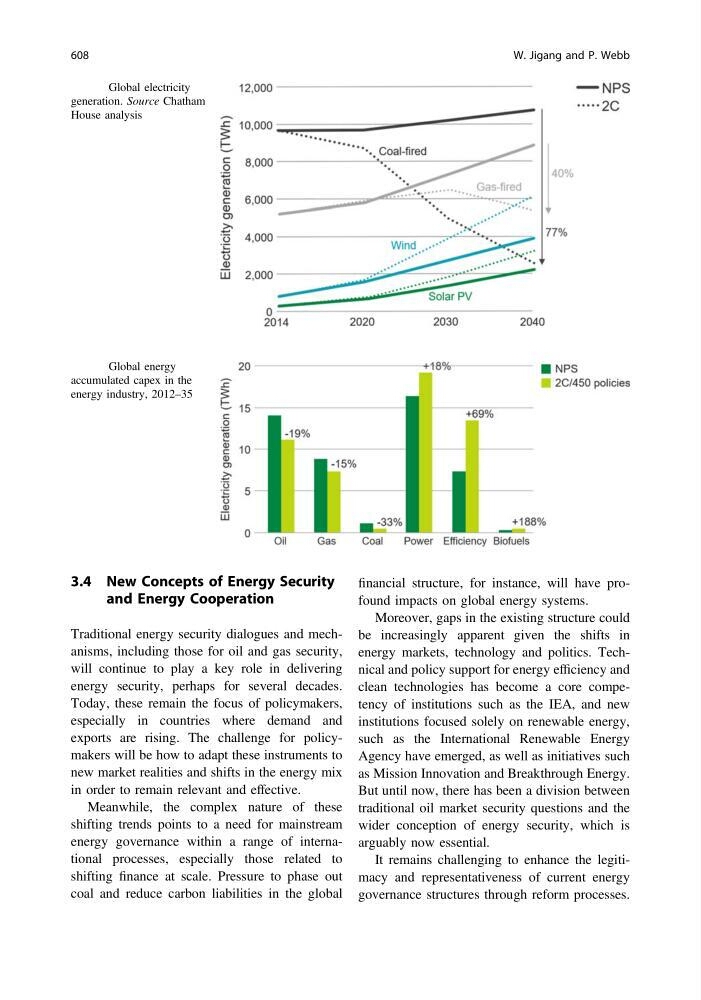
Fig. 8 Global energy
accumulated capex in the
energy industry, 2012–35
Fig. 7 Global electricity
generation. Source Chatham
House analysis
608
W. Jigang and P. Webb