

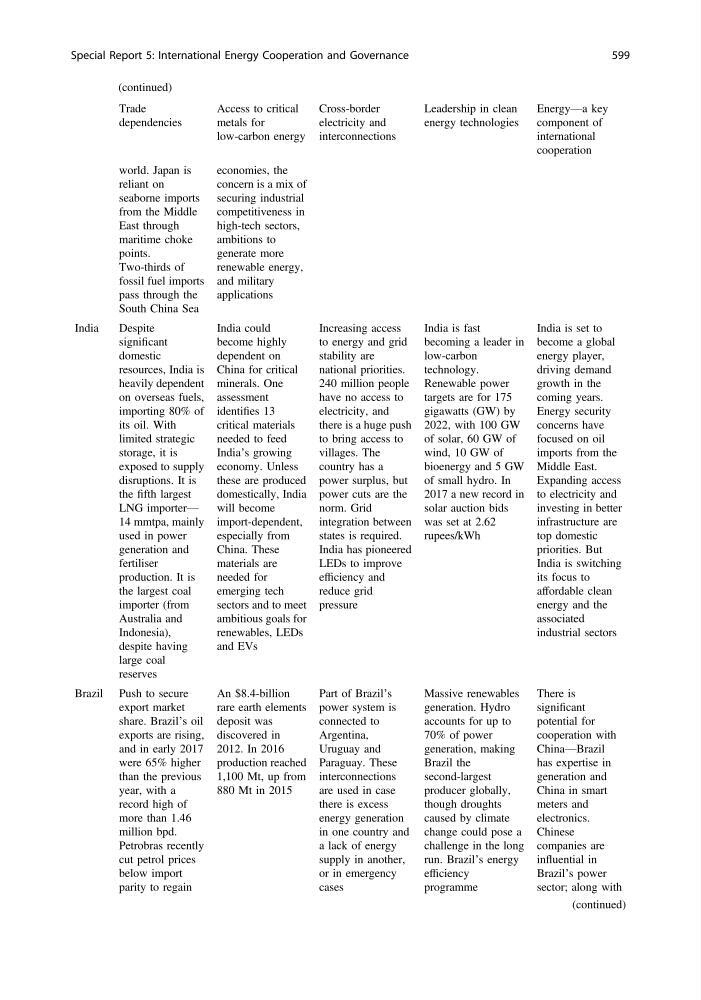
Table 1 (continued)
Trade
dependencies
Access to critical
metals for
low-carbon energy
Cross-border
electricity and
interconnections
Leadership in clean
energy technologies
Energy—a key
component of
international
cooperation
world. Japan is
reliant on
seaborne imports
from the Middle
East through
maritime choke
points.
Two-thirds of
fossil fuel imports
pass through the
South China Sea
economies, the
concern is a mix of
securing industrial
competitiveness in
high-tech sectors,
ambitions to
generate more
renewable energy,
and military
applications
India
Despite
significant
domestic
resources, India is
heavily dependent
on overseas fuels,
importing 80% of
its oil. With
limited strategic
storage, it is
exposed to supply
disruptions. It is
the fifth largest
LNG importer—
14 mmtpa, mainly
used in power
generation and
fertiliser
production. It is
the largest coal
importer (from
Australia and
Indonesia),
despite having
large coal
reserves
India could
become highly
dependent on
China for critical
minerals. One
assessment
identifies 13
critical materials
needed to feed
India’s growing
economy. Unless
these are produced
domestically, India
will become
import-dependent,
especially from
China. These
materials are
needed for
emerging tech
sectors and to meet
ambitious goals for
renewables, LEDs
and EVs
Increasing access
to energy and grid
stability are
national priorities.
240 million people
have no access to
electricity, and
there is a huge push
to bring access to
villages. The
country has a
power surplus, but
power cuts are the
norm. Grid
integration between
states is required.
India has pioneered
LEDs to improve
efficiency and
reduce grid
pressure
India is fast
becoming a leader in
low-carbon
technology.
Renewable power
targets are for 175
gigawatts (GW) by
2022, with 100 GW
of solar, 60 GW of
wind, 10 GW of
bioenergy and 5 GW
of small hydro. In
2017 a new record in
solar auction bids
was set at 2.62
rupees/kWh
India is set to
become a global
energy player,
driving demand
growth in the
coming years.
Energy security
concerns have
focused on oil
imports from the
Middle East.
Expanding access
to electricity and
investing in better
infrastructure are
top domestic
priorities. But
India is switching
its focus to
affordable clean
energy and the
associated
industrial sectors
Brazil Push to secure
export market
share. Brazil’s oil
exports are rising,
and in early 2017
were 65% higher
than the previous
year, with a
record high of
more than 1.46
million bpd.
Petrobras recently
cut petrol prices
below import
parity to regain
An $8.4-billion
rare earth elements
deposit was
discovered in
2012. In 2016
production reached
1,100 Mt, up from
880 Mt in 2015
Part of Brazil’s
power system is
connected to
Argentina,
Uruguay and
Paraguay. These
interconnections
are used in case
there is excess
energy generation
in one country and
a lack of energy
supply in another,
or in emergency
cases
Massive renewables
generation. Hydro
accounts for up to
70% of power
generation, making
Brazil the
second-largest
producer globally,
though droughts
caused by climate
change could pose a
challenge in the long
run. Brazil’s energy
efficiency
programme
There is
significant
potential for
cooperation with
China—Brazil
has expertise in
generation and
China in smart
meters and
electronics.
Chinese
companies are
influential in
Brazil’s power
sector; along with
(continued)
Special Report 5: International Energy Cooperation and Governance
599