

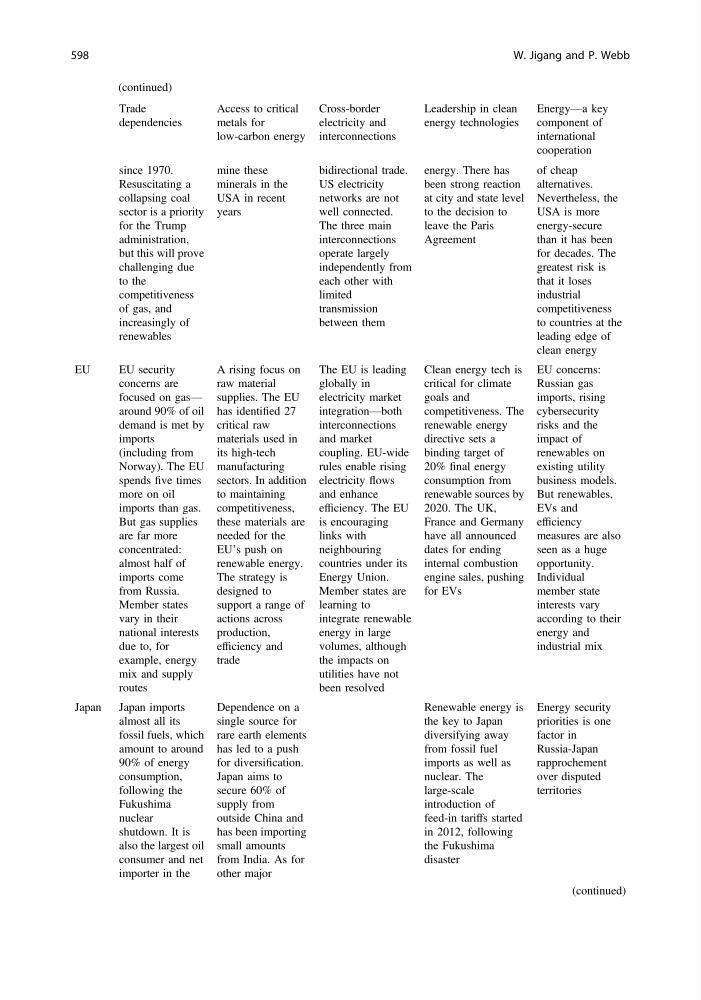
Table 1 (continued)
Trade
dependencies
Access to critical
metals for
low-carbon energy
Cross-border
electricity and
interconnections
Leadership in clean
energy technologies
Energy—a key
component of
international
cooperation
since 1970.
Resuscitating a
collapsing coal
sector is a priority
for the Trump
administration,
but this will prove
challenging due
to the
competitiveness
of gas, and
increasingly of
renewables
mine these
minerals in the
USA in recent
years
bidirectional trade.
US electricity
networks are not
well connected.
The three main
interconnections
operate largely
independently from
each other with
limited
transmission
between them
energy. There has
been strong reaction
at city and state level
to the decision to
leave the Paris
Agreement
of cheap
alternatives.
Nevertheless, the
USA is more
energy-secure
than it has been
for decades. The
greatest risk is
that it loses
industrial
competitiveness
to countries at the
leading edge of
clean energy
EU
EU security
concerns are
focused on gas—
around 90% of oil
demand is met by
imports
(including from
Norway). The EU
spends five times
more on oil
imports than gas.
But gas supplies
are far more
concentrated:
almost half of
imports come
from Russia.
Member states
vary in their
national interests
due to, for
example, energy
mix and supply
routes
A rising focus on
raw material
supplies. The EU
has identified 27
critical raw
materials used in
its high-tech
manufacturing
sectors. In addition
to maintaining
competitiveness,
these materials are
needed for the
EU’s push on
renewable energy.
The strategy is
designed to
support a range of
actions across
production,
efficiency and
trade
The EU is leading
globally in
electricity market
integration—both
interconnections
and market
coupling. EU-wide
rules enable rising
electricity flows
and enhance
efficiency. The EU
is encouraging
links with
neighbouring
countries under its
Energy Union.
Member states are
learning to
integrate renewable
energy in large
volumes, although
the impacts on
utilities have not
been resolved
Clean energy tech is
critical for climate
goals and
competitiveness. The
renewable energy
directive sets a
binding target of
20% final energy
consumption from
renewable sources by
2020. The UK,
France and Germany
have all announced
dates for ending
internal combustion
engine sales, pushing
for EVs
EU concerns:
Russian gas
imports, rising
cybersecurity
risks and the
impact of
renewables on
existing utility
business models.
But renewables,
EVs and
efficiency
measures are also
seen as a huge
opportunity.
Individual
member state
interests vary
according to their
energy and
industrial mix
Japan
Japan imports
almost all its
fossil fuels, which
amount to around
90% of energy
consumption,
following the
Fukushima
nuclear
shutdown. It is
also the largest oil
consumer and net
importer in the
Dependence on a
single source for
rare earth elements
has led to a push
for diversification.
Japan aims to
secure 60% of
supply from
outside China and
has been importing
small amounts
from India. As for
other major
Renewable energy is
the key to Japan
diversifying away
from fossil fuel
imports as well as
nuclear. The
large-scale
introduction of
feed-in tariffs started
in 2012, following
the Fukushima
disaster
Energy security
priorities is one
factor in
Russia-Japan
rapprochement
over disputed
territories
(continued)
598
W. Jigang and P. Webb