

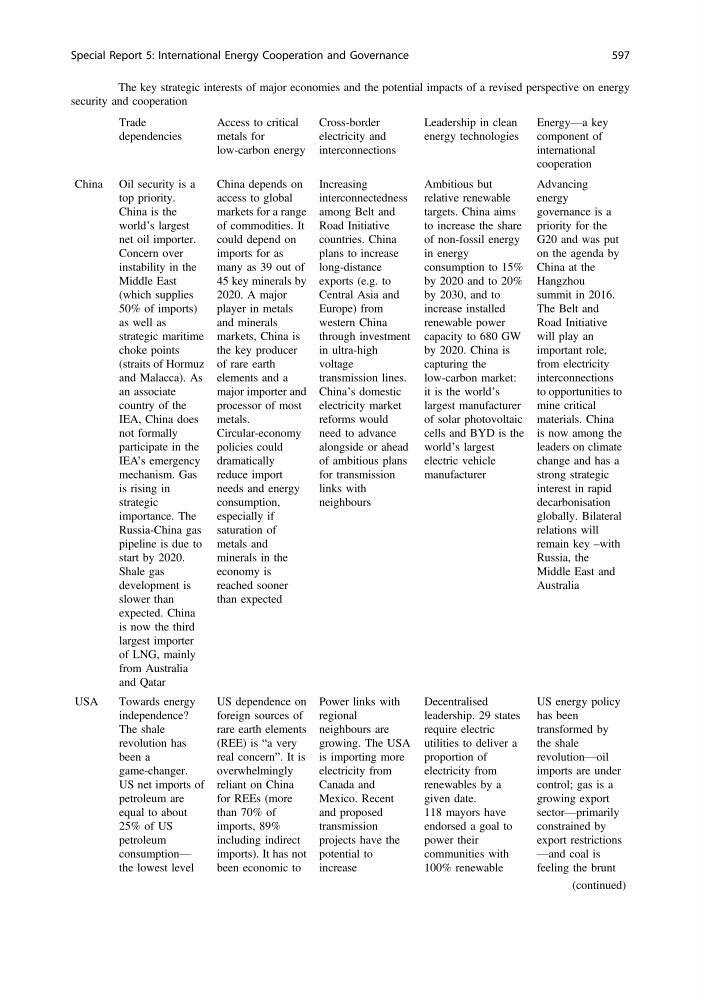
Table 1 The key strategic interests of major economies and the potential impacts of a revised perspective on energy
security and cooperation
Trade
dependencies
Access to critical
metals for
low-carbon energy
Cross-border
electricity and
interconnections
Leadership in clean
energy technologies
Energy—a key
component of
international
cooperation
China Oil security is a
top priority.
China is the
world’s largest
net oil importer.
Concern over
instability in the
Middle East
(which supplies
50% of imports)
as well as
strategic maritime
choke points
(straits of Hormuz
and Malacca). As
an associate
country of the
IEA, China does
not formally
participate in the
IEA’s emergency
mechanism. Gas
is rising in
strategic
importance. The
Russia-China gas
pipeline is due to
start by 2020.
Shale gas
development is
slower than
expected. China
is now the third
largest importer
of LNG, mainly
from Australia
and Qatar
China depends on
access to global
markets for a range
of commodities. It
could depend on
imports for as
many as 39 out of
45 key minerals by
2020. A major
player in metals
and minerals
markets, China is
the key producer
of rare earth
elements and a
major importer and
processor of most
metals.
Circular-economy
policies could
dramatically
reduce import
needs and energy
consumption,
especially if
saturation of
metals and
minerals in the
economy is
reached sooner
than expected
Increasing
interconnectedness
among Belt and
Road Initiative
countries. China
plans to increase
long-distance
exports (e.g. to
Central Asia and
Europe) from
western China
through investment
in ultra-high
voltage
transmission lines.
China’s domestic
electricity market
reforms would
need to advance
alongside or ahead
of ambitious plans
for transmission
links with
neighbours
Ambitious but
relative renewable
targets. China aims
to increase the share
of non-fossil energy
in energy
consumption to 15%
by 2020 and to 20%
by 2030, and to
increase installed
renewable power
capacity to 680 GW
by 2020. China is
capturing the
low-carbon market:
it is the world’s
largest manufacturer
of solar photovoltaic
cells and BYD is the
world’s largest
electric vehicle
manufacturer
Advancing
energy
governance is a
priority for the
G20 and was put
on the agenda by
China at the
Hangzhou
summit in 2016.
The Belt and
Road Initiative
will play an
important role,
from electricity
interconnections
to opportunities to
mine critical
materials. China
is now among the
leaders on climate
change and has a
strong strategic
interest in rapid
decarbonisation
globally. Bilateral
relations will
remain key –with
Russia, the
Middle East and
Australia
USA
Towards energy
independence?
The shale
revolution has
been a
game-changer.
US net imports of
petroleum are
equal to about
25% of US
petroleum
consumption—
the lowest level
US dependence on
foreign sources of
rare earth elements
(REE) is “a very
real concern”. It is
overwhelmingly
reliant on China
for REEs (more
than 70% of
imports, 89%
including indirect
imports). It has not
been economic to
Power links with
regional
neighbours are
growing. The USA
is importing more
electricity from
Canada and
Mexico. Recent
and proposed
transmission
projects have the
potential to
increase
Decentralised
leadership. 29 states
require electric
utilities to deliver a
proportion of
electricity from
renewables by a
given date.
118 mayors have
endorsed a goal to
power their
communities with
100% renewable
US energy policy
has been
transformed by
the shale
revolution—oil
imports are under
control; gas is a
growing export
sector—primarily
constrained by
export restrictions
—and coal is
feeling the brunt
(continued)
Special Report 5: International Energy Cooperation and Governance
597