

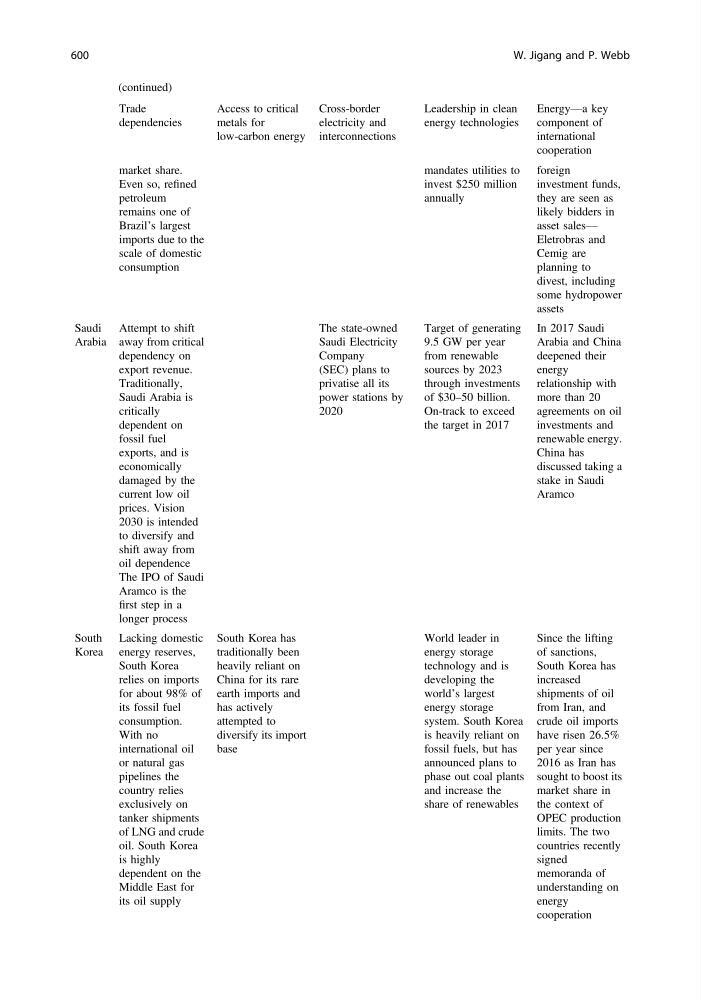
Table 1 (continued)
Trade
dependencies
Access to critical
metals for
low-carbon energy
Cross-border
electricity and
interconnections
Leadership in clean
energy technologies
Energy—a key
component of
international
cooperation
market share.
Even so, refined
petroleum
remains one of
Brazil’s largest
imports due to the
scale of domestic
consumption
mandates utilities to
invest $250 million
annually
foreign
investment funds,
they are seen as
likely bidders in
asset sales—
Eletrobras and
Cemig are
planning to
divest, including
some hydropower
assets
Saudi
Arabia
Attempt to shift
away from critical
dependency on
export revenue.
Traditionally,
Saudi Arabia is
critically
dependent on
fossil fuel
exports, and is
economically
damaged by the
current low oil
prices. Vision
2030 is intended
to diversify and
shift away from
oil dependence
The IPO of Saudi
Aramco is the
first step in a
longer process
The state-owned
Saudi Electricity
Company
(SEC) plans to
privatise all its
power stations by
2020
Target of generating
9.5 GW per year
from renewable
sources by 2023
through investments
of $30–50 billion.
On-track to exceed
the target in 2017
In 2017 Saudi
Arabia and China
deepened their
energy
relationship with
more than 20
agreements on oil
investments and
renewable energy.
China has
discussed taking a
stake in Saudi
Aramco
South
Korea
Lacking domestic
energy reserves,
South Korea
relies on imports
for about 98% of
its fossil fuel
consumption.
With no
international oil
or natural gas
pipelines the
country relies
exclusively on
tanker shipments
of LNG and crude
oil. South Korea
is highly
dependent on the
Middle East for
its oil supply
South Korea has
traditionally been
heavily reliant on
China for its rare
earth imports and
has actively
attempted to
diversify its import
base
World leader in
energy storage
technology and is
developing the
world’s largest
energy storage
system. South Korea
is heavily reliant on
fossil fuels, but has
announced plans to
phase out coal plants
and increase the
share of renewables
Since the lifting
of sanctions,
South Korea has
increased
shipments of oil
from Iran, and
crude oil imports
have risen 26.5%
per year since
2016 as Iran has
sought to boost its
market share in
the context of
OPEC production
limits. The two
countries recently
signed
memoranda of
understanding on
energy
cooperation
600
W. Jigang and P. Webb