

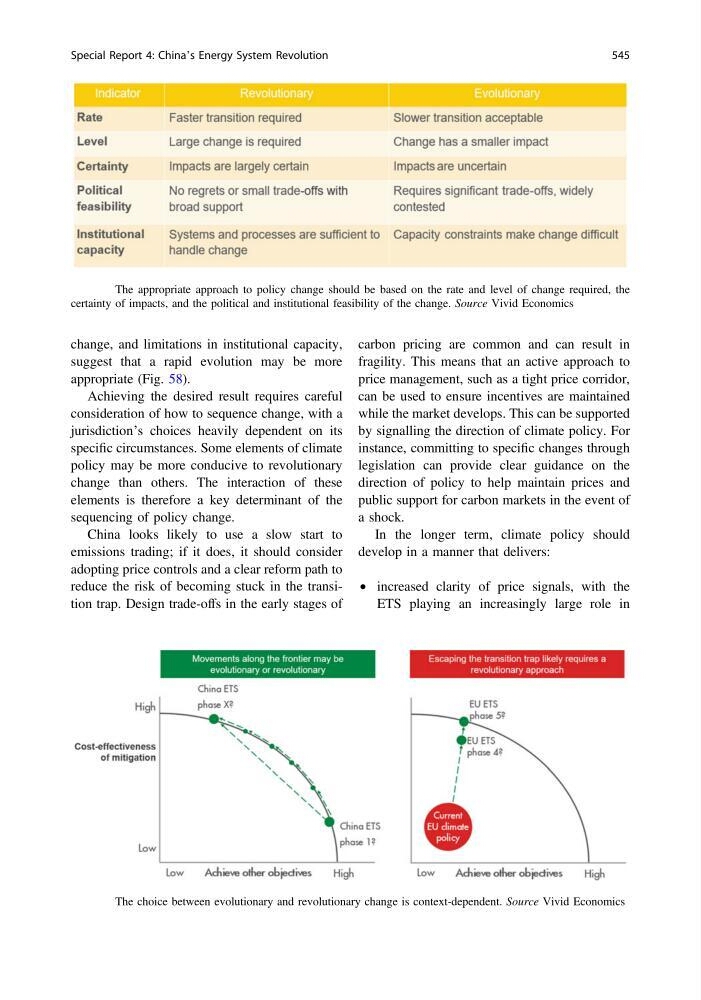
change, and limitations in institutional capacity,
suggest that a rapid evolution may be more
appropriate (Fig. 58).
Achieving the desired result requires careful
consideration of how to sequence change, with a
jurisdiction’s choices heavily dependent on its
specific circumstances. Some elements of climate
policy may be more conducive to revolutionary
change than others. The interaction of these
elements is therefore a key determinant of the
sequencing of policy change.
China looks likely to use a slow start to
emissions trading; if it does, it should consider
adopting price controls and a clear reform path to
reduce the risk of becoming stuck in the transition trap. Design trade-offs in the early stages of
carbon pricing are common and can result in
fragility. This means that an active approach to
price management, such as a tight price corridor,
can be used to ensure incentives are maintained
while the market develops. This can be supported
by signalling the direction of climate policy. For
instance, committing to specific changes through
legislation can provide clear guidance on the
direction of policy to help maintain prices and
public support for carbon markets in the event of
a shock.
In the longer term, climate policy should
develop in a manner that delivers:
• increased clarity of price signals, with the
ETS playing an increasingly large role in
Fig. 58 The choice between evolutionary and revolutionary change is context-dependent. Source Vivid Economics
Fig. 57 The appropriate approach to policy change should be based on the rate and level of change required, the
certainty of impacts, and the political and institutional feasibility of the change. Source Vivid Economics
Special Report 4: China’s Energy System Revolution
545
suggest that a rapid evolution may be more
appropriate (Fig. 58).
Achieving the desired result requires careful
consideration of how to sequence change, with a
jurisdiction’s choices heavily dependent on its
specific circumstances. Some elements of climate
policy may be more conducive to revolutionary
change than others. The interaction of these
elements is therefore a key determinant of the
sequencing of policy change.
China looks likely to use a slow start to
emissions trading; if it does, it should consider
adopting price controls and a clear reform path to
reduce the risk of becoming stuck in the transition trap. Design trade-offs in the early stages of
carbon pricing are common and can result in
fragility. This means that an active approach to
price management, such as a tight price corridor,
can be used to ensure incentives are maintained
while the market develops. This can be supported
by signalling the direction of climate policy. For
instance, committing to specific changes through
legislation can provide clear guidance on the
direction of policy to help maintain prices and
public support for carbon markets in the event of
a shock.
In the longer term, climate policy should
develop in a manner that delivers:
• increased clarity of price signals, with the
ETS playing an increasingly large role in
Fig. 58 The choice between evolutionary and revolutionary change is context-dependent. Source Vivid Economics
Fig. 57 The appropriate approach to policy change should be based on the rate and level of change required, the
certainty of impacts, and the political and institutional feasibility of the change. Source Vivid Economics
Special Report 4: China’s Energy System Revolution
545