

8.4 Evolutionary and Revolutionary
Change in Carbon Markets
Changes in carbon markets can be evolutionary
or revolutionary. China will shortly establish a
carbon market. On December 19, 2017, the
National Development and Reform Commission
(NDRC) announced the official launch of China’s carbon emissions trading system, starting
with the power generation sector. Previously, the
NDRC had issued the Plan for Building a
National Carbon Emissions Permit Trading
Market (for the Power Generation Sector), which
outlined the design of China’s carbon emissions
trading system. However, the design is likely to
change over time in response to shocks and
changing policy priorities. Identifying the changes necessary and what they entail can help guide
the future policy direction for China’s carbon
market. Our research shows that the
cost-effectiveness of climate change mitigation
will become more important over time as greater
levels of higher-cost mitigation are required. This
means that policymakers may wish to move from
a carbon-pricing system that is less weighted
towards cost-effectiveness to one where the
cost-effectiveness of the policy is a more
important consideration. The nature of the policy
change required to give this effect depends on the
nature of the problem and China’s specific
circumstances.
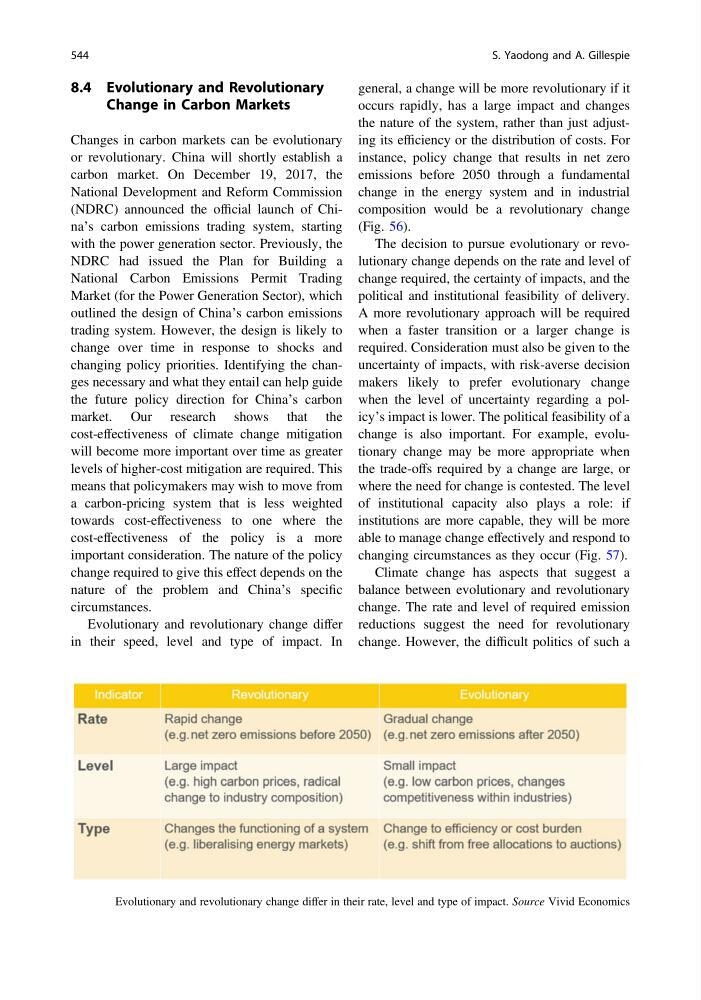
Evolutionary and revolutionary change differ
in their speed, level and type of impact. In
general, a change will be more revolutionary if it
occurs rapidly, has a large impact and changes
the nature of the system, rather than just adjusting its efficiency or the distribution of costs. For
instance, policy change that results in net zero
emissions before 2050 through a fundamental
change in the energy system and in industrial
composition would be a revolutionary change
(Fig. 56).
The decision to pursue evolutionary or revolutionary change depends on the rate and level of
change required, the certainty of impacts, and the
political and institutional feasibility of delivery.
A more revolutionary approach will be required
when a faster transition or a larger change is
required. Consideration must also be given to the
uncertainty of impacts, with risk-averse decision
makers likely to prefer evolutionary change
when the level of uncertainty regarding a policy’s impact is lower. The political feasibility of a
change is also important. For example, evolutionary change may be more appropriate when
the trade-offs required by a change are large, or
where the need for change is contested. The level
of institutional capacity also plays a role: if
institutions are more capable, they will be more
able to manage change effectively and respond to
changing circumstances as they occur (Fig. 57).
Climate change has aspects that suggest a
balance between evolutionary and revolutionary
change. The rate and level of required emission
reductions suggest the need for revolutionary
change. However, the difficult politics of such a
Fig. 56 Evolutionary and revolutionary change differ in their rate, level and type of impact. Source Vivid Economics
544
S. Yaodong and A. Gillespie
Change in Carbon Markets
Changes in carbon markets can be evolutionary
or revolutionary. China will shortly establish a
carbon market. On December 19, 2017, the
National Development and Reform Commission
(NDRC) announced the official launch of China’s carbon emissions trading system, starting
with the power generation sector. Previously, the
NDRC had issued the Plan for Building a
National Carbon Emissions Permit Trading
Market (for the Power Generation Sector), which
outlined the design of China’s carbon emissions
trading system. However, the design is likely to
change over time in response to shocks and
changing policy priorities. Identifying the changes necessary and what they entail can help guide
the future policy direction for China’s carbon
market. Our research shows that the
cost-effectiveness of climate change mitigation
will become more important over time as greater
levels of higher-cost mitigation are required. This
means that policymakers may wish to move from
a carbon-pricing system that is less weighted
towards cost-effectiveness to one where the
cost-effectiveness of the policy is a more
important consideration. The nature of the policy
change required to give this effect depends on the
nature of the problem and China’s specific
circumstances.
Evolutionary and revolutionary change differ
in their speed, level and type of impact. In
general, a change will be more revolutionary if it
occurs rapidly, has a large impact and changes
the nature of the system, rather than just adjusting its efficiency or the distribution of costs. For
instance, policy change that results in net zero
emissions before 2050 through a fundamental
change in the energy system and in industrial
composition would be a revolutionary change
(Fig. 56).
The decision to pursue evolutionary or revolutionary change depends on the rate and level of
change required, the certainty of impacts, and the
political and institutional feasibility of delivery.
A more revolutionary approach will be required
when a faster transition or a larger change is
required. Consideration must also be given to the
uncertainty of impacts, with risk-averse decision
makers likely to prefer evolutionary change
when the level of uncertainty regarding a policy’s impact is lower. The political feasibility of a
change is also important. For example, evolutionary change may be more appropriate when
the trade-offs required by a change are large, or
where the need for change is contested. The level
of institutional capacity also plays a role: if
institutions are more capable, they will be more
able to manage change effectively and respond to
changing circumstances as they occur (Fig. 57).
Climate change has aspects that suggest a
balance between evolutionary and revolutionary
change. The rate and level of required emission
reductions suggest the need for revolutionary
change. However, the difficult politics of such a
Fig. 56 Evolutionary and revolutionary change differ in their rate, level and type of impact. Source Vivid Economics
544
S. Yaodong and A. Gillespie