

make the most of renewable energy and support its
long-term development.
To this end, and based on its findings in the
recommended scenario, this report proposes an
Accelerated development scenario in which we
investigate energy demand in transport and its
impact on China’s energy supply mix. EV development scenarios are set up as follows (Table 1).
Estimates for vehicle energy consumption in
the Accelerated scenario are shown in Fig. 19.
They assume vehicle ownership remains unchanged and newly added EVs replace mainly diesel
and petrol vehicles and do not affect the number of
natural gas-fuelled vehicles. Petrol and diesel
consumption are expected to decrease by 100 Mt
by 2030 and by 130 Mt by 2050. Meanwhile,
electricity demand is projected to increase by
200,000 GWh by 2030 and by 340,000 GWh by
2050, compared to the recommended scenario.
3.2.3 Accelerate Electrification
by Decarbonisation
In 2014, electricity accounted for nearly a quarter
of China’s end-use energy demand. The country’s electrification rate is comparable to that of
many OECD economies. As China’s society and
economy develop, consumer demand for higher
quality energy will grow, and technological and
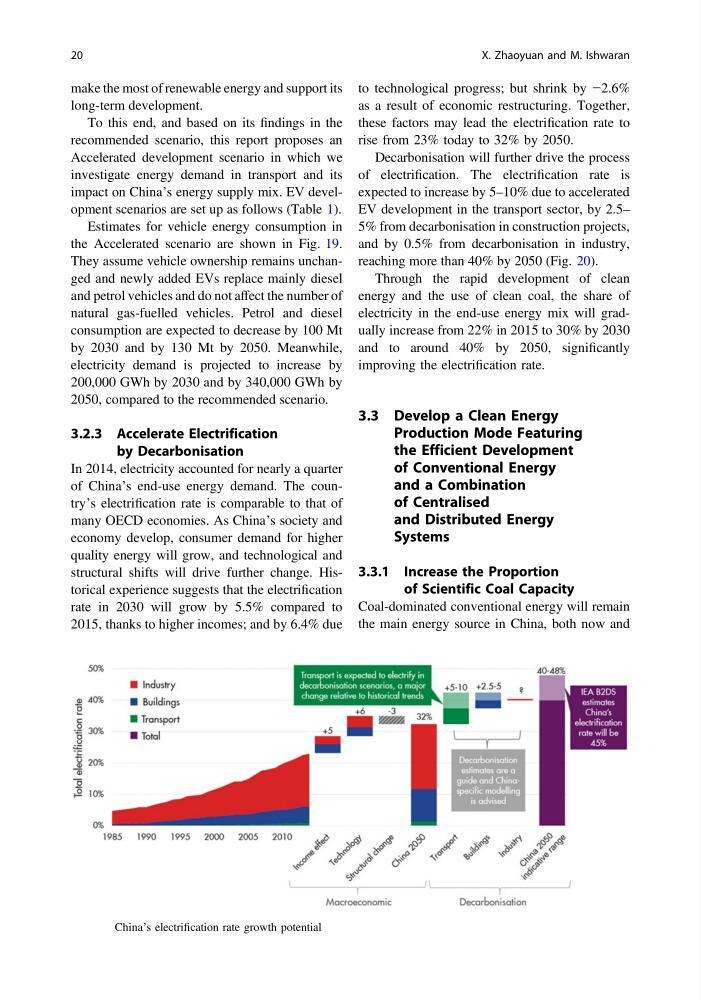
structural shifts will drive further change. Historical experience suggests that the electrification
rate in 2030 will grow by 5.5% compared to
2015, thanks to higher incomes; and by 6.4% due
to technological progress; but shrink by −2.6%
as a result of economic restructuring. Together,
these factors may lead the electrification rate to
rise from 23% today to 32% by 2050.
Decarbonisation will further drive the process
of electrification. The electrification rate is
expected to increase by 5–10% due to accelerated
EV development in the transport sector, by 2.5–
5% from decarbonisation in construction projects,
and by 0.5% from decarbonisation in industry,
reaching more than 40% by 2050 (Fig. 20).
Through the rapid development of clean
energy and the use of clean coal, the share of
electricity in the end-use energy mix will gradually increase from 22% in 2015 to 30% by 2030
and to around 40% by 2050, significantly
improving the electrification rate.
3.3 Develop a Clean Energy
Production Mode Featuring
the Efficient Development
of Conventional Energy
and a Combination
of Centralised
and Distributed Energy
Systems
3.3.1 Increase the Proportion
of Scientific Coal Capacity
Coal-dominated conventional energy will remain
the main energy source in China, both now and
Fig. 20 China’s electrification rate growth potential
20
X. Zhaoyuan and M. Ishwaran
long-term development.
To this end, and based on its findings in the
recommended scenario, this report proposes an
Accelerated development scenario in which we
investigate energy demand in transport and its
impact on China’s energy supply mix. EV development scenarios are set up as follows (Table 1).
Estimates for vehicle energy consumption in
the Accelerated scenario are shown in Fig. 19.
They assume vehicle ownership remains unchanged and newly added EVs replace mainly diesel
and petrol vehicles and do not affect the number of
natural gas-fuelled vehicles. Petrol and diesel
consumption are expected to decrease by 100 Mt
by 2030 and by 130 Mt by 2050. Meanwhile,
electricity demand is projected to increase by
200,000 GWh by 2030 and by 340,000 GWh by
2050, compared to the recommended scenario.
3.2.3 Accelerate Electrification
by Decarbonisation
In 2014, electricity accounted for nearly a quarter
of China’s end-use energy demand. The country’s electrification rate is comparable to that of
many OECD economies. As China’s society and
economy develop, consumer demand for higher
quality energy will grow, and technological and
structural shifts will drive further change. Historical experience suggests that the electrification
rate in 2030 will grow by 5.5% compared to
2015, thanks to higher incomes; and by 6.4% due
to technological progress; but shrink by −2.6%
as a result of economic restructuring. Together,
these factors may lead the electrification rate to
rise from 23% today to 32% by 2050.
Decarbonisation will further drive the process
of electrification. The electrification rate is
expected to increase by 5–10% due to accelerated
EV development in the transport sector, by 2.5–
5% from decarbonisation in construction projects,
and by 0.5% from decarbonisation in industry,
reaching more than 40% by 2050 (Fig. 20).
Through the rapid development of clean
energy and the use of clean coal, the share of
electricity in the end-use energy mix will gradually increase from 22% in 2015 to 30% by 2030
and to around 40% by 2050, significantly
improving the electrification rate.
3.3 Develop a Clean Energy
Production Mode Featuring
the Efficient Development
of Conventional Energy
and a Combination
of Centralised
and Distributed Energy
Systems
3.3.1 Increase the Proportion
of Scientific Coal Capacity
Coal-dominated conventional energy will remain
the main energy source in China, both now and
Fig. 20 China’s electrification rate growth potential
20
X. Zhaoyuan and M. Ishwaran