

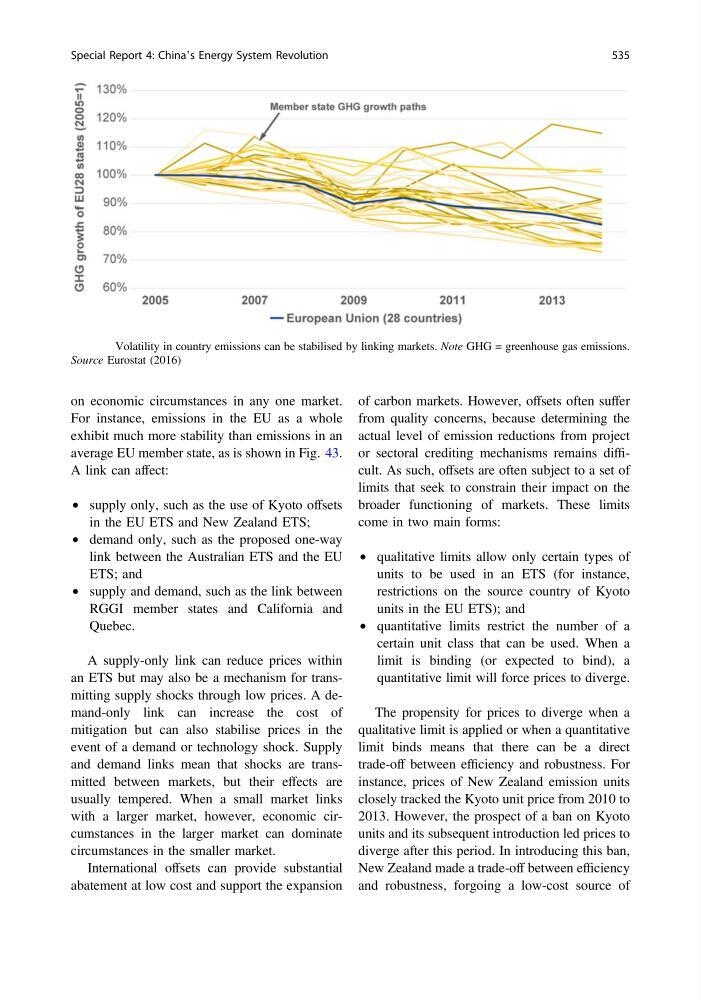
on economic circumstances in any one market.
For instance, emissions in the EU as a whole
exhibit much more stability than emissions in an
average EU member state, as is shown in Fig. 43.
A link can affect:
• supply only, such as the use of Kyoto offsets
in the EU ETS and New Zealand ETS;
• demand only, such as the proposed one-way
link between the Australian ETS and the EU
ETS; and
• supply and demand, such as the link between
RGGI member states and California and
Quebec.
A supply-only link can reduce prices within
an ETS but may also be a mechanism for transmitting supply shocks through low prices. A demand-only link can increase the cost of
mitigation but can also stabilise prices in the
event of a demand or technology shock. Supply
and demand links mean that shocks are transmitted between markets, but their effects are
usually tempered. When a small market links
with a larger market, however, economic circumstances in the larger market can dominate
circumstances in the smaller market.
International offsets can provide substantial
abatement at low cost and support the expansion
of carbon markets. However, offsets often suffer
from quality concerns, because determining the
actual level of emission reductions from project
or sectoral crediting mechanisms remains difficult. As such, offsets are often subject to a set of
limits that seek to constrain their impact on the
broader functioning of markets. These limits
come in two main forms:
• qualitative limits allow only certain types of
units to be used in an ETS (for instance,
restrictions on the source country of Kyoto
units in the EU ETS); and
• quantitative limits restrict the number of a
certain unit class that can be used. When a
limit is binding (or expected to bind), a
quantitative limit will force prices to diverge.
The propensity for prices to diverge when a
qualitative limit is applied or when a quantitative
limit binds means that there can be a direct
trade-off between efficiency and robustness. For
instance, prices of New Zealand emission units
closely tracked the Kyoto unit price from 2010 to
2013. However, the prospect of a ban on Kyoto
units and its subsequent introduction led prices to
diverge after this period. In introducing this ban,
New Zealand made a trade-off between efficiency
and robustness, forgoing a low-cost source of
Fig. 43 Volatility in country emissions can be stabilised by linking markets. Note GHG = greenhouse gas emissions.
Source Eurostat (2016)
Special Report 4: China’s Energy System Revolution
535
For instance, emissions in the EU as a whole
exhibit much more stability than emissions in an
average EU member state, as is shown in Fig. 43.
A link can affect:
• supply only, such as the use of Kyoto offsets
in the EU ETS and New Zealand ETS;
• demand only, such as the proposed one-way
link between the Australian ETS and the EU
ETS; and
• supply and demand, such as the link between
RGGI member states and California and
Quebec.
A supply-only link can reduce prices within
an ETS but may also be a mechanism for transmitting supply shocks through low prices. A demand-only link can increase the cost of
mitigation but can also stabilise prices in the
event of a demand or technology shock. Supply
and demand links mean that shocks are transmitted between markets, but their effects are
usually tempered. When a small market links
with a larger market, however, economic circumstances in the larger market can dominate
circumstances in the smaller market.
International offsets can provide substantial
abatement at low cost and support the expansion
of carbon markets. However, offsets often suffer
from quality concerns, because determining the
actual level of emission reductions from project
or sectoral crediting mechanisms remains difficult. As such, offsets are often subject to a set of
limits that seek to constrain their impact on the
broader functioning of markets. These limits
come in two main forms:
• qualitative limits allow only certain types of
units to be used in an ETS (for instance,
restrictions on the source country of Kyoto
units in the EU ETS); and
• quantitative limits restrict the number of a
certain unit class that can be used. When a
limit is binding (or expected to bind), a
quantitative limit will force prices to diverge.
The propensity for prices to diverge when a
qualitative limit is applied or when a quantitative
limit binds means that there can be a direct
trade-off between efficiency and robustness. For
instance, prices of New Zealand emission units
closely tracked the Kyoto unit price from 2010 to
2013. However, the prospect of a ban on Kyoto
units and its subsequent introduction led prices to
diverge after this period. In introducing this ban,
New Zealand made a trade-off between efficiency
and robustness, forgoing a low-cost source of
Fig. 43 Volatility in country emissions can be stabilised by linking markets. Note GHG = greenhouse gas emissions.
Source Eurostat (2016)
Special Report 4: China’s Energy System Revolution
535