

Economic shocks can also be concentrated in
specific sectors. For instance, the EU ETS primarily covers emissions from the industrial and
energy sectors. These sectors were particularly
affected by the recession in 2007–08, where
production levels in those sectors covered fluctuated far more than in the EU as a whole. This
was reflected in emission outcomes, and therefore demand for European emission allowances.
This sharp fall in demand was largely responsible
for the fall in prices that occurred in 2008. This is
shown in Fig. 41.
(2) Banking
The banking of carbon units can both increase
the cost-effectiveness of an ETS by enabling
substitution of abatement across time and
improve the robustness of the market. Banking
lets firms stockpile carbon units for later use.
This makes caps across compliance periods
function as a budget rather than a target. This in
turn means that when emissions in a compliance
year are lower than expected, carbon units of that
vintage retain their value, as they can still be used
to discharge liabilities. Banking increases efficiency as it enables emissions to be reduced at
the time when mitigation is at its lowest cost; it
also increases robustness by ensuring that carbon
units retain a positive value even after a shock.
However, this also means that when a shock is
large, banking can lead to a persistent oversupply
that can continue to depress prices for many
years.
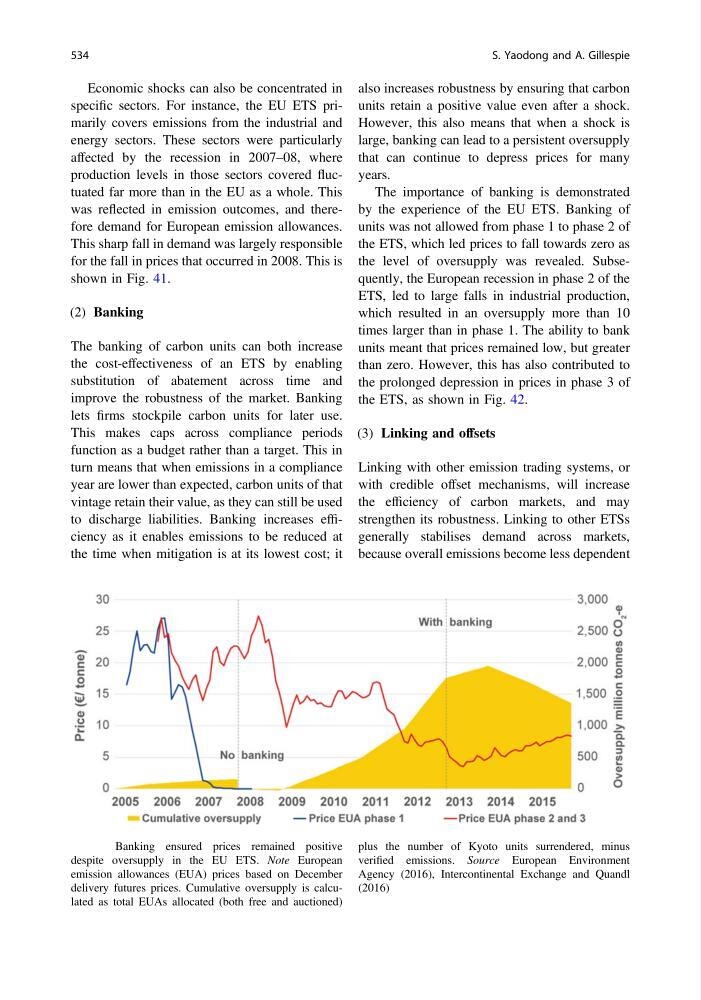
The importance of banking is demonstrated
by the experience of the EU ETS. Banking of
units was not allowed from phase 1 to phase 2 of
the ETS, which led prices to fall towards zero as
the level of oversupply was revealed. Subsequently, the European recession in phase 2 of the
ETS, led to large falls in industrial production,
which resulted in an oversupply more than 10
times larger than in phase 1. The ability to bank
units meant that prices remained low, but greater
than zero. However, this has also contributed to
the prolonged depression in prices in phase 3 of
the ETS, as shown in Fig. 42.
(3) Linking and offsets
Linking with other emission trading systems, or
with credible offset mechanisms, will increase
the efficiency of carbon markets, and may
strengthen its robustness. Linking to other ETSs
generally stabilises demand across markets,
because overall emissions become less dependent
Fig. 42 Banking ensured prices remained positive
despite oversupply in the EU ETS. Note European
emission allowances (EUA) prices based on December
delivery futures prices. Cumulative oversupply is calculated as total EUAs allocated (both free and auctioned)
plus the number of Kyoto units surrendered, minus
verified emissions. Source European Environment
Agency (2016), Intercontinental Exchange and Quandl
(2016)
534
S. Yaodong and A. Gillespie
specific sectors. For instance, the EU ETS primarily covers emissions from the industrial and
energy sectors. These sectors were particularly
affected by the recession in 2007–08, where
production levels in those sectors covered fluctuated far more than in the EU as a whole. This
was reflected in emission outcomes, and therefore demand for European emission allowances.
This sharp fall in demand was largely responsible
for the fall in prices that occurred in 2008. This is
shown in Fig. 41.
(2) Banking
The banking of carbon units can both increase
the cost-effectiveness of an ETS by enabling
substitution of abatement across time and
improve the robustness of the market. Banking
lets firms stockpile carbon units for later use.
This makes caps across compliance periods
function as a budget rather than a target. This in
turn means that when emissions in a compliance
year are lower than expected, carbon units of that
vintage retain their value, as they can still be used
to discharge liabilities. Banking increases efficiency as it enables emissions to be reduced at
the time when mitigation is at its lowest cost; it
also increases robustness by ensuring that carbon
units retain a positive value even after a shock.
However, this also means that when a shock is
large, banking can lead to a persistent oversupply
that can continue to depress prices for many
years.
The importance of banking is demonstrated
by the experience of the EU ETS. Banking of
units was not allowed from phase 1 to phase 2 of
the ETS, which led prices to fall towards zero as
the level of oversupply was revealed. Subsequently, the European recession in phase 2 of the
ETS, led to large falls in industrial production,
which resulted in an oversupply more than 10
times larger than in phase 1. The ability to bank
units meant that prices remained low, but greater
than zero. However, this has also contributed to
the prolonged depression in prices in phase 3 of
the ETS, as shown in Fig. 42.
(3) Linking and offsets
Linking with other emission trading systems, or
with credible offset mechanisms, will increase
the efficiency of carbon markets, and may
strengthen its robustness. Linking to other ETSs
generally stabilises demand across markets,
because overall emissions become less dependent
Fig. 42 Banking ensured prices remained positive
despite oversupply in the EU ETS. Note European
emission allowances (EUA) prices based on December
delivery futures prices. Cumulative oversupply is calculated as total EUAs allocated (both free and auctioned)
plus the number of Kyoto units surrendered, minus
verified emissions. Source European Environment
Agency (2016), Intercontinental Exchange and Quandl
(2016)
534
S. Yaodong and A. Gillespie