

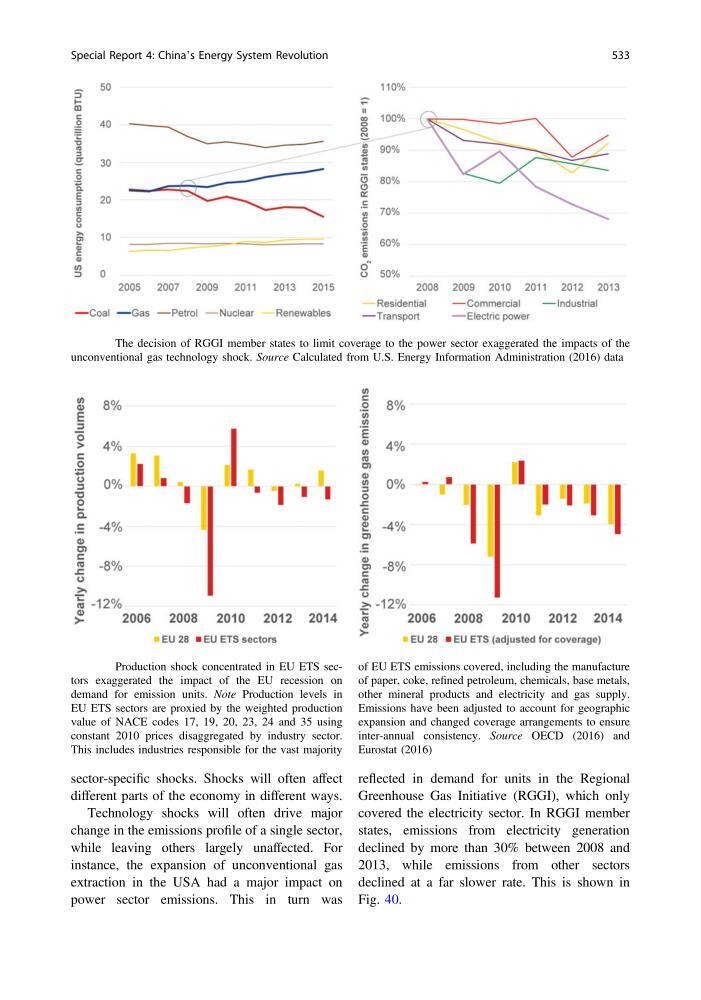
sector-specific shocks. Shocks will often affect
different parts of the economy in different ways.
Technology shocks will often drive major
change in the emissions profile of a single sector,
while leaving others largely unaffected. For
instance, the expansion of unconventional gas
extraction in the USA had a major impact on
power sector emissions. This in turn was
reflected in demand for units in the Regional
Greenhouse Gas Initiative (RGGI), which only
covered the electricity sector. In RGGI member
states, emissions from electricity generation
declined by more than 30% between 2008 and
2013, while emissions from other sectors
declined at a far slower rate. This is shown in
Fig. 40.
Fig. 40 The decision of RGGI member states to limit coverage to the power sector exaggerated the impacts of the
unconventional gas technology shock. Source Calculated from U.S. Energy Information Administration (2016) data
Fig. 41 Production shock concentrated in EU ETS sectors exaggerated the impact of the EU recession on
demand for emission units. Note Production levels in
EU ETS sectors are proxied by the weighted production
value of NACE codes 17, 19, 20, 23, 24 and 35 using
constant 2010 prices disaggregated by industry sector.
This includes industries responsible for the vast majority
of EU ETS emissions covered, including the manufacture
of paper, coke, refined petroleum, chemicals, base metals,
other mineral products and electricity and gas supply.
Emissions have been adjusted to account for geographic
expansion and changed coverage arrangements to ensure
inter-annual consistency. Source OECD (2016) and
Eurostat (2016)
Special Report 4: China’s Energy System Revolution
533
different parts of the economy in different ways.
Technology shocks will often drive major
change in the emissions profile of a single sector,
while leaving others largely unaffected. For
instance, the expansion of unconventional gas
extraction in the USA had a major impact on
power sector emissions. This in turn was
reflected in demand for units in the Regional
Greenhouse Gas Initiative (RGGI), which only
covered the electricity sector. In RGGI member
states, emissions from electricity generation
declined by more than 30% between 2008 and
2013, while emissions from other sectors
declined at a far slower rate. This is shown in
Fig. 40.
Fig. 40 The decision of RGGI member states to limit coverage to the power sector exaggerated the impacts of the
unconventional gas technology shock. Source Calculated from U.S. Energy Information Administration (2016) data
Fig. 41 Production shock concentrated in EU ETS sectors exaggerated the impact of the EU recession on
demand for emission units. Note Production levels in
EU ETS sectors are proxied by the weighted production
value of NACE codes 17, 19, 20, 23, 24 and 35 using
constant 2010 prices disaggregated by industry sector.
This includes industries responsible for the vast majority
of EU ETS emissions covered, including the manufacture
of paper, coke, refined petroleum, chemicals, base metals,
other mineral products and electricity and gas supply.
Emissions have been adjusted to account for geographic
expansion and changed coverage arrangements to ensure
inter-annual consistency. Source OECD (2016) and
Eurostat (2016)
Special Report 4: China’s Energy System Revolution
533