

pass-through is determined by the broader set of
rules that determine which users will face the costs
and incentives following from a carbon price.
Broad coverage and cost pass-through
increase market efficiency by incentivising
more abatement options. Examples of the
abatement options that might be incentivised
through different coverage and cost pass-through
arrangements are outlined in Fig. 38. When
coverage is limited or cost pass-through does not
occur, these options are not considered, which
means that mitigation becomes more expensive.
The potential emission reductions from any
given mitigation option increase with the carbon
price. This means that as carbon prices rise more
and more, potential mitigation options will be
missed if a specific source of mitigation is not
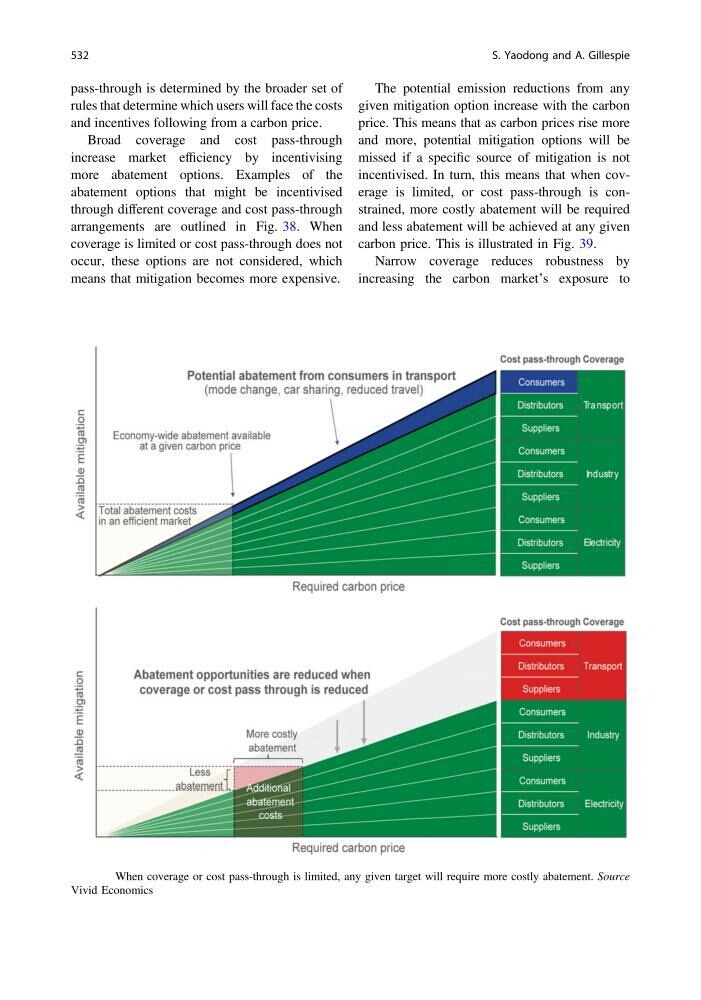
incentivised. In turn, this means that when coverage is limited, or cost pass-through is constrained, more costly abatement will be required
and less abatement will be achieved at any given
carbon price. This is illustrated in Fig. 39.
Narrow coverage reduces robustness by
increasing the carbon market’s exposure to
Fig. 39 When coverage or cost pass-through is limited, any given target will require more costly abatement. Source
Vivid Economics
532
S. Yaodong and A. Gillespie
rules that determine which users will face the costs
and incentives following from a carbon price.
Broad coverage and cost pass-through
increase market efficiency by incentivising
more abatement options. Examples of the
abatement options that might be incentivised
through different coverage and cost pass-through
arrangements are outlined in Fig. 38. When
coverage is limited or cost pass-through does not
occur, these options are not considered, which
means that mitigation becomes more expensive.
The potential emission reductions from any
given mitigation option increase with the carbon
price. This means that as carbon prices rise more
and more, potential mitigation options will be
missed if a specific source of mitigation is not
incentivised. In turn, this means that when coverage is limited, or cost pass-through is constrained, more costly abatement will be required
and less abatement will be achieved at any given
carbon price. This is illustrated in Fig. 39.
Narrow coverage reduces robustness by
increasing the carbon market’s exposure to
Fig. 39 When coverage or cost pass-through is limited, any given target will require more costly abatement. Source
Vivid Economics
532
S. Yaodong and A. Gillespie