

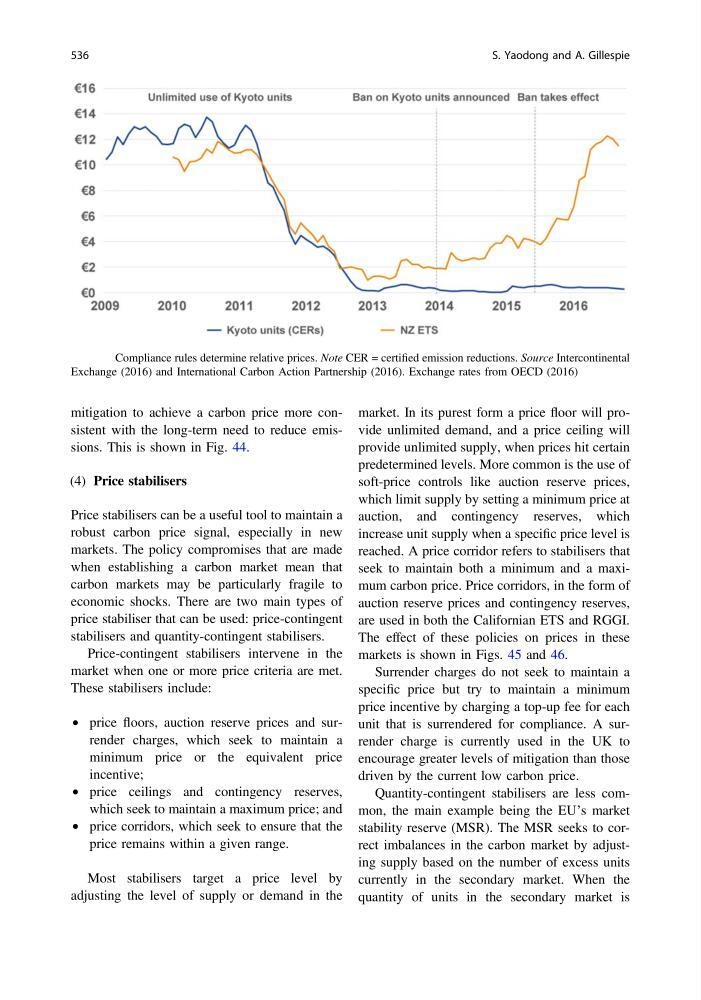
mitigation to achieve a carbon price more consistent with the long-term need to reduce emissions. This is shown in Fig. 44.
(4) Price stabilisers
Price stabilisers can be a useful tool to maintain a
robust carbon price signal, especially in new
markets. The policy compromises that are made
when establishing a carbon market mean that
carbon markets may be particularly fragile to
economic shocks. There are two main types of
price stabiliser that can be used: price-contingent
stabilisers and quantity-contingent stabilisers.
Price-contingent stabilisers intervene in the
market when one or more price criteria are met.
These stabilisers include:
• price floors, auction reserve prices and surrender charges, which seek to maintain a
minimum price or the equivalent price
incentive;
• price ceilings and contingency reserves,
which seek to maintain a maximum price; and
• price corridors, which seek to ensure that the
price remains within a given range.
Most stabilisers target a price level by
adjusting the level of supply or demand in the
market. In its purest form a price floor will provide unlimited demand, and a price ceiling will
provide unlimited supply, when prices hit certain
predetermined levels. More common is the use of
soft-price controls like auction reserve prices,
which limit supply by setting a minimum price at
auction, and contingency reserves, which
increase unit supply when a specific price level is
reached. A price corridor refers to stabilisers that
seek to maintain both a minimum and a maximum carbon price. Price corridors, in the form of
auction reserve prices and contingency reserves,
are used in both the Californian ETS and RGGI.
The effect of these policies on prices in these
markets is shown in Figs. 45 and 46.
Surrender charges do not seek to maintain a
specific price but try to maintain a minimum
price incentive by charging a top-up fee for each
unit that is surrendered for compliance. A surrender charge is currently used in the UK to
encourage greater levels of mitigation than those
driven by the current low carbon price.
Quantity-contingent stabilisers are less common, the main example being the EU’s market
stability reserve (MSR). The MSR seeks to correct imbalances in the carbon market by adjusting supply based on the number of excess units
currently in the secondary market. When the
quantity of units in the secondary market is
Fig. 44 Compliance rules determine relative prices. Note CER = certified emission reductions. Source Intercontinental
Exchange (2016) and International Carbon Action Partnership (2016). Exchange rates from OECD (2016)
536
S. Yaodong and A. Gillespie
(4) Price stabilisers
Price stabilisers can be a useful tool to maintain a
robust carbon price signal, especially in new
markets. The policy compromises that are made
when establishing a carbon market mean that
carbon markets may be particularly fragile to
economic shocks. There are two main types of
price stabiliser that can be used: price-contingent
stabilisers and quantity-contingent stabilisers.
Price-contingent stabilisers intervene in the
market when one or more price criteria are met.
These stabilisers include:
• price floors, auction reserve prices and surrender charges, which seek to maintain a
minimum price or the equivalent price
incentive;
• price ceilings and contingency reserves,
which seek to maintain a maximum price; and
• price corridors, which seek to ensure that the
price remains within a given range.
Most stabilisers target a price level by
adjusting the level of supply or demand in the
market. In its purest form a price floor will provide unlimited demand, and a price ceiling will
provide unlimited supply, when prices hit certain
predetermined levels. More common is the use of
soft-price controls like auction reserve prices,
which limit supply by setting a minimum price at
auction, and contingency reserves, which
increase unit supply when a specific price level is
reached. A price corridor refers to stabilisers that
seek to maintain both a minimum and a maximum carbon price. Price corridors, in the form of
auction reserve prices and contingency reserves,
are used in both the Californian ETS and RGGI.
The effect of these policies on prices in these
markets is shown in Figs. 45 and 46.
Surrender charges do not seek to maintain a
specific price but try to maintain a minimum
price incentive by charging a top-up fee for each
unit that is surrendered for compliance. A surrender charge is currently used in the UK to
encourage greater levels of mitigation than those
driven by the current low carbon price.
Quantity-contingent stabilisers are less common, the main example being the EU’s market
stability reserve (MSR). The MSR seeks to correct imbalances in the carbon market by adjusting supply based on the number of excess units
currently in the secondary market. When the
quantity of units in the secondary market is
Fig. 44 Compliance rules determine relative prices. Note CER = certified emission reductions. Source Intercontinental
Exchange (2016) and International Carbon Action Partnership (2016). Exchange rates from OECD (2016)
536
S. Yaodong and A. Gillespie