

of charge, to offset potential impacts on competitiveness and avoid carbon leakage. Carbon
leakage may occur when domestic companies are
unable to pass on their cost increases because of
competition from companies overseas that are
not subject to an equivalent carbon price. This
can mean that emission reductions that occur
domestically are offset by emission increases
overseas, as production can transfer to jurisdictions with a lower—or no—carbon price.
When allocations are done poorly, they can
contribute to overallocation, which can increase
the fragility of the carbon pricing system. There
are two main approaches to free allocations:
• grandparenting, where assistance is tied to
historical emissions; and
• production-based
benchmarking,
where
assistance is tied to the level of actual
production.
Grandparenting on its own does not cause
overallocation. However, it is often part of a
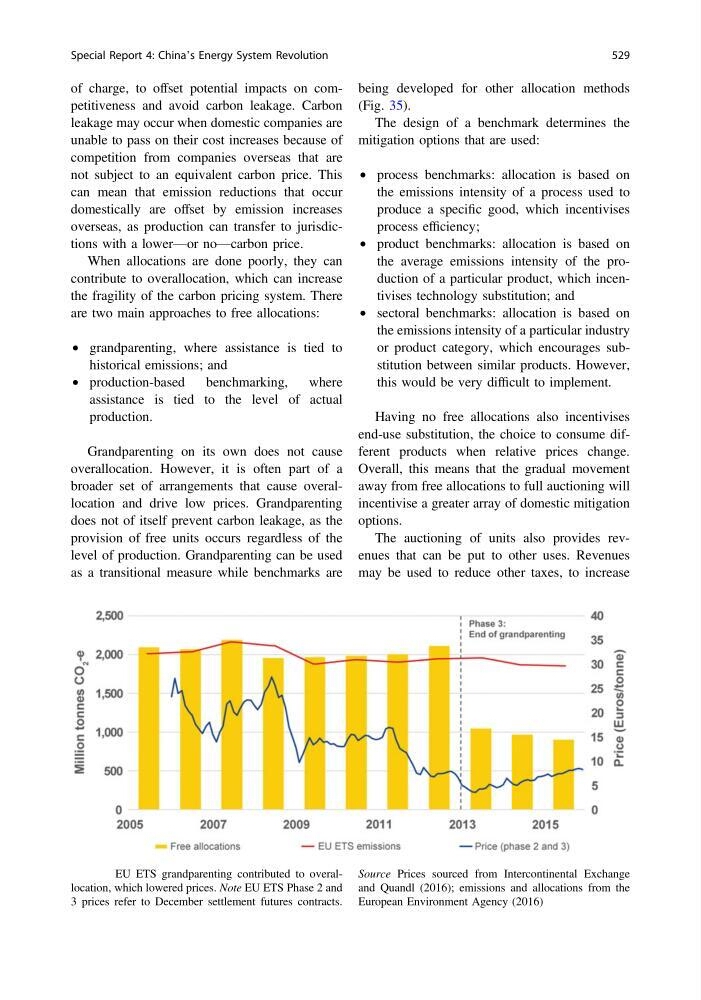
broader set of arrangements that cause overallocation and drive low prices. Grandparenting
does not of itself prevent carbon leakage, as the
provision of free units occurs regardless of the
level of production. Grandparenting can be used
as a transitional measure while benchmarks are
being developed for other allocation methods
(Fig. 35).
The design of a benchmark determines the
mitigation options that are used:
• process benchmarks: allocation is based on
the emissions intensity of a process used to
produce a specific good, which incentivises
process efficiency;
• product benchmarks: allocation is based on
the average emissions intensity of the production of a particular product, which incentivises technology substitution; and
• sectoral benchmarks: allocation is based on
the emissions intensity of a particular industry
or product category, which encourages substitution between similar products. However,
this would be very difficult to implement.
Having no free allocations also incentivises
end-use substitution, the choice to consume different products when relative prices change.
Overall, this means that the gradual movement
away from free allocations to full auctioning will
incentivise a greater array of domestic mitigation
options.
The auctioning of units also provides revenues that can be put to other uses. Revenues
may be used to reduce other taxes, to increase
Fig. 35 EU ETS grandparenting contributed to overallocation, which lowered prices. Note EU ETS Phase 2 and
3 prices refer to December settlement futures contracts.
Source Prices sourced from Intercontinental Exchange
and Quandl (2016); emissions and allocations from the
European Environment Agency (2016)
Special Report 4: China’s Energy System Revolution
529
leakage may occur when domestic companies are
unable to pass on their cost increases because of
competition from companies overseas that are
not subject to an equivalent carbon price. This
can mean that emission reductions that occur
domestically are offset by emission increases
overseas, as production can transfer to jurisdictions with a lower—or no—carbon price.
When allocations are done poorly, they can
contribute to overallocation, which can increase
the fragility of the carbon pricing system. There
are two main approaches to free allocations:
• grandparenting, where assistance is tied to
historical emissions; and
• production-based
benchmarking,
where
assistance is tied to the level of actual
production.
Grandparenting on its own does not cause
overallocation. However, it is often part of a
broader set of arrangements that cause overallocation and drive low prices. Grandparenting
does not of itself prevent carbon leakage, as the
provision of free units occurs regardless of the
level of production. Grandparenting can be used
as a transitional measure while benchmarks are
being developed for other allocation methods
(Fig. 35).
The design of a benchmark determines the
mitigation options that are used:
• process benchmarks: allocation is based on
the emissions intensity of a process used to
produce a specific good, which incentivises
process efficiency;
• product benchmarks: allocation is based on
the average emissions intensity of the production of a particular product, which incentivises technology substitution; and
• sectoral benchmarks: allocation is based on
the emissions intensity of a particular industry
or product category, which encourages substitution between similar products. However,
this would be very difficult to implement.
Having no free allocations also incentivises
end-use substitution, the choice to consume different products when relative prices change.
Overall, this means that the gradual movement
away from free allocations to full auctioning will
incentivise a greater array of domestic mitigation
options.
The auctioning of units also provides revenues that can be put to other uses. Revenues
may be used to reduce other taxes, to increase
Fig. 35 EU ETS grandparenting contributed to overallocation, which lowered prices. Note EU ETS Phase 2 and
3 prices refer to December settlement futures contracts.
Source Prices sourced from Intercontinental Exchange
and Quandl (2016); emissions and allocations from the
European Environment Agency (2016)
Special Report 4: China’s Energy System Revolution
529