

8.3 International Experience
Creating a carbon market is a process of setting
rules for the creation of carbon units, deciding
how they should be distributed, establishing rules
for market governance and trade, and managing
interactions between the carbon market and other
policies:
• creating carbon units is the process of determining targets and caps;
• distributing carbon units involves deciding on
the level and manner of distribution of free
carbon units, and the use of revenue-raising
distribution mechanisms, such as auctions;
• governance includes rules regarding coverage
and cost pass-through, the banking of units,
the use of domestic and international offsets,
linking with other emissions trading systems,
the use of price controls and the impact of
design on the development of the secondary
market; and
• managing policy interactions involves considering the appropriate role of carbon price
and complementary, overlapping and countervailing policies.
8.3.1 Creating Carbon Units
Targets and coverage decisions will largely
determine an ETS’s cap—the number of carbon
units that can be created. Targets determine the
long-term trajectory of emissions in a jurisdiction, and therefore the long-term supply of units
in the carbon markets. Caps give the number of
emission units that are added to a carbon market
in each compliance period. They are generally
calculated as the target level of emissions less the
expected emissions from sectors that are not
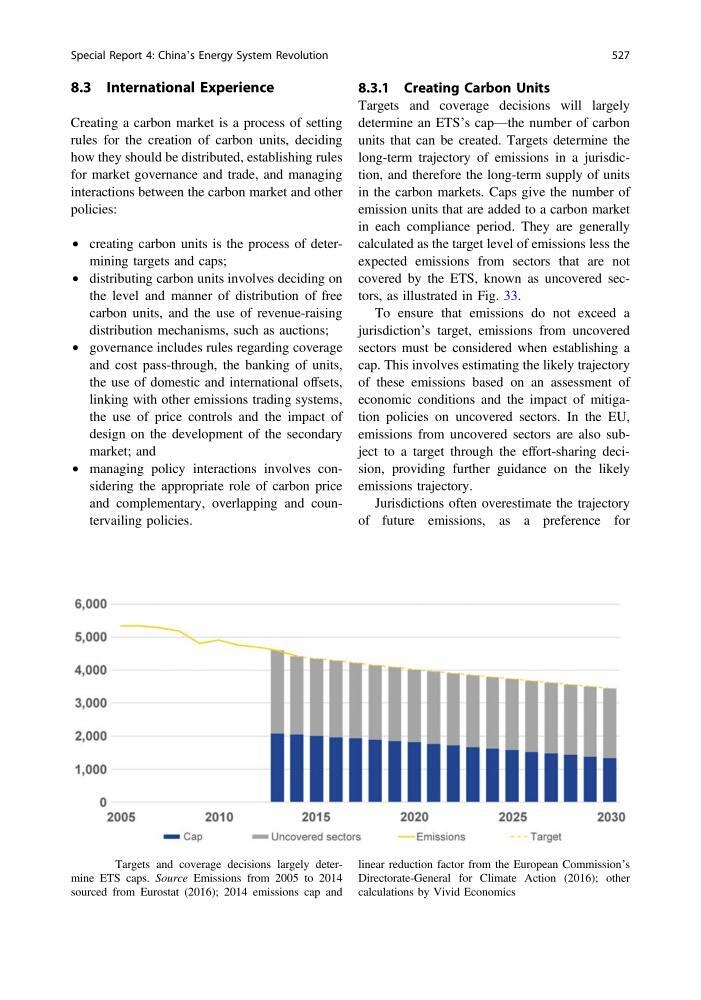
covered by the ETS, known as uncovered sectors, as illustrated in Fig. 33.
To ensure that emissions do not exceed a
jurisdiction’s target, emissions from uncovered
sectors must be considered when establishing a
cap. This involves estimating the likely trajectory
of these emissions based on an assessment of
economic conditions and the impact of mitigation policies on uncovered sectors. In the EU,
emissions from uncovered sectors are also subject to a target through the effort-sharing decision, providing further guidance on the likely
emissions trajectory.
Jurisdictions often overestimate the trajectory
of future emissions, as a preference for
Fig. 33 Targets and coverage decisions largely determine ETS caps. Source Emissions from 2005 to 2014
sourced from Eurostat (2016); 2014 emissions cap and
linear reduction factor from the European Commission’s
Directorate-General for Climate Action (2016); other
calculations by Vivid Economics
Special Report 4: China’s Energy System Revolution
527
Creating a carbon market is a process of setting
rules for the creation of carbon units, deciding
how they should be distributed, establishing rules
for market governance and trade, and managing
interactions between the carbon market and other
policies:
• creating carbon units is the process of determining targets and caps;
• distributing carbon units involves deciding on
the level and manner of distribution of free
carbon units, and the use of revenue-raising
distribution mechanisms, such as auctions;
• governance includes rules regarding coverage
and cost pass-through, the banking of units,
the use of domestic and international offsets,
linking with other emissions trading systems,
the use of price controls and the impact of
design on the development of the secondary
market; and
• managing policy interactions involves considering the appropriate role of carbon price
and complementary, overlapping and countervailing policies.
8.3.1 Creating Carbon Units
Targets and coverage decisions will largely
determine an ETS’s cap—the number of carbon
units that can be created. Targets determine the
long-term trajectory of emissions in a jurisdiction, and therefore the long-term supply of units
in the carbon markets. Caps give the number of
emission units that are added to a carbon market
in each compliance period. They are generally
calculated as the target level of emissions less the
expected emissions from sectors that are not
covered by the ETS, known as uncovered sectors, as illustrated in Fig. 33.
To ensure that emissions do not exceed a
jurisdiction’s target, emissions from uncovered
sectors must be considered when establishing a
cap. This involves estimating the likely trajectory
of these emissions based on an assessment of
economic conditions and the impact of mitigation policies on uncovered sectors. In the EU,
emissions from uncovered sectors are also subject to a target through the effort-sharing decision, providing further guidance on the likely
emissions trajectory.
Jurisdictions often overestimate the trajectory
of future emissions, as a preference for
Fig. 33 Targets and coverage decisions largely determine ETS caps. Source Emissions from 2005 to 2014
sourced from Eurostat (2016); 2014 emissions cap and
linear reduction factor from the European Commission’s
Directorate-General for Climate Action (2016); other
calculations by Vivid Economics
Special Report 4: China’s Energy System Revolution
527