

assets, which have instead largely been incentivised through overlapping policy, such as minimum renewable energy generation requirements,
energy efficiency standards and feed-in tariffs.
China can draw on the lessons from international experience to avoid the transition trap and
develop a robust carbon market. If well designed,
carbon markets can be a cost-effective mechanism for achieving emission reductions alongside
attaining other objectives. International experience provides a range of lessons applicable to
China as it considers the role of carbon markets,
and how it can improve market design and
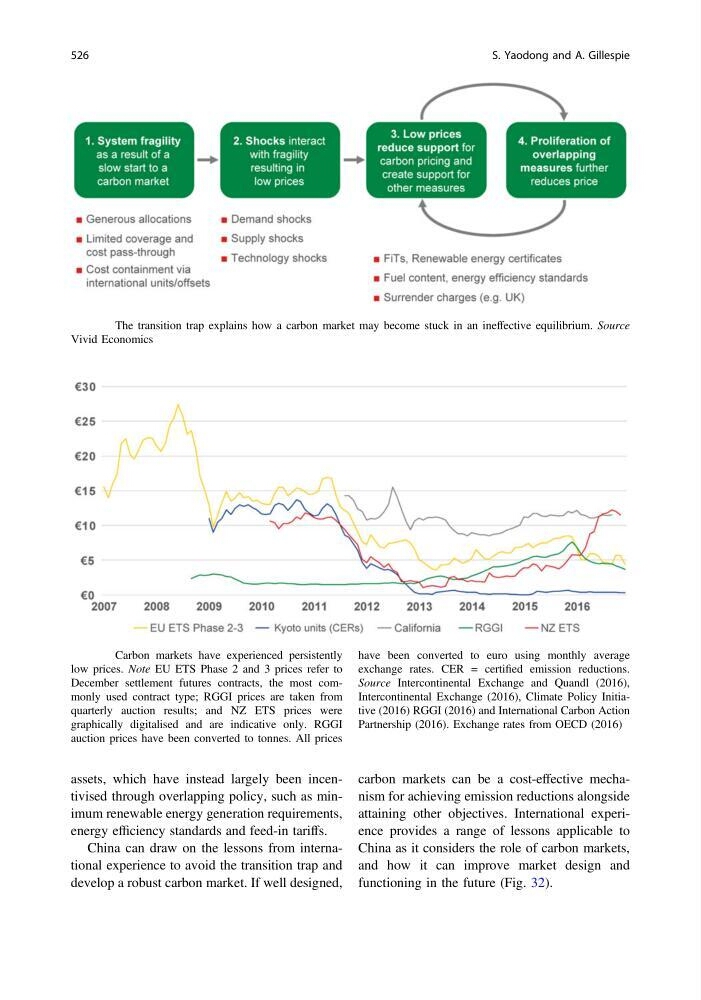
functioning in the future (Fig. 32).
Fig. 31 The transition trap explains how a carbon market may become stuck in an ineffective equilibrium. Source
Vivid Economics
Fig. 32 Carbon markets have experienced persistently
low prices. Note EU ETS Phase 2 and 3 prices refer to
December settlement futures contracts, the most commonly used contract type; RGGI prices are taken from
quarterly auction results; and NZ ETS prices were
graphically digitalised and are indicative only. RGGI
auction prices have been converted to tonnes. All prices
have been converted to euro using monthly average
exchange rates. CER = certified emission reductions.
Source Intercontinental Exchange and Quandl (2016),
Intercontinental Exchange (2016), Climate Policy Initiative (2016) RGGI (2016) and International Carbon Action
Partnership (2016). Exchange rates from OECD (2016)
526
S. Yaodong and A. Gillespie
energy efficiency standards and feed-in tariffs.
China can draw on the lessons from international experience to avoid the transition trap and
develop a robust carbon market. If well designed,
carbon markets can be a cost-effective mechanism for achieving emission reductions alongside
attaining other objectives. International experience provides a range of lessons applicable to
China as it considers the role of carbon markets,
and how it can improve market design and
functioning in the future (Fig. 32).
Fig. 31 The transition trap explains how a carbon market may become stuck in an ineffective equilibrium. Source
Vivid Economics
Fig. 32 Carbon markets have experienced persistently
low prices. Note EU ETS Phase 2 and 3 prices refer to
December settlement futures contracts, the most commonly used contract type; RGGI prices are taken from
quarterly auction results; and NZ ETS prices were
graphically digitalised and are indicative only. RGGI
auction prices have been converted to tonnes. All prices
have been converted to euro using monthly average
exchange rates. CER = certified emission reductions.
Source Intercontinental Exchange and Quandl (2016),
Intercontinental Exchange (2016), Climate Policy Initiative (2016) RGGI (2016) and International Carbon Action
Partnership (2016). Exchange rates from OECD (2016)
526
S. Yaodong and A. Gillespie