

reductions and emission reduction units,
which depressed prices in the EU ETS; and
• technology shocks: such as the shale gas
revolution that changed the structure of the
east-coast US energy industry and depressed
prices in the Regional Greenhouse Gas
Initiative.
Often policymakers will seek to limit opposition to a new policy through a slow start.
A slow start may have different elements in different contexts. However, most are characterised
by seeking to limit the reallocation of resources
between groups in the economy. For instance, a
slow start may see the grandparenting of free
allocations to existing firms, the limitation of
coverage to only a small set of emission sources,
or significant access to low-cost emission
reductions through the use of international units
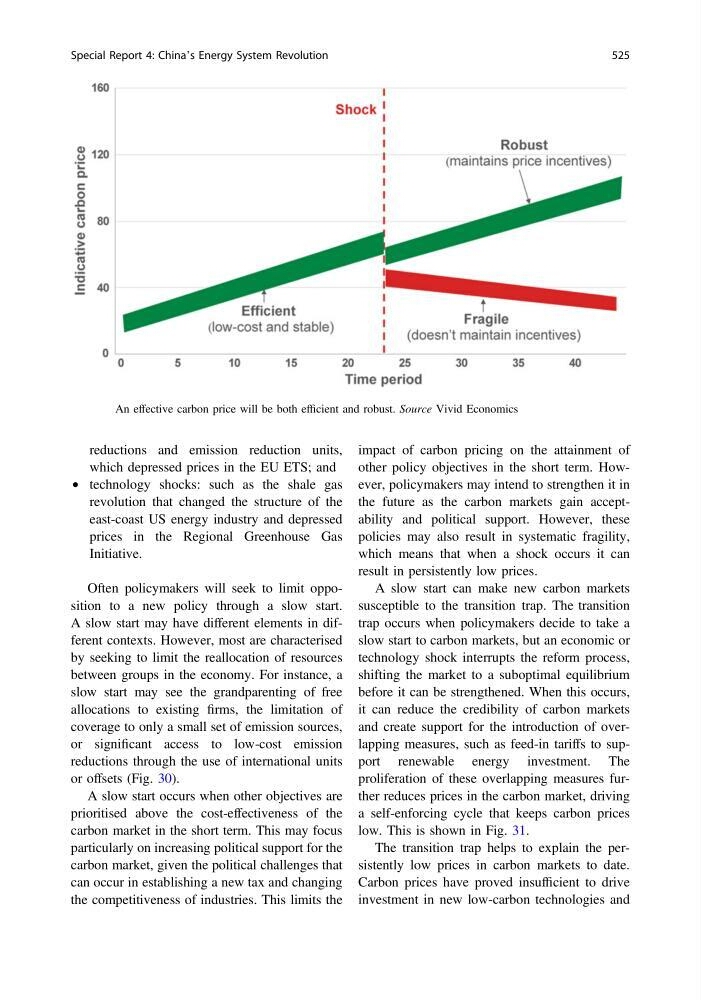
or offsets (Fig. 30).
A slow start occurs when other objectives are
prioritised above the cost-effectiveness of the
carbon market in the short term. This may focus
particularly on increasing political support for the
carbon market, given the political challenges that
can occur in establishing a new tax and changing
the competitiveness of industries. This limits the
impact of carbon pricing on the attainment of
other policy objectives in the short term. However, policymakers may intend to strengthen it in
the future as the carbon markets gain acceptability and political support. However, these
policies may also result in systematic fragility,
which means that when a shock occurs it can
result in persistently low prices.
A slow start can make new carbon markets
susceptible to the transition trap. The transition
trap occurs when policymakers decide to take a
slow start to carbon markets, but an economic or
technology shock interrupts the reform process,
shifting the market to a suboptimal equilibrium
before it can be strengthened. When this occurs,
it can reduce the credibility of carbon markets
and create support for the introduction of overlapping measures, such as feed-in tariffs to support renewable energy investment. The
proliferation of these overlapping measures further reduces prices in the carbon market, driving
a self-enforcing cycle that keeps carbon prices
low. This is shown in Fig. 31.
The transition trap helps to explain the persistently low prices in carbon markets to date.
Carbon prices have proved insufficient to drive
investment in new low-carbon technologies and
Fig. 30 An effective carbon price will be both efficient and robust. Source Vivid Economics
Special Report 4: China’s Energy System Revolution
525
which depressed prices in the EU ETS; and
• technology shocks: such as the shale gas
revolution that changed the structure of the
east-coast US energy industry and depressed
prices in the Regional Greenhouse Gas
Initiative.
Often policymakers will seek to limit opposition to a new policy through a slow start.
A slow start may have different elements in different contexts. However, most are characterised
by seeking to limit the reallocation of resources
between groups in the economy. For instance, a
slow start may see the grandparenting of free
allocations to existing firms, the limitation of
coverage to only a small set of emission sources,
or significant access to low-cost emission
reductions through the use of international units
or offsets (Fig. 30).
A slow start occurs when other objectives are
prioritised above the cost-effectiveness of the
carbon market in the short term. This may focus
particularly on increasing political support for the
carbon market, given the political challenges that
can occur in establishing a new tax and changing
the competitiveness of industries. This limits the
impact of carbon pricing on the attainment of
other policy objectives in the short term. However, policymakers may intend to strengthen it in
the future as the carbon markets gain acceptability and political support. However, these
policies may also result in systematic fragility,
which means that when a shock occurs it can
result in persistently low prices.
A slow start can make new carbon markets
susceptible to the transition trap. The transition
trap occurs when policymakers decide to take a
slow start to carbon markets, but an economic or
technology shock interrupts the reform process,
shifting the market to a suboptimal equilibrium
before it can be strengthened. When this occurs,
it can reduce the credibility of carbon markets
and create support for the introduction of overlapping measures, such as feed-in tariffs to support renewable energy investment. The
proliferation of these overlapping measures further reduces prices in the carbon market, driving
a self-enforcing cycle that keeps carbon prices
low. This is shown in Fig. 31.
The transition trap helps to explain the persistently low prices in carbon markets to date.
Carbon prices have proved insufficient to drive
investment in new low-carbon technologies and
Fig. 30 An effective carbon price will be both efficient and robust. Source Vivid Economics
Special Report 4: China’s Energy System Revolution
525