

preferred quantity of these objectives that would
be obtained with a given constraint.
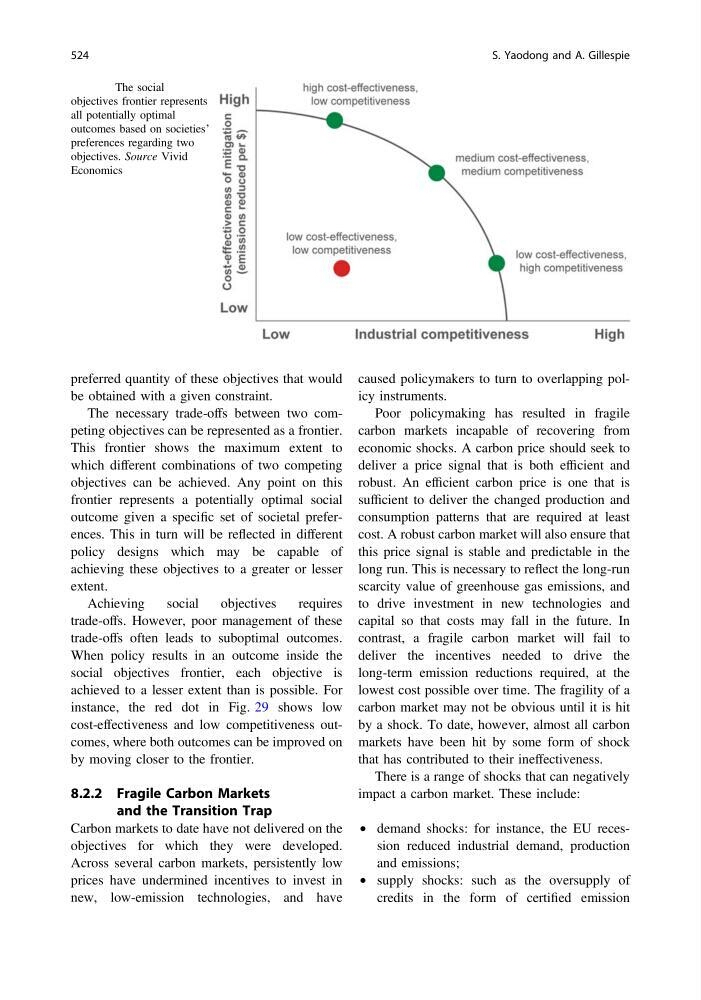
The necessary trade-offs between two competing objectives can be represented as a frontier.
This frontier shows the maximum extent to
which different combinations of two competing
objectives can be achieved. Any point on this
frontier represents a potentially optimal social
outcome given a specific set of societal preferences. This in turn will be reflected in different
policy designs which may be capable of
achieving these objectives to a greater or lesser
extent.
Achieving
social
objectives
requires
trade-offs. However, poor management of these
trade-offs often leads to suboptimal outcomes.
When policy results in an outcome inside the
social objectives frontier, each objective is
achieved to a lesser extent than is possible. For
instance, the red dot in Fig. 29 shows low
cost-effectiveness and low competitiveness outcomes, where both outcomes can be improved on
by moving closer to the frontier.
8.2.2 Fragile Carbon Markets
and the Transition Trap
Carbon markets to date have not delivered on the
objectives for which they were developed.
Across several carbon markets, persistently low
prices have undermined incentives to invest in
new, low-emission technologies, and have
caused policymakers to turn to overlapping policy instruments.
Poor policymaking has resulted in fragile
carbon markets incapable of recovering from
economic shocks. A carbon price should seek to
deliver a price signal that is both efficient and
robust. An efficient carbon price is one that is
sufficient to deliver the changed production and
consumption patterns that are required at least
cost. A robust carbon market will also ensure that
this price signal is stable and predictable in the
long run. This is necessary to reflect the long-run
scarcity value of greenhouse gas emissions, and
to drive investment in new technologies and
capital so that costs may fall in the future. In
contrast, a fragile carbon market will fail to
deliver the incentives needed to drive the
long-term emission reductions required, at the
lowest cost possible over time. The fragility of a
carbon market may not be obvious until it is hit
by a shock. To date, however, almost all carbon
markets have been hit by some form of shock
that has contributed to their ineffectiveness.
There is a range of shocks that can negatively
impact a carbon market. These include:
• demand shocks: for instance, the EU recession reduced industrial demand, production
and emissions;
• supply shocks: such as the oversupply of
credits in the form of certified emission
Fig. 29 The social
objectives frontier represents
all potentially optimal
outcomes based on societies’
preferences regarding two
objectives. Source Vivid
Economics
524
S. Yaodong and A. Gillespie
be obtained with a given constraint.
The necessary trade-offs between two competing objectives can be represented as a frontier.
This frontier shows the maximum extent to
which different combinations of two competing
objectives can be achieved. Any point on this
frontier represents a potentially optimal social
outcome given a specific set of societal preferences. This in turn will be reflected in different
policy designs which may be capable of
achieving these objectives to a greater or lesser
extent.
Achieving
social
objectives
requires
trade-offs. However, poor management of these
trade-offs often leads to suboptimal outcomes.
When policy results in an outcome inside the
social objectives frontier, each objective is
achieved to a lesser extent than is possible. For
instance, the red dot in Fig. 29 shows low
cost-effectiveness and low competitiveness outcomes, where both outcomes can be improved on
by moving closer to the frontier.
8.2.2 Fragile Carbon Markets
and the Transition Trap
Carbon markets to date have not delivered on the
objectives for which they were developed.
Across several carbon markets, persistently low
prices have undermined incentives to invest in
new, low-emission technologies, and have
caused policymakers to turn to overlapping policy instruments.
Poor policymaking has resulted in fragile
carbon markets incapable of recovering from
economic shocks. A carbon price should seek to
deliver a price signal that is both efficient and
robust. An efficient carbon price is one that is
sufficient to deliver the changed production and
consumption patterns that are required at least
cost. A robust carbon market will also ensure that
this price signal is stable and predictable in the
long run. This is necessary to reflect the long-run
scarcity value of greenhouse gas emissions, and
to drive investment in new technologies and
capital so that costs may fall in the future. In
contrast, a fragile carbon market will fail to
deliver the incentives needed to drive the
long-term emission reductions required, at the
lowest cost possible over time. The fragility of a
carbon market may not be obvious until it is hit
by a shock. To date, however, almost all carbon
markets have been hit by some form of shock
that has contributed to their ineffectiveness.
There is a range of shocks that can negatively
impact a carbon market. These include:
• demand shocks: for instance, the EU recession reduced industrial demand, production
and emissions;
• supply shocks: such as the oversupply of
credits in the form of certified emission
Fig. 29 The social
objectives frontier represents
all potentially optimal
outcomes based on societies’
preferences regarding two
objectives. Source Vivid
Economics
524
S. Yaodong and A. Gillespie