

development and commercialisation of
low-emission energy technologies;
• network effects, which may create barriers to
the expansion of low-emission transport; and
• asymmetric information, which means that
opportunities to improve energy efficiency are
left untapped.
Different market failures may require different
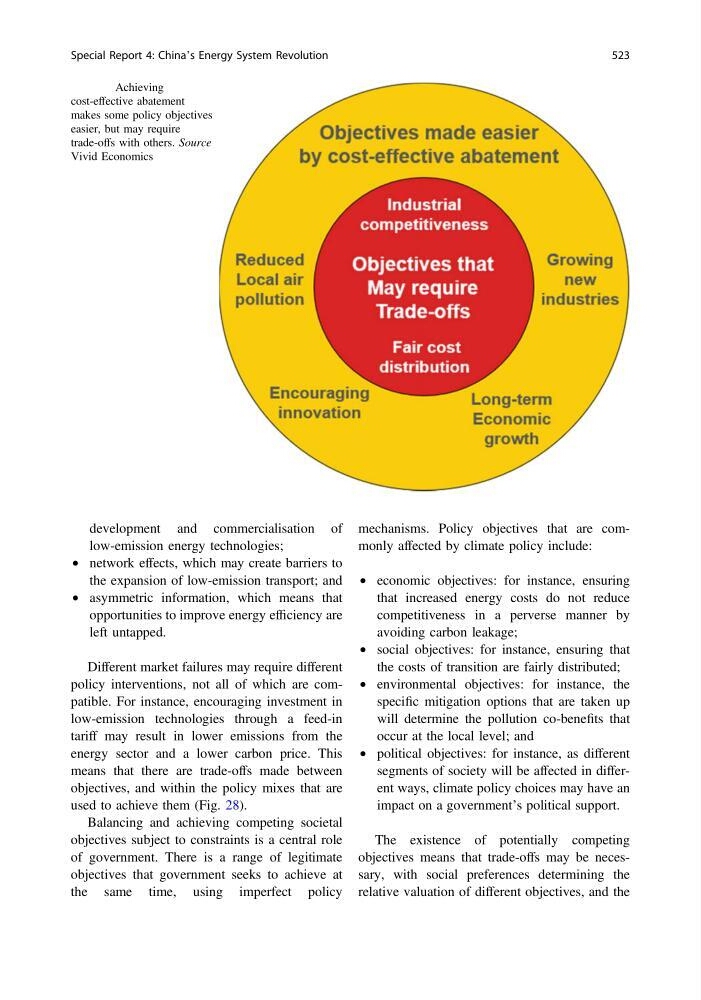
policy interventions, not all of which are compatible. For instance, encouraging investment in
low-emission technologies through a feed-in
tariff may result in lower emissions from the
energy sector and a lower carbon price. This
means that there are trade-offs made between
objectives, and within the policy mixes that are
used to achieve them (Fig. 28).
Balancing and achieving competing societal
objectives subject to constraints is a central role
of government. There is a range of legitimate
objectives that government seeks to achieve at
the same time, using imperfect policy
mechanisms. Policy objectives that are commonly affected by climate policy include:
• economic objectives: for instance, ensuring
that increased energy costs do not reduce
competitiveness in a perverse manner by
avoiding carbon leakage;
• social objectives: for instance, ensuring that
the costs of transition are fairly distributed;
• environmental objectives: for instance, the
specific mitigation options that are taken up
will determine the pollution co-benefits that
occur at the local level; and
• political objectives: for instance, as different
segments of society will be affected in different ways, climate policy choices may have an
impact on a government’s political support.
The existence of potentially competing
objectives means that trade-offs may be necessary, with social preferences determining the
relative valuation of different objectives, and the
Fig. 28 Achieving
cost-effective abatement
makes some policy objectives
easier, but may require
trade-offs with others. Source
Vivid Economics
Special Report 4: China’s Energy System Revolution
523
low-emission energy technologies;
• network effects, which may create barriers to
the expansion of low-emission transport; and
• asymmetric information, which means that
opportunities to improve energy efficiency are
left untapped.
Different market failures may require different
policy interventions, not all of which are compatible. For instance, encouraging investment in
low-emission technologies through a feed-in
tariff may result in lower emissions from the
energy sector and a lower carbon price. This
means that there are trade-offs made between
objectives, and within the policy mixes that are
used to achieve them (Fig. 28).
Balancing and achieving competing societal
objectives subject to constraints is a central role
of government. There is a range of legitimate
objectives that government seeks to achieve at
the same time, using imperfect policy
mechanisms. Policy objectives that are commonly affected by climate policy include:
• economic objectives: for instance, ensuring
that increased energy costs do not reduce
competitiveness in a perverse manner by
avoiding carbon leakage;
• social objectives: for instance, ensuring that
the costs of transition are fairly distributed;
• environmental objectives: for instance, the
specific mitigation options that are taken up
will determine the pollution co-benefits that
occur at the local level; and
• political objectives: for instance, as different
segments of society will be affected in different ways, climate policy choices may have an
impact on a government’s political support.
The existence of potentially competing
objectives means that trade-offs may be necessary, with social preferences determining the
relative valuation of different objectives, and the
Fig. 28 Achieving
cost-effective abatement
makes some policy objectives
easier, but may require
trade-offs with others. Source
Vivid Economics
Special Report 4: China’s Energy System Revolution
523