

By reducing the costs of achieving climate mitigation, more of a society’s resources can be
devoted to achieving other objectives.
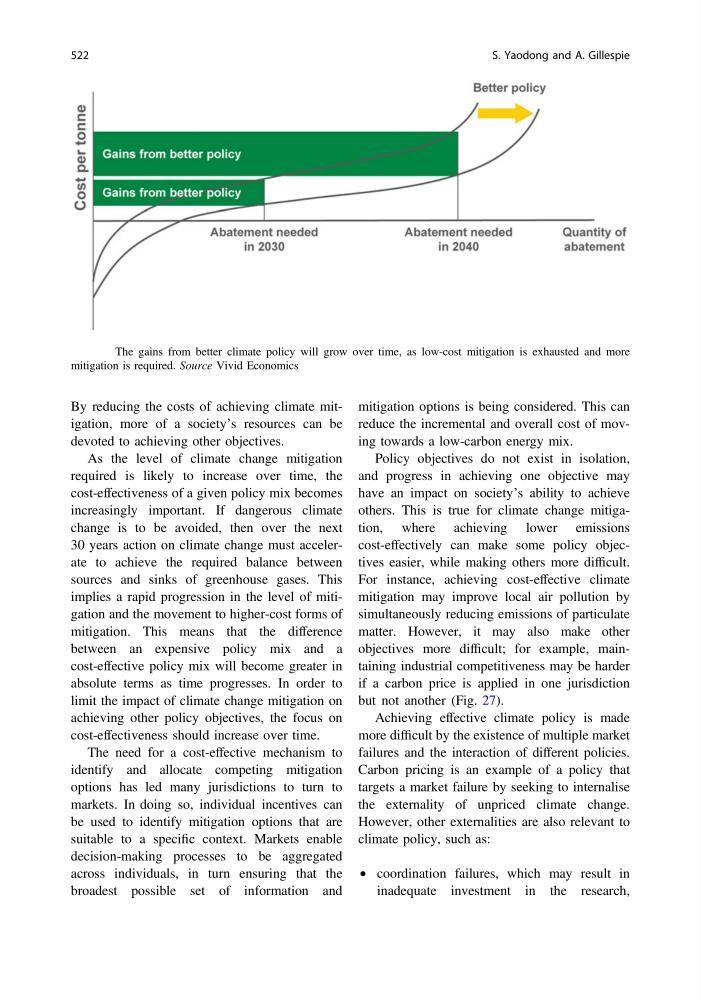
As the level of climate change mitigation
required is likely to increase over time, the
cost-effectiveness of a given policy mix becomes
increasingly important. If dangerous climate
change is to be avoided, then over the next
30 years action on climate change must accelerate to achieve the required balance between
sources and sinks of greenhouse gases. This
implies a rapid progression in the level of mitigation and the movement to higher-cost forms of
mitigation. This means that the difference
between an expensive policy mix and a
cost-effective policy mix will become greater in
absolute terms as time progresses. In order to
limit the impact of climate change mitigation on
achieving other policy objectives, the focus on
cost-effectiveness should increase over time.
The need for a cost-effective mechanism to
identify and allocate competing mitigation
options has led many jurisdictions to turn to
markets. In doing so, individual incentives can
be used to identify mitigation options that are
suitable to a specific context. Markets enable
decision-making processes to be aggregated
across individuals, in turn ensuring that the
broadest possible set of information and
mitigation options is being considered. This can
reduce the incremental and overall cost of moving towards a low-carbon energy mix.
Policy objectives do not exist in isolation,
and progress in achieving one objective may
have an impact on society’s ability to achieve
others. This is true for climate change mitigation, where achieving lower emissions
cost-effectively can make some policy objectives easier, while making others more difficult.
For instance, achieving cost-effective climate
mitigation may improve local air pollution by
simultaneously reducing emissions of particulate
matter. However, it may also make other
objectives more difficult; for example, maintaining industrial competitiveness may be harder
if a carbon price is applied in one jurisdiction
but not another (Fig. 27).
Achieving effective climate policy is made
more difficult by the existence of multiple market
failures and the interaction of different policies.
Carbon pricing is an example of a policy that
targets a market failure by seeking to internalise
the externality of unpriced climate change.
However, other externalities are also relevant to
climate policy, such as:
• coordination failures, which may result in
inadequate investment in the research,
Fig. 27 The gains from better climate policy will grow over time, as low-cost mitigation is exhausted and more
mitigation is required. Source Vivid Economics
522
S. Yaodong and A. Gillespie
devoted to achieving other objectives.
As the level of climate change mitigation
required is likely to increase over time, the
cost-effectiveness of a given policy mix becomes
increasingly important. If dangerous climate
change is to be avoided, then over the next
30 years action on climate change must accelerate to achieve the required balance between
sources and sinks of greenhouse gases. This
implies a rapid progression in the level of mitigation and the movement to higher-cost forms of
mitigation. This means that the difference
between an expensive policy mix and a
cost-effective policy mix will become greater in
absolute terms as time progresses. In order to
limit the impact of climate change mitigation on
achieving other policy objectives, the focus on
cost-effectiveness should increase over time.
The need for a cost-effective mechanism to
identify and allocate competing mitigation
options has led many jurisdictions to turn to
markets. In doing so, individual incentives can
be used to identify mitigation options that are
suitable to a specific context. Markets enable
decision-making processes to be aggregated
across individuals, in turn ensuring that the
broadest possible set of information and
mitigation options is being considered. This can
reduce the incremental and overall cost of moving towards a low-carbon energy mix.
Policy objectives do not exist in isolation,
and progress in achieving one objective may
have an impact on society’s ability to achieve
others. This is true for climate change mitigation, where achieving lower emissions
cost-effectively can make some policy objectives easier, while making others more difficult.
For instance, achieving cost-effective climate
mitigation may improve local air pollution by
simultaneously reducing emissions of particulate
matter. However, it may also make other
objectives more difficult; for example, maintaining industrial competitiveness may be harder
if a carbon price is applied in one jurisdiction
but not another (Fig. 27).
Achieving effective climate policy is made
more difficult by the existence of multiple market
failures and the interaction of different policies.
Carbon pricing is an example of a policy that
targets a market failure by seeking to internalise
the externality of unpriced climate change.
However, other externalities are also relevant to
climate policy, such as:
• coordination failures, which may result in
inadequate investment in the research,
Fig. 27 The gains from better climate policy will grow over time, as low-cost mitigation is exhausted and more
mitigation is required. Source Vivid Economics
522
S. Yaodong and A. Gillespie