

companies, and plays an important guiding role
in standardising the power sales market. Its main
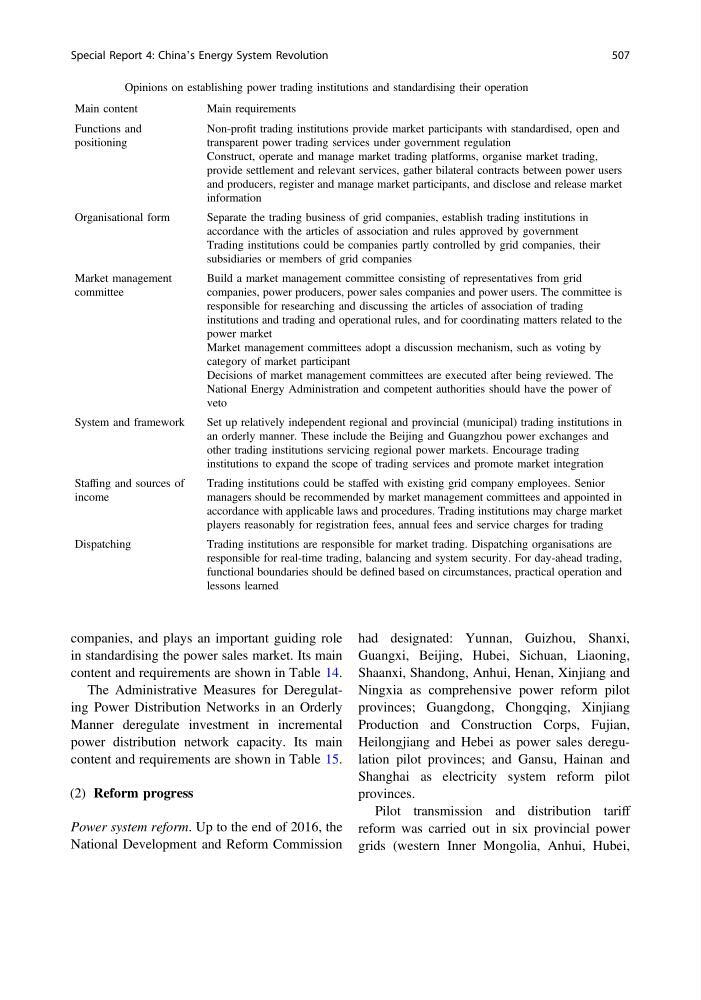
content and requirements are shown in Table 14.
The Administrative Measures for Deregulating Power Distribution Networks in an Orderly
Manner deregulate investment in incremental
power distribution network capacity. Its main
content and requirements are shown in Table 15.
(2) Reform progress
Power system reform. Up to the end of 2016, the
National Development and Reform Commission
had designated: Yunnan, Guizhou, Shanxi,
Guangxi, Beijing, Hubei, Sichuan, Liaoning,
Shaanxi, Shandong, Anhui, Henan, Xinjiang and
Ningxia as comprehensive power reform pilot
provinces; Guangdong, Chongqing, Xinjiang
Production and Construction Corps, Fujian,
Heilongjiang and Hebei as power sales deregulation pilot provinces; and Gansu, Hainan and
Shanghai as electricity system reform pilot
provinces.
Pilot transmission and distribution tariff
reform was carried out in six provincial power
grids (western Inner Mongolia, Anhui, Hubei,
Table 10 Opinions on establishing power trading institutions and standardising their operation
Main content
Main requirements
Functions and
positioning
Non-profit trading institutions provide market participants with standardised, open and
transparent power trading services under government regulation
Construct, operate and manage market trading platforms, organise market trading,
provide settlement and relevant services, gather bilateral contracts between power users
and producers, register and manage market participants, and disclose and release market
information
Organisational form
Separate the trading business of grid companies, establish trading institutions in
accordance with the articles of association and rules approved by government
Trading institutions could be companies partly controlled by grid companies, their
subsidiaries or members of grid companies
Market management
committee
Build a market management committee consisting of representatives from grid
companies, power producers, power sales companies and power users. The committee is
responsible for researching and discussing the articles of association of trading
institutions and trading and operational rules, and for coordinating matters related to the
power market
Market management committees adopt a discussion mechanism, such as voting by
category of market participant
Decisions of market management committees are executed after being reviewed. The
National Energy Administration and competent authorities should have the power of
veto
System and framework
Set up relatively independent regional and provincial (municipal) trading institutions in
an orderly manner. These include the Beijing and Guangzhou power exchanges and
other trading institutions servicing regional power markets. Encourage trading
institutions to expand the scope of trading services and promote market integration
Staffing and sources of
income
Trading institutions could be staffed with existing grid company employees. Senior
managers should be recommended by market management committees and appointed in
accordance with applicable laws and procedures. Trading institutions may charge market
players reasonably for registration fees, annual fees and service charges for trading
Dispatching
Trading institutions are responsible for market trading. Dispatching organisations are
responsible for real-time trading, balancing and system security. For day-ahead trading,
functional boundaries should be defined based on circumstances, practical operation and
lessons learned
Special Report 4: China’s Energy System Revolution
507
in standardising the power sales market. Its main
content and requirements are shown in Table 14.
The Administrative Measures for Deregulating Power Distribution Networks in an Orderly
Manner deregulate investment in incremental
power distribution network capacity. Its main
content and requirements are shown in Table 15.
(2) Reform progress
Power system reform. Up to the end of 2016, the
National Development and Reform Commission
had designated: Yunnan, Guizhou, Shanxi,
Guangxi, Beijing, Hubei, Sichuan, Liaoning,
Shaanxi, Shandong, Anhui, Henan, Xinjiang and
Ningxia as comprehensive power reform pilot
provinces; Guangdong, Chongqing, Xinjiang
Production and Construction Corps, Fujian,
Heilongjiang and Hebei as power sales deregulation pilot provinces; and Gansu, Hainan and
Shanghai as electricity system reform pilot
provinces.
Pilot transmission and distribution tariff
reform was carried out in six provincial power
grids (western Inner Mongolia, Anhui, Hubei,
Table 10 Opinions on establishing power trading institutions and standardising their operation
Main content
Main requirements
Functions and
positioning
Non-profit trading institutions provide market participants with standardised, open and
transparent power trading services under government regulation
Construct, operate and manage market trading platforms, organise market trading,
provide settlement and relevant services, gather bilateral contracts between power users
and producers, register and manage market participants, and disclose and release market
information
Organisational form
Separate the trading business of grid companies, establish trading institutions in
accordance with the articles of association and rules approved by government
Trading institutions could be companies partly controlled by grid companies, their
subsidiaries or members of grid companies
Market management
committee
Build a market management committee consisting of representatives from grid
companies, power producers, power sales companies and power users. The committee is
responsible for researching and discussing the articles of association of trading
institutions and trading and operational rules, and for coordinating matters related to the
power market
Market management committees adopt a discussion mechanism, such as voting by
category of market participant
Decisions of market management committees are executed after being reviewed. The
National Energy Administration and competent authorities should have the power of
veto
System and framework
Set up relatively independent regional and provincial (municipal) trading institutions in
an orderly manner. These include the Beijing and Guangzhou power exchanges and
other trading institutions servicing regional power markets. Encourage trading
institutions to expand the scope of trading services and promote market integration
Staffing and sources of
income
Trading institutions could be staffed with existing grid company employees. Senior
managers should be recommended by market management committees and appointed in
accordance with applicable laws and procedures. Trading institutions may charge market
players reasonably for registration fees, annual fees and service charges for trading
Dispatching
Trading institutions are responsible for market trading. Dispatching organisations are
responsible for real-time trading, balancing and system security. For day-ahead trading,
functional boundaries should be defined based on circumstances, practical operation and
lessons learned
Special Report 4: China’s Energy System Revolution
507