

power trading institutions. Its main content and
key requirements are shown in Table 10.
The Opinions on Implementing an Orderly
Liberalisation of Power Generation and Consumption Planning lists the following objectives:
(i) build a power operation mechanism that features orderly competition and is strongly supported, and that shifts the power system
gradually from plan-oriented to one in which the
market plays a decisive role; (ii) ensure power
supply to households and other users who do not
have bargaining power by establishing a power
generation and purchase priority mechanism,
granting preferential grid access for public and
peak-shaving purposes. The main content and
requirements of the document are shown in
Table 11.
The Opinions on Promoting Power Sales
Reform has the following objectives: introduce
competition into power sales, open power sales
to private capital, expand user choice, develop
power sellers in different ways, and form a
competition-based environment of diversified
buyers and sellers. Its main content and
requirements are shown in Table 12.
The main objectives of the Guidance on
Strengthening and Standardising the Supervision
and Management of Privately Owned Coal-Fired
Power Plants are: gradually make privately
owned power plants equal with state-owned
power plants, promote the orderly development
of privately owned power plants, increase the
absorption of clean energy, improve energy use
efficiency, and ensure fair market competition. Its
main content and requirements are shown in
Table 13.
The Administrative Measures for Access and
Withdrawal of Electricity Sales Companies provides clear stipulations on access, exit, classification and scope of business of power sales
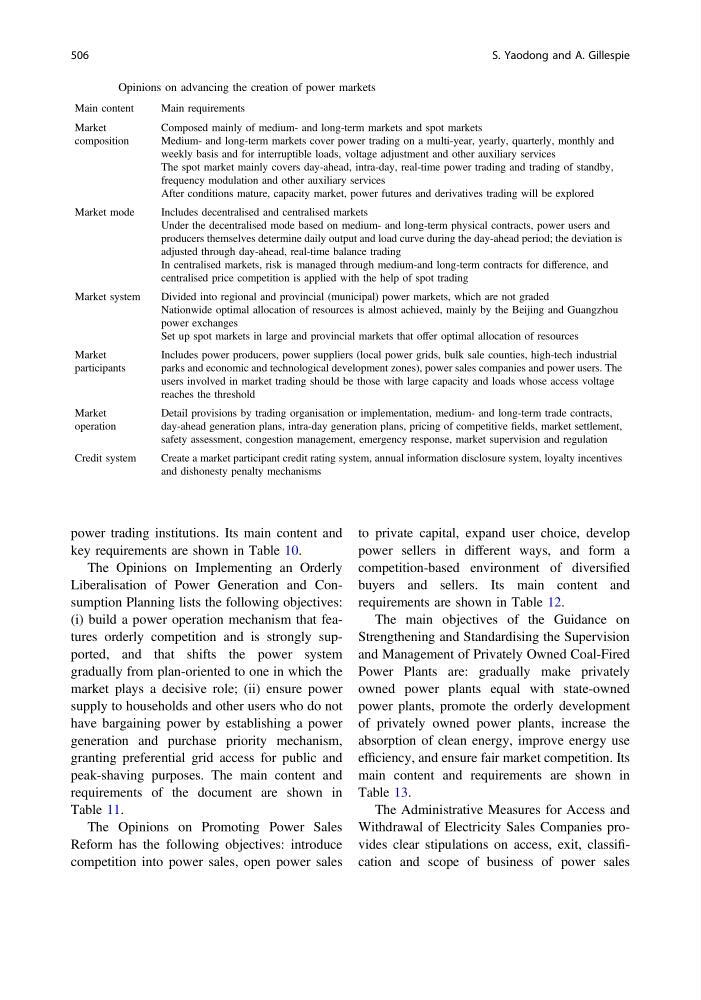
Table 9 Opinions on advancing the creation of power markets
Main content
Main requirements
Market
composition
Composed mainly of medium- and long-term markets and spot markets
Medium- and long-term markets cover power trading on a multi-year, yearly, quarterly, monthly and
weekly basis and for interruptible loads, voltage adjustment and other auxiliary services
The spot market mainly covers day-ahead, intra-day, real-time power trading and trading of standby,
frequency modulation and other auxiliary services
After conditions mature, capacity market, power futures and derivatives trading will be explored
Market mode
Includes decentralised and centralised markets
Under the decentralised mode based on medium- and long-term physical contracts, power users and
producers themselves determine daily output and load curve during the day-ahead period; the deviation is
adjusted through day-ahead, real-time balance trading
In centralised markets, risk is managed through medium-and long-term contracts for difference, and
centralised price competition is applied with the help of spot trading
Market system
Divided into regional and provincial (municipal) power markets, which are not graded
Nationwide optimal allocation of resources is almost achieved, mainly by the Beijing and Guangzhou
power exchanges
Set up spot markets in large and provincial markets that offer optimal allocation of resources
Market
participants
Includes power producers, power suppliers (local power grids, bulk sale counties, high-tech industrial
parks and economic and technological development zones), power sales companies and power users. The
users involved in market trading should be those with large capacity and loads whose access voltage
reaches the threshold
Market
operation
Detail provisions by trading organisation or implementation, medium- and long-term trade contracts,
day-ahead generation plans, intra-day generation plans, pricing of competitive fields, market settlement,
safety assessment, congestion management, emergency response, market supervision and regulation
Credit system
Create a market participant credit rating system, annual information disclosure system, loyalty incentives
and dishonesty penalty mechanisms
506
S. Yaodong and A. Gillespie
key requirements are shown in Table 10.
The Opinions on Implementing an Orderly
Liberalisation of Power Generation and Consumption Planning lists the following objectives:
(i) build a power operation mechanism that features orderly competition and is strongly supported, and that shifts the power system
gradually from plan-oriented to one in which the
market plays a decisive role; (ii) ensure power
supply to households and other users who do not
have bargaining power by establishing a power
generation and purchase priority mechanism,
granting preferential grid access for public and
peak-shaving purposes. The main content and
requirements of the document are shown in
Table 11.
The Opinions on Promoting Power Sales
Reform has the following objectives: introduce
competition into power sales, open power sales
to private capital, expand user choice, develop
power sellers in different ways, and form a
competition-based environment of diversified
buyers and sellers. Its main content and
requirements are shown in Table 12.
The main objectives of the Guidance on
Strengthening and Standardising the Supervision
and Management of Privately Owned Coal-Fired
Power Plants are: gradually make privately
owned power plants equal with state-owned
power plants, promote the orderly development
of privately owned power plants, increase the
absorption of clean energy, improve energy use
efficiency, and ensure fair market competition. Its
main content and requirements are shown in
Table 13.
The Administrative Measures for Access and
Withdrawal of Electricity Sales Companies provides clear stipulations on access, exit, classification and scope of business of power sales
Table 9 Opinions on advancing the creation of power markets
Main content
Main requirements
Market
composition
Composed mainly of medium- and long-term markets and spot markets
Medium- and long-term markets cover power trading on a multi-year, yearly, quarterly, monthly and
weekly basis and for interruptible loads, voltage adjustment and other auxiliary services
The spot market mainly covers day-ahead, intra-day, real-time power trading and trading of standby,
frequency modulation and other auxiliary services
After conditions mature, capacity market, power futures and derivatives trading will be explored
Market mode
Includes decentralised and centralised markets
Under the decentralised mode based on medium- and long-term physical contracts, power users and
producers themselves determine daily output and load curve during the day-ahead period; the deviation is
adjusted through day-ahead, real-time balance trading
In centralised markets, risk is managed through medium-and long-term contracts for difference, and
centralised price competition is applied with the help of spot trading
Market system
Divided into regional and provincial (municipal) power markets, which are not graded
Nationwide optimal allocation of resources is almost achieved, mainly by the Beijing and Guangzhou
power exchanges
Set up spot markets in large and provincial markets that offer optimal allocation of resources
Market
participants
Includes power producers, power suppliers (local power grids, bulk sale counties, high-tech industrial
parks and economic and technological development zones), power sales companies and power users. The
users involved in market trading should be those with large capacity and loads whose access voltage
reaches the threshold
Market
operation
Detail provisions by trading organisation or implementation, medium- and long-term trade contracts,
day-ahead generation plans, intra-day generation plans, pricing of competitive fields, market settlement,
safety assessment, congestion management, emergency response, market supervision and regulation
Credit system
Create a market participant credit rating system, annual information disclosure system, loyalty incentives
and dishonesty penalty mechanisms
506
S. Yaodong and A. Gillespie