

7.4.4 Progress in the New Round
of Power System Reform
(1) Reform policies
The ZhongFa No. 9 Document defines the targets
and tasks of China’s power system reform. The
six main support documents published in
November 2015 provide a specific working plan
for the reforms. The National Development and
Reform Commission and National Energy
Administration are formulating detailed rules for
their implementation. The Administrative Measures for Access and Withdrawal of Electricity
Sale Companies and Administrative Measures
for Orderly Deregulation of Power Distribution
Networks were released in October 2016.
The Opinions on Promoting Transmission and
Distribution Tariff Reform sets three objectives:
(i) build a reasonable, scientific, transparent and
independent transmission and distribution tariff
system that is well regulated with clear rules;
(ii) form a transmission and distribution pricing
mechanism based on the principle of “allowable
cost + reasonable profit”; and (iii) define government funds and cross-subsidies. The main
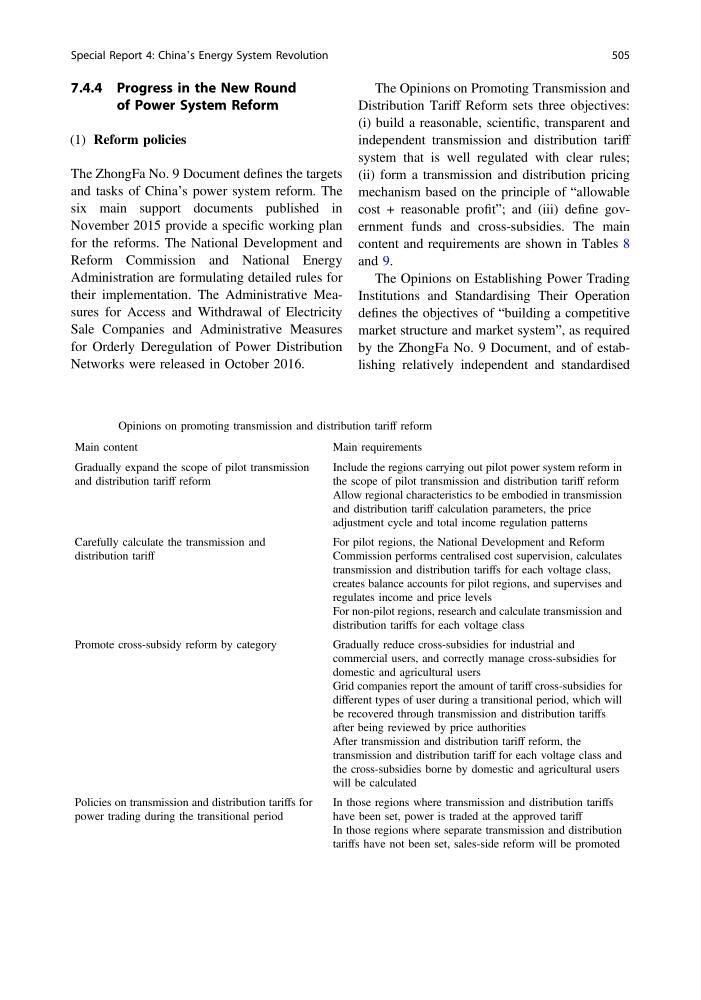
content and requirements are shown in Tables 8
and 9.
The Opinions on Establishing Power Trading
Institutions and Standardising Their Operation
defines the objectives of “building a competitive
market structure and market system”, as required
by the ZhongFa No. 9 Document, and of establishing relatively independent and standardised
Table 8 Opinions on promoting transmission and distribution tariff reform
Main content
Main requirements
Gradually expand the scope of pilot transmission
and distribution tariff reform
Include the regions carrying out pilot power system reform in
the scope of pilot transmission and distribution tariff reform
Allow regional characteristics to be embodied in transmission
and distribution tariff calculation parameters, the price
adjustment cycle and total income regulation patterns
Carefully calculate the transmission and
distribution tariff
For pilot regions, the National Development and Reform
Commission performs centralised cost supervision, calculates
transmission and distribution tariffs for each voltage class,
creates balance accounts for pilot regions, and supervises and
regulates income and price levels
For non-pilot regions, research and calculate transmission and
distribution tariffs for each voltage class
Promote cross-subsidy reform by category
Gradually reduce cross-subsidies for industrial and
commercial users, and correctly manage cross-subsidies for
domestic and agricultural users
Grid companies report the amount of tariff cross-subsidies for
different types of user during a transitional period, which will
be recovered through transmission and distribution tariffs
after being reviewed by price authorities
After transmission and distribution tariff reform, the
transmission and distribution tariff for each voltage class and
the cross-subsidies borne by domestic and agricultural users
will be calculated
Policies on transmission and distribution tariffs for
power trading during the transitional period
In those regions where transmission and distribution tariffs
have been set, power is traded at the approved tariff
In those regions where separate transmission and distribution
tariffs have not been set, sales-side reform will be promoted
Special Report 4: China’s Energy System Revolution
505
of Power System Reform
(1) Reform policies
The ZhongFa No. 9 Document defines the targets
and tasks of China’s power system reform. The
six main support documents published in
November 2015 provide a specific working plan
for the reforms. The National Development and
Reform Commission and National Energy
Administration are formulating detailed rules for
their implementation. The Administrative Measures for Access and Withdrawal of Electricity
Sale Companies and Administrative Measures
for Orderly Deregulation of Power Distribution
Networks were released in October 2016.
The Opinions on Promoting Transmission and
Distribution Tariff Reform sets three objectives:
(i) build a reasonable, scientific, transparent and
independent transmission and distribution tariff
system that is well regulated with clear rules;
(ii) form a transmission and distribution pricing
mechanism based on the principle of “allowable
cost + reasonable profit”; and (iii) define government funds and cross-subsidies. The main
content and requirements are shown in Tables 8
and 9.
The Opinions on Establishing Power Trading
Institutions and Standardising Their Operation
defines the objectives of “building a competitive
market structure and market system”, as required
by the ZhongFa No. 9 Document, and of establishing relatively independent and standardised
Table 8 Opinions on promoting transmission and distribution tariff reform
Main content
Main requirements
Gradually expand the scope of pilot transmission
and distribution tariff reform
Include the regions carrying out pilot power system reform in
the scope of pilot transmission and distribution tariff reform
Allow regional characteristics to be embodied in transmission
and distribution tariff calculation parameters, the price
adjustment cycle and total income regulation patterns
Carefully calculate the transmission and
distribution tariff
For pilot regions, the National Development and Reform
Commission performs centralised cost supervision, calculates
transmission and distribution tariffs for each voltage class,
creates balance accounts for pilot regions, and supervises and
regulates income and price levels
For non-pilot regions, research and calculate transmission and
distribution tariffs for each voltage class
Promote cross-subsidy reform by category
Gradually reduce cross-subsidies for industrial and
commercial users, and correctly manage cross-subsidies for
domestic and agricultural users
Grid companies report the amount of tariff cross-subsidies for
different types of user during a transitional period, which will
be recovered through transmission and distribution tariffs
after being reviewed by price authorities
After transmission and distribution tariff reform, the
transmission and distribution tariff for each voltage class and
the cross-subsidies borne by domestic and agricultural users
will be calculated
Policies on transmission and distribution tariffs for
power trading during the transitional period
In those regions where transmission and distribution tariffs
have been set, power is traded at the approved tariff
In those regions where separate transmission and distribution
tariffs have not been set, sales-side reform will be promoted
Special Report 4: China’s Energy System Revolution
505