

to an unbundled sector with an independent
service operator, where the government regulates
the cost of service provision. To avoid moral
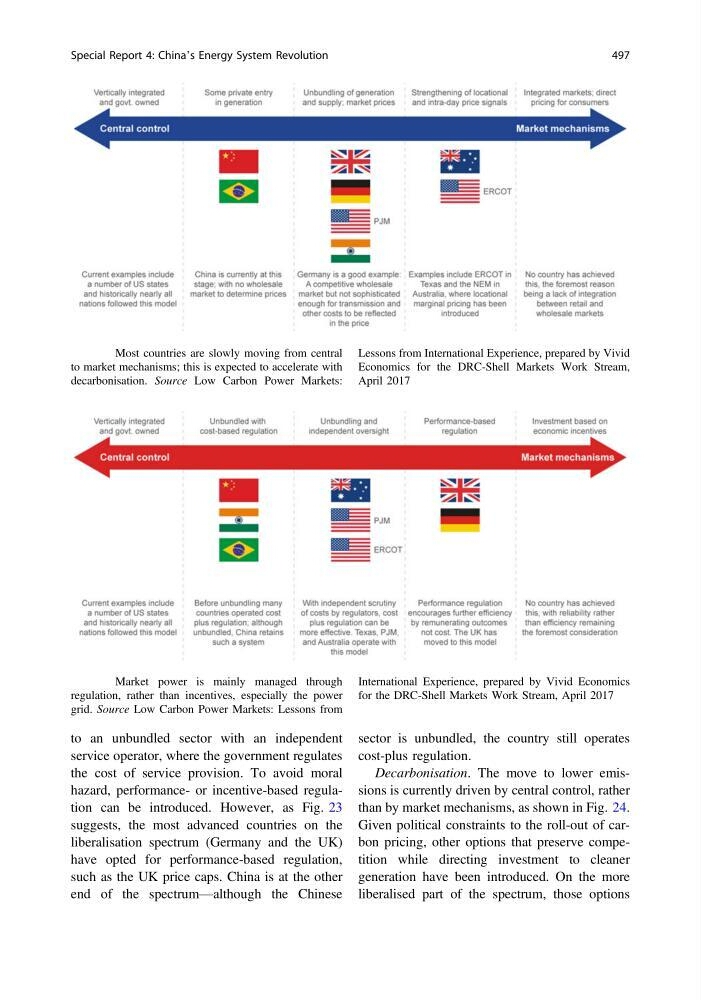
hazard, performance- or incentive-based regulation can be introduced. However, as Fig. 23
suggests, the most advanced countries on the
liberalisation spectrum (Germany and the UK)
have opted for performance-based regulation,
such as the UK price caps. China is at the other
end of the spectrum—although the Chinese
sector is unbundled, the country still operates
cost-plus regulation.
Decarbonisation. The move to lower emissions is currently driven by central control, rather
than by market mechanisms, as shown in Fig. 24.
Given political constraints to the roll-out of carbon pricing, other options that preserve competition while directing investment to cleaner
generation have been introduced. On the more
liberalised part of the spectrum, those options
Fig. 22 Most countries are slowly moving from central
to market mechanisms; this is expected to accelerate with
decarbonisation. Source Low Carbon Power Markets:
Lessons from International Experience, prepared by Vivid
Economics for the DRC-Shell Markets Work Stream,
April 2017
Fig. 23 Market power is mainly managed through
regulation, rather than incentives, especially the power
grid. Source Low Carbon Power Markets: Lessons from
International Experience, prepared by Vivid Economics
for the DRC-Shell Markets Work Stream, April 2017
Special Report 4: China’s Energy System Revolution
497
service operator, where the government regulates
the cost of service provision. To avoid moral
hazard, performance- or incentive-based regulation can be introduced. However, as Fig. 23
suggests, the most advanced countries on the
liberalisation spectrum (Germany and the UK)
have opted for performance-based regulation,
such as the UK price caps. China is at the other
end of the spectrum—although the Chinese
sector is unbundled, the country still operates
cost-plus regulation.
Decarbonisation. The move to lower emissions is currently driven by central control, rather
than by market mechanisms, as shown in Fig. 24.
Given political constraints to the roll-out of carbon pricing, other options that preserve competition while directing investment to cleaner
generation have been introduced. On the more
liberalised part of the spectrum, those options
Fig. 22 Most countries are slowly moving from central
to market mechanisms; this is expected to accelerate with
decarbonisation. Source Low Carbon Power Markets:
Lessons from International Experience, prepared by Vivid
Economics for the DRC-Shell Markets Work Stream,
April 2017
Fig. 23 Market power is mainly managed through
regulation, rather than incentives, especially the power
grid. Source Low Carbon Power Markets: Lessons from
International Experience, prepared by Vivid Economics
for the DRC-Shell Markets Work Stream, April 2017
Special Report 4: China’s Energy System Revolution
497