

7.2 Use of Central Control or Market
Mechanisms in Seven
Countries
19
Vivid Economics prepared a report summarising
international experience in power market reform
for the DRC-Shell Markets Work Stream. The
report describes the choices made in seven
countries on managing their power systems by
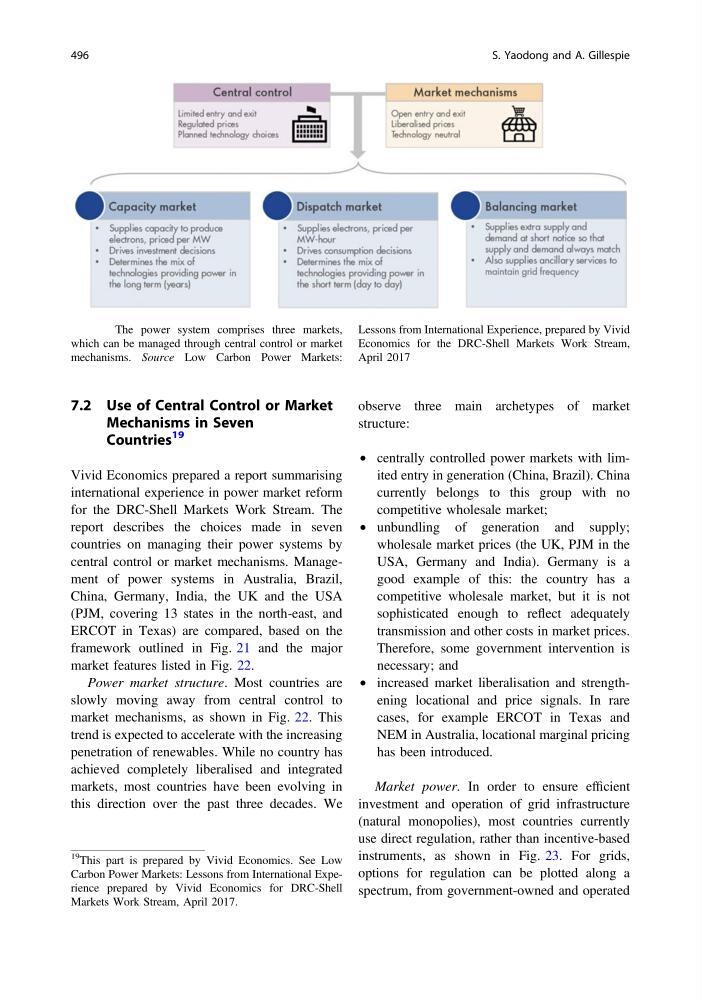
central control or market mechanisms. Management of power systems in Australia, Brazil,
China, Germany, India, the UK and the USA
(PJM, covering 13 states in the north-east, and
ERCOT in Texas) are compared, based on the
framework outlined in Fig. 21 and the major
market features listed in Fig. 22.
Power market structure. Most countries are
slowly moving away from central control to
market mechanisms, as shown in Fig. 22. This
trend is expected to accelerate with the increasing
penetration of renewables. While no country has
achieved completely liberalised and integrated
markets, most countries have been evolving in
this direction over the past three decades. We
observe three main archetypes of market
structure:
• centrally controlled power markets with limited entry in generation (China, Brazil). China
currently belongs to this group with no
competitive wholesale market;
• unbundling of generation and supply;
wholesale market prices (the UK, PJM in the
USA, Germany and India). Germany is a
good example of this: the country has a
competitive wholesale market, but it is not
sophisticated enough to reflect adequately
transmission and other costs in market prices.
Therefore, some government intervention is
necessary; and
• increased market liberalisation and strengthening locational and price signals. In rare
cases, for example ERCOT in Texas and
NEM in Australia, locational marginal pricing
has been introduced.
Market power. In order to ensure efficient
investment and operation of grid infrastructure
(natural monopolies), most countries currently
use direct regulation, rather than incentive-based
instruments, as shown in Fig. 23. For grids,
options for regulation can be plotted along a
spectrum, from government-owned and operated
Fig. 21 The power system comprises three markets,
which can be managed through central control or market
mechanisms. Source Low Carbon Power Markets:
Lessons from International Experience, prepared by Vivid
Economics for the DRC-Shell Markets Work Stream,
April 2017
19
This part is prepared by Vivid Economics. See Low
Carbon Power Markets: Lessons from International Experience prepared by Vivid Economics for DRC-Shell
Markets Work Stream, April 2017.
496
S. Yaodong and A. Gillespie
Mechanisms in Seven
Countries
19
Vivid Economics prepared a report summarising
international experience in power market reform
for the DRC-Shell Markets Work Stream. The
report describes the choices made in seven
countries on managing their power systems by
central control or market mechanisms. Management of power systems in Australia, Brazil,
China, Germany, India, the UK and the USA
(PJM, covering 13 states in the north-east, and
ERCOT in Texas) are compared, based on the
framework outlined in Fig. 21 and the major
market features listed in Fig. 22.
Power market structure. Most countries are
slowly moving away from central control to
market mechanisms, as shown in Fig. 22. This
trend is expected to accelerate with the increasing
penetration of renewables. While no country has
achieved completely liberalised and integrated
markets, most countries have been evolving in
this direction over the past three decades. We
observe three main archetypes of market
structure:
• centrally controlled power markets with limited entry in generation (China, Brazil). China
currently belongs to this group with no
competitive wholesale market;
• unbundling of generation and supply;
wholesale market prices (the UK, PJM in the
USA, Germany and India). Germany is a
good example of this: the country has a
competitive wholesale market, but it is not
sophisticated enough to reflect adequately
transmission and other costs in market prices.
Therefore, some government intervention is
necessary; and
• increased market liberalisation and strengthening locational and price signals. In rare
cases, for example ERCOT in Texas and
NEM in Australia, locational marginal pricing
has been introduced.
Market power. In order to ensure efficient
investment and operation of grid infrastructure
(natural monopolies), most countries currently
use direct regulation, rather than incentive-based
instruments, as shown in Fig. 23. For grids,
options for regulation can be plotted along a
spectrum, from government-owned and operated
Fig. 21 The power system comprises three markets,
which can be managed through central control or market
mechanisms. Source Low Carbon Power Markets:
Lessons from International Experience, prepared by Vivid
Economics for the DRC-Shell Markets Work Stream,
April 2017
19
This part is prepared by Vivid Economics. See Low
Carbon Power Markets: Lessons from International Experience prepared by Vivid Economics for DRC-Shell
Markets Work Stream, April 2017.
496
S. Yaodong and A. Gillespie