

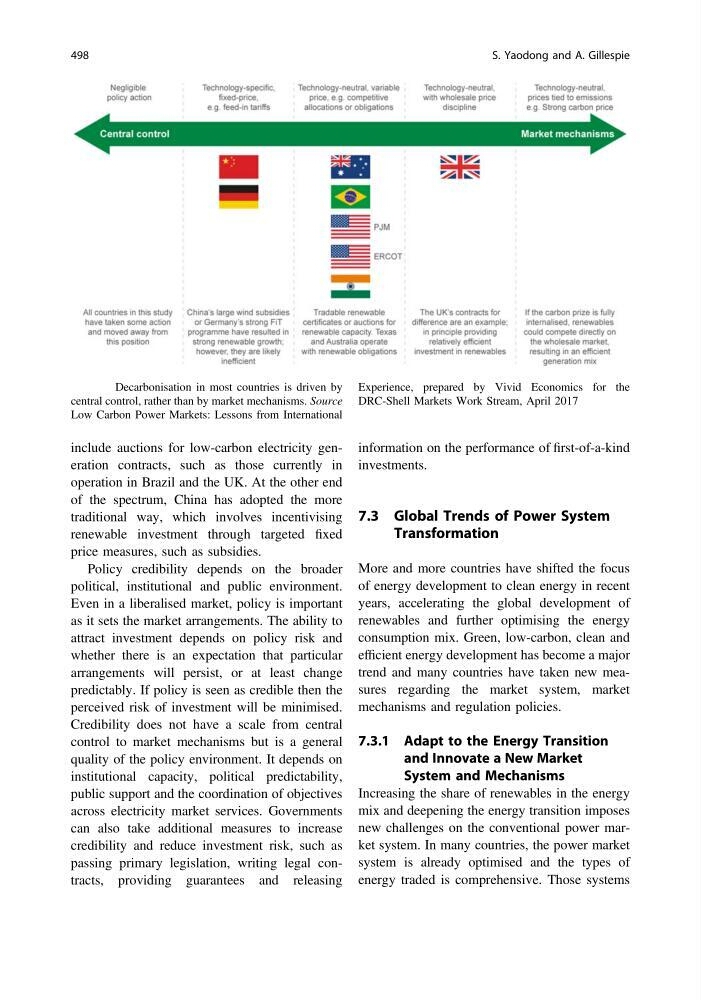
include auctions for low-carbon electricity generation contracts, such as those currently in
operation in Brazil and the UK. At the other end
of the spectrum, China has adopted the more
traditional way, which involves incentivising
renewable investment through targeted fixed
price measures, such as subsidies.
Policy credibility depends on the broader
political, institutional and public environment.
Even in a liberalised market, policy is important
as it sets the market arrangements. The ability to
attract investment depends on policy risk and
whether there is an expectation that particular
arrangements will persist, or at least change
predictably. If policy is seen as credible then the
perceived risk of investment will be minimised.
Credibility does not have a scale from central
control to market mechanisms but is a general
quality of the policy environment. It depends on
institutional capacity, political predictability,
public support and the coordination of objectives
across electricity market services. Governments
can also take additional measures to increase
credibility and reduce investment risk, such as
passing primary legislation, writing legal contracts, providing guarantees and releasing
information on the performance of first-of-a-kind
investments.
7.3 Global Trends of Power System
Transformation
More and more countries have shifted the focus
of energy development to clean energy in recent
years, accelerating the global development of
renewables and further optimising the energy
consumption mix. Green, low-carbon, clean and
efficient energy development has become a major
trend and many countries have taken new measures regarding the market system, market
mechanisms and regulation policies.
7.3.1 Adapt to the Energy Transition
and Innovate a New Market
System and Mechanisms
Increasing the share of renewables in the energy
mix and deepening the energy transition imposes
new challenges on the conventional power market system. In many countries, the power market
system is already optimised and the types of
energy traded is comprehensive. Those systems
Fig. 24 Decarbonisation in most countries is driven by
central control, rather than by market mechanisms. Source
Low Carbon Power Markets: Lessons from International
Experience, prepared by Vivid Economics for the
DRC-Shell Markets Work Stream, April 2017
498
S. Yaodong and A. Gillespie
operation in Brazil and the UK. At the other end
of the spectrum, China has adopted the more
traditional way, which involves incentivising
renewable investment through targeted fixed
price measures, such as subsidies.
Policy credibility depends on the broader
political, institutional and public environment.
Even in a liberalised market, policy is important
as it sets the market arrangements. The ability to
attract investment depends on policy risk and
whether there is an expectation that particular
arrangements will persist, or at least change
predictably. If policy is seen as credible then the
perceived risk of investment will be minimised.
Credibility does not have a scale from central
control to market mechanisms but is a general
quality of the policy environment. It depends on
institutional capacity, political predictability,
public support and the coordination of objectives
across electricity market services. Governments
can also take additional measures to increase
credibility and reduce investment risk, such as
passing primary legislation, writing legal contracts, providing guarantees and releasing
information on the performance of first-of-a-kind
investments.
7.3 Global Trends of Power System
Transformation
More and more countries have shifted the focus
of energy development to clean energy in recent
years, accelerating the global development of
renewables and further optimising the energy
consumption mix. Green, low-carbon, clean and
efficient energy development has become a major
trend and many countries have taken new measures regarding the market system, market
mechanisms and regulation policies.
7.3.1 Adapt to the Energy Transition
and Innovate a New Market
System and Mechanisms
Increasing the share of renewables in the energy
mix and deepening the energy transition imposes
new challenges on the conventional power market system. In many countries, the power market
system is already optimised and the types of
energy traded is comprehensive. Those systems
Fig. 24 Decarbonisation in most countries is driven by
central control, rather than by market mechanisms. Source
Low Carbon Power Markets: Lessons from International
Experience, prepared by Vivid Economics for the
DRC-Shell Markets Work Stream, April 2017
498
S. Yaodong and A. Gillespie