

services, transmission and distribution networks,
and consumer participation in retail markets
through mechanisms such as demand-response to
prices—and the incentives to support a more
flexible and complex system.
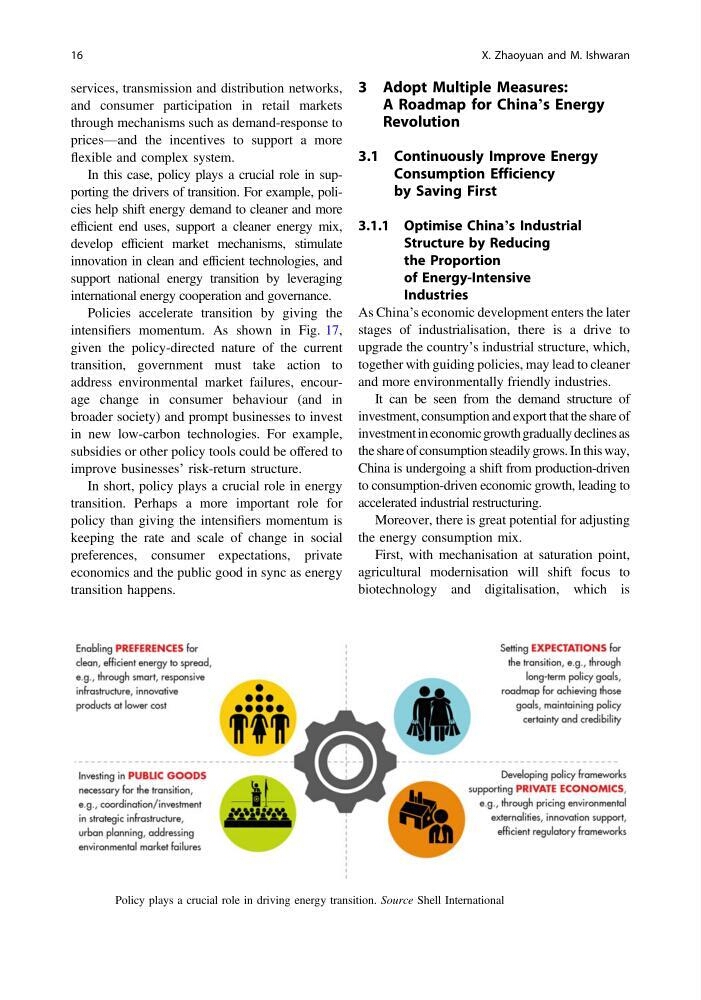
In this case, policy plays a crucial role in supporting the drivers of transition. For example, policies help shift energy demand to cleaner and more
efficient end uses, support a cleaner energy mix,
develop efficient market mechanisms, stimulate
innovation in clean and efficient technologies, and
support national energy transition by leveraging
international energy cooperation and governance.
Policies accelerate transition by giving the
intensifiers momentum. As shown in Fig. 17,
given the policy-directed nature of the current
transition, government must take action to
address environmental market failures, encourage change in consumer behaviour (and in
broader society) and prompt businesses to invest
in new low-carbon technologies. For example,
subsidies or other policy tools could be offered to
improve businesses’ risk-return structure.
In short, policy plays a crucial role in energy
transition. Perhaps a more important role for
policy than giving the intensifiers momentum is
keeping the rate and scale of change in social
preferences, consumer expectations, private
economics and the public good in sync as energy
transition happens.
3 Adopt Multiple Measures:
A Roadmap for China’s Energy
Revolution
3.1 Continuously Improve Energy
Consumption Efficiency
by Saving First
3.1.1 Optimise China’s Industrial
Structure by Reducing
the Proportion
of Energy-Intensive
Industries
As China’s economic development enters the later
stages of industrialisation, there is a drive to
upgrade the country’s industrial structure, which,
together with guiding policies, may lead to cleaner
and more environmentally friendly industries.
It can be seen from the demand structure of
investment, consumption and export that the share of
investment in economic growth gradually declines as
the share of consumption steadily grows. In this way,
China is undergoing a shift from production-driven
to consumption-driven economic growth, leading to
accelerated industrial restructuring.
Moreover, there is great potential for adjusting
the energy consumption mix.
First, with mechanisation at saturation point,
agricultural modernisation will shift focus to
biotechnology and digitalisation, which is
Fig. 17 Policy plays a crucial role in driving energy transition. Source Shell International
16
X. Zhaoyuan and M. Ishwaran
and consumer participation in retail markets
through mechanisms such as demand-response to
prices—and the incentives to support a more
flexible and complex system.
In this case, policy plays a crucial role in supporting the drivers of transition. For example, policies help shift energy demand to cleaner and more
efficient end uses, support a cleaner energy mix,
develop efficient market mechanisms, stimulate
innovation in clean and efficient technologies, and
support national energy transition by leveraging
international energy cooperation and governance.
Policies accelerate transition by giving the
intensifiers momentum. As shown in Fig. 17,
given the policy-directed nature of the current
transition, government must take action to
address environmental market failures, encourage change in consumer behaviour (and in
broader society) and prompt businesses to invest
in new low-carbon technologies. For example,
subsidies or other policy tools could be offered to
improve businesses’ risk-return structure.
In short, policy plays a crucial role in energy
transition. Perhaps a more important role for
policy than giving the intensifiers momentum is
keeping the rate and scale of change in social
preferences, consumer expectations, private
economics and the public good in sync as energy
transition happens.
3 Adopt Multiple Measures:
A Roadmap for China’s Energy
Revolution
3.1 Continuously Improve Energy
Consumption Efficiency
by Saving First
3.1.1 Optimise China’s Industrial
Structure by Reducing
the Proportion
of Energy-Intensive
Industries
As China’s economic development enters the later
stages of industrialisation, there is a drive to
upgrade the country’s industrial structure, which,
together with guiding policies, may lead to cleaner
and more environmentally friendly industries.
It can be seen from the demand structure of
investment, consumption and export that the share of
investment in economic growth gradually declines as
the share of consumption steadily grows. In this way,
China is undergoing a shift from production-driven
to consumption-driven economic growth, leading to
accelerated industrial restructuring.
Moreover, there is great potential for adjusting
the energy consumption mix.
First, with mechanisation at saturation point,
agricultural modernisation will shift focus to
biotechnology and digitalisation, which is
Fig. 17 Policy plays a crucial role in driving energy transition. Source Shell International
16
X. Zhaoyuan and M. Ishwaran