

Private economics cause businesses to act
Energy transition may improve the private economics of businesses through positive spillover
effects, which encourage further action. Businesses will act if it creates value for them, or if the
benefits from energy transition are greater than the
cost. When businesses take action this can change
the private value of future action via externalities,
positive spillovers or complementary goods. For
example, the cost of wind power decreased as
deployment increased due to the positive spillover
of learning effects. Because action now increases
the net private value of future action, this
encourages future action, which then further
increases the net private value of future action,
creating a positive feedback loop.
Public good causes government to act
Government tends to act if the economics or the
politics of the transition improve.
If energy transition generates value for society, it will win the public’s backing, and in turn it
can generate national political support or directly
drive policy action. International political support
can also modify national political support. For
example, the Paris Agreement and the International Energy Agency have affected national
political support for climate action and energy
security respectively.
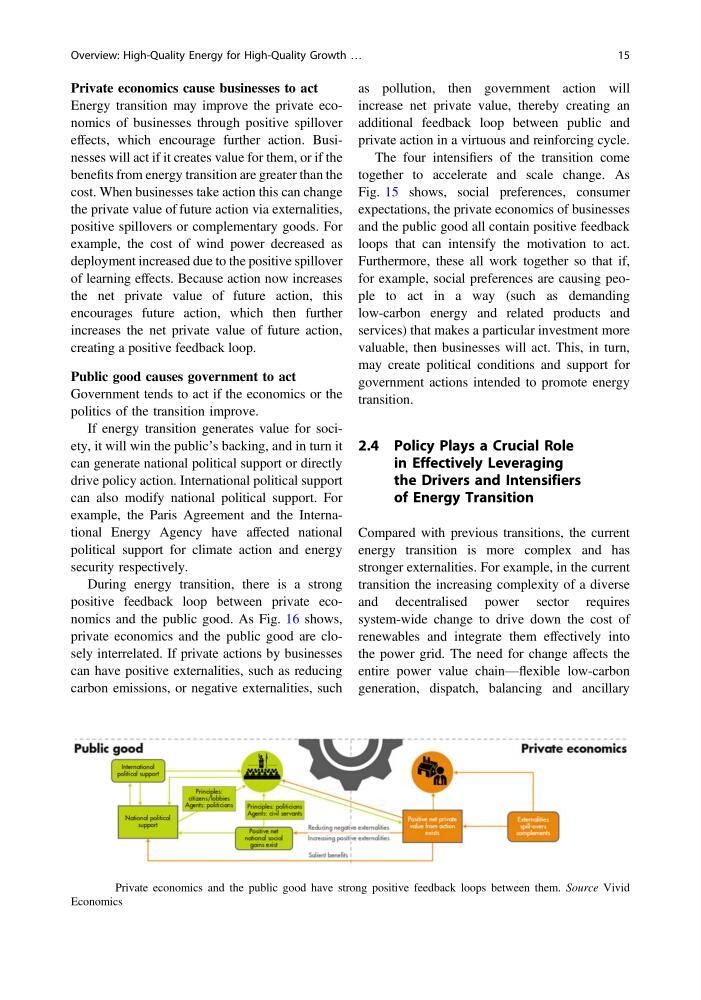
During energy transition, there is a strong
positive feedback loop between private economics and the public good. As Fig. 16 shows,
private economics and the public good are closely interrelated. If private actions by businesses
can have positive externalities, such as reducing
carbon emissions, or negative externalities, such
as pollution, then government action will
increase net private value, thereby creating an
additional feedback loop between public and
private action in a virtuous and reinforcing cycle.
The four intensifiers of the transition come
together to accelerate and scale change. As
Fig. 15 shows, social preferences, consumer
expectations, the private economics of businesses
and the public good all contain positive feedback
loops that can intensify the motivation to act.
Furthermore, these all work together so that if,
for example, social preferences are causing people to act in a way (such as demanding
low-carbon energy and related products and
services) that makes a particular investment more
valuable, then businesses will act. This, in turn,
may create political conditions and support for
government actions intended to promote energy
transition.
2.4 Policy Plays a Crucial Role
in Effectively Leveraging
the Drivers and Intensifiers
of Energy Transition
Compared with previous transitions, the current
energy transition is more complex and has
stronger externalities. For example, in the current
transition the increasing complexity of a diverse
and decentralised power sector requires
system-wide change to drive down the cost of
renewables and integrate them effectively into
the power grid. The need for change affects the
entire power value chain—flexible low-carbon
generation, dispatch, balancing and ancillary
Fig. 16 Private economics and the public good have strong positive feedback loops between them. Source Vivid
Economics
Overview: High-Quality Energy for High-Quality Growth …
15
Energy transition may improve the private economics of businesses through positive spillover
effects, which encourage further action. Businesses will act if it creates value for them, or if the
benefits from energy transition are greater than the
cost. When businesses take action this can change
the private value of future action via externalities,
positive spillovers or complementary goods. For
example, the cost of wind power decreased as
deployment increased due to the positive spillover
of learning effects. Because action now increases
the net private value of future action, this
encourages future action, which then further
increases the net private value of future action,
creating a positive feedback loop.
Public good causes government to act
Government tends to act if the economics or the
politics of the transition improve.
If energy transition generates value for society, it will win the public’s backing, and in turn it
can generate national political support or directly
drive policy action. International political support
can also modify national political support. For
example, the Paris Agreement and the International Energy Agency have affected national
political support for climate action and energy
security respectively.
During energy transition, there is a strong
positive feedback loop between private economics and the public good. As Fig. 16 shows,
private economics and the public good are closely interrelated. If private actions by businesses
can have positive externalities, such as reducing
carbon emissions, or negative externalities, such
as pollution, then government action will
increase net private value, thereby creating an
additional feedback loop between public and
private action in a virtuous and reinforcing cycle.
The four intensifiers of the transition come
together to accelerate and scale change. As
Fig. 15 shows, social preferences, consumer
expectations, the private economics of businesses
and the public good all contain positive feedback
loops that can intensify the motivation to act.
Furthermore, these all work together so that if,
for example, social preferences are causing people to act in a way (such as demanding
low-carbon energy and related products and
services) that makes a particular investment more
valuable, then businesses will act. This, in turn,
may create political conditions and support for
government actions intended to promote energy
transition.
2.4 Policy Plays a Crucial Role
in Effectively Leveraging
the Drivers and Intensifiers
of Energy Transition
Compared with previous transitions, the current
energy transition is more complex and has
stronger externalities. For example, in the current
transition the increasing complexity of a diverse
and decentralised power sector requires
system-wide change to drive down the cost of
renewables and integrate them effectively into
the power grid. The need for change affects the
entire power value chain—flexible low-carbon
generation, dispatch, balancing and ancillary
Fig. 16 Private economics and the public good have strong positive feedback loops between them. Source Vivid
Economics
Overview: High-Quality Energy for High-Quality Growth …
15