

International cooperation
An increase in a country’s participation in global
energy trade can also trigger an energy revolution. For example, new gas pipelines or liquefied
natural gas (LNG) infrastructure could increase
trade in natural gas. New technologies and
infrastructure can deepen international cooperation and have a transformational impact on future
development. For example, extra high voltage
power transmission enables long-distance power
trade between countries.
2.3 Accelerating the Energy
Transition Requires Four
Intensifiers
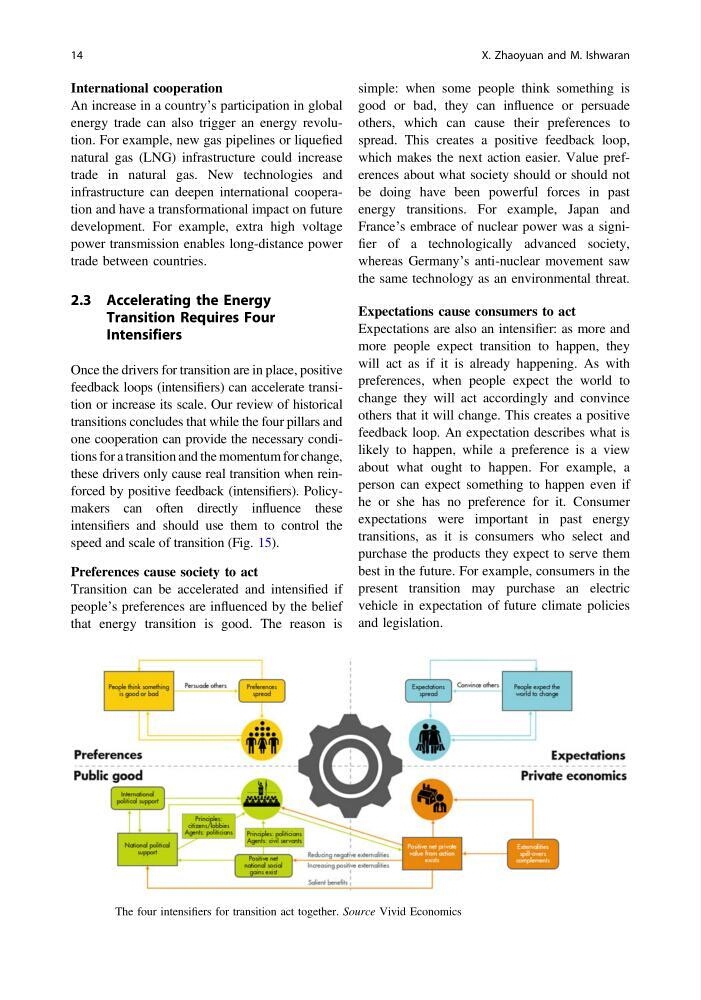
Once the drivers for transition are in place, positive
feedback loops (intensifiers) can accelerate transition or increase its scale. Our review of historical
transitions concludes that while the four pillars and
one cooperation can provide the necessary conditions for a transition and the momentum for change,
these drivers only cause real transition when reinforced by positive feedback (intensifiers). Policymakers can often directly influence these
intensifiers and should use them to control the
speed and scale of transition (Fig. 15).
Preferences cause society to act
Transition can be accelerated and intensified if
people’s preferences are influenced by the belief
that energy transition is good. The reason is
simple: when some people think something is
good or bad, they can influence or persuade
others, which can cause their preferences to
spread. This creates a positive feedback loop,
which makes the next action easier. Value preferences about what society should or should not
be doing have been powerful forces in past
energy transitions. For example, Japan and
France’s embrace of nuclear power was a signifier of a technologically advanced society,
whereas Germany’s anti-nuclear movement saw
the same technology as an environmental threat.
Expectations cause consumers to act
Expectations are also an intensifier: as more and
more people expect transition to happen, they
will act as if it is already happening. As with
preferences, when people expect the world to
change they will act accordingly and convince
others that it will change. This creates a positive
feedback loop. An expectation describes what is
likely to happen, while a preference is a view
about what ought to happen. For example, a
person can expect something to happen even if
he or she has no preference for it. Consumer
expectations were important in past energy
transitions, as it is consumers who select and
purchase the products they expect to serve them
best in the future. For example, consumers in the
present transition may purchase an electric
vehicle in expectation of future climate policies
and legislation.
Fig. 15 The four intensifiers for transition act together. Source Vivid Economics
14
X. Zhaoyuan and M. Ishwaran
An increase in a country’s participation in global
energy trade can also trigger an energy revolution. For example, new gas pipelines or liquefied
natural gas (LNG) infrastructure could increase
trade in natural gas. New technologies and
infrastructure can deepen international cooperation and have a transformational impact on future
development. For example, extra high voltage
power transmission enables long-distance power
trade between countries.
2.3 Accelerating the Energy
Transition Requires Four
Intensifiers
Once the drivers for transition are in place, positive
feedback loops (intensifiers) can accelerate transition or increase its scale. Our review of historical
transitions concludes that while the four pillars and
one cooperation can provide the necessary conditions for a transition and the momentum for change,
these drivers only cause real transition when reinforced by positive feedback (intensifiers). Policymakers can often directly influence these
intensifiers and should use them to control the
speed and scale of transition (Fig. 15).
Preferences cause society to act
Transition can be accelerated and intensified if
people’s preferences are influenced by the belief
that energy transition is good. The reason is
simple: when some people think something is
good or bad, they can influence or persuade
others, which can cause their preferences to
spread. This creates a positive feedback loop,
which makes the next action easier. Value preferences about what society should or should not
be doing have been powerful forces in past
energy transitions. For example, Japan and
France’s embrace of nuclear power was a signifier of a technologically advanced society,
whereas Germany’s anti-nuclear movement saw
the same technology as an environmental threat.
Expectations cause consumers to act
Expectations are also an intensifier: as more and
more people expect transition to happen, they
will act as if it is already happening. As with
preferences, when people expect the world to
change they will act accordingly and convince
others that it will change. This creates a positive
feedback loop. An expectation describes what is
likely to happen, while a preference is a view
about what ought to happen. For example, a
person can expect something to happen even if
he or she has no preference for it. Consumer
expectations were important in past energy
transitions, as it is consumers who select and
purchase the products they expect to serve them
best in the future. For example, consumers in the
present transition may purchase an electric
vehicle in expectation of future climate policies
and legislation.
Fig. 15 The four intensifiers for transition act together. Source Vivid Economics
14
X. Zhaoyuan and M. Ishwaran