

2.2 To Achieve the Energy
Revolution, China Needs
to Get Five Driving Forces
into Play: Four Pillars
and International
Cooperation
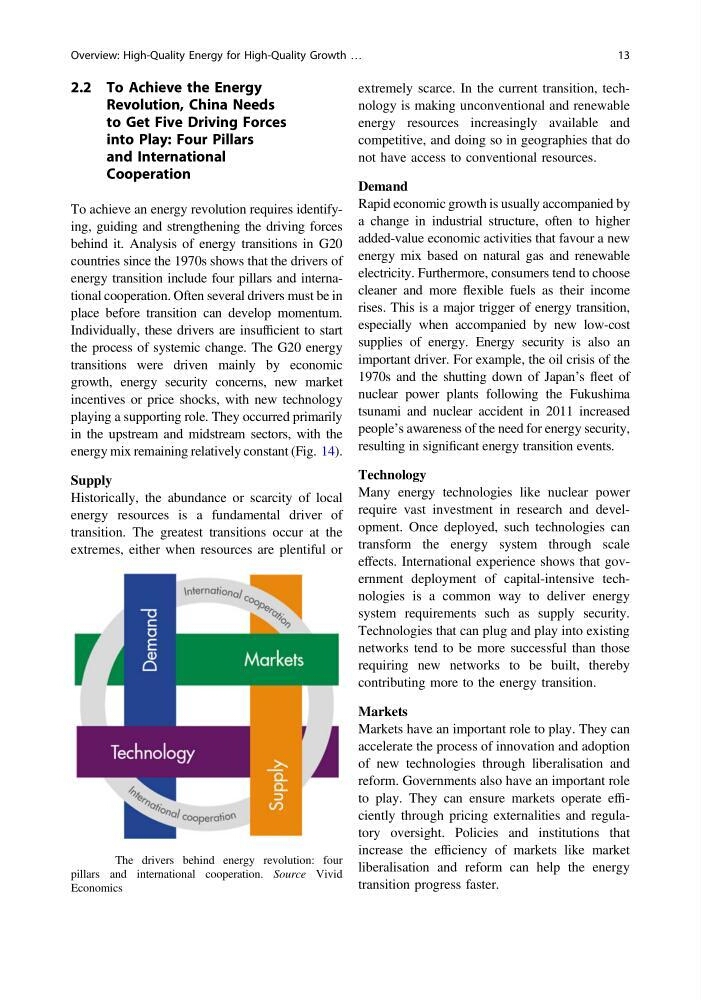
To achieve an energy revolution requires identifying, guiding and strengthening the driving forces
behind it. Analysis of energy transitions in G20
countries since the 1970s shows that the drivers of
energy transition include four pillars and international cooperation. Often several drivers must be in
place before transition can develop momentum.
Individually, these drivers are insufficient to start
the process of systemic change. The G20 energy
transitions were driven mainly by economic
growth, energy security concerns, new market
incentives or price shocks, with new technology
playing a supporting role. They occurred primarily
in the upstream and midstream sectors, with the
energy mix remaining relatively constant (Fig. 14).
Supply
Historically, the abundance or scarcity of local
energy resources is a fundamental driver of
transition. The greatest transitions occur at the
extremes, either when resources are plentiful or
extremely scarce. In the current transition, technology is making unconventional and renewable
energy resources increasingly available and
competitive, and doing so in geographies that do
not have access to conventional resources.
Demand
Rapid economic growth is usually accompanied by
a change in industrial structure, often to higher
added-value economic activities that favour a new
energy mix based on natural gas and renewable
electricity. Furthermore, consumers tend to choose
cleaner and more flexible fuels as their income
rises. This is a major trigger of energy transition,
especially when accompanied by new low-cost
supplies of energy. Energy security is also an
important driver. For example, the oil crisis of the
1970s and the shutting down of Japan’s fleet of
nuclear power plants following the Fukushima
tsunami and nuclear accident in 2011 increased
people’s awareness of the need for energy security,
resulting in significant energy transition events.
Technology
Many energy technologies like nuclear power
require vast investment in research and development. Once deployed, such technologies can
transform the energy system through scale
effects. International experience shows that government deployment of capital-intensive technologies is a common way to deliver energy
system requirements such as supply security.
Technologies that can plug and play into existing
networks tend to be more successful than those
requiring new networks to be built, thereby
contributing more to the energy transition.
Markets
Markets have an important role to play. They can
accelerate the process of innovation and adoption
of new technologies through liberalisation and
reform. Governments also have an important role
to play. They can ensure markets operate efficiently through pricing externalities and regulatory oversight. Policies and institutions that
increase the efficiency of markets like market
liberalisation and reform can help the energy
transition progress faster.
Fig. 14 The drivers behind energy revolution: four
pillars and international cooperation. Source Vivid
Economics
Overview: High-Quality Energy for High-Quality Growth …
13
Revolution, China Needs
to Get Five Driving Forces
into Play: Four Pillars
and International
Cooperation
To achieve an energy revolution requires identifying, guiding and strengthening the driving forces
behind it. Analysis of energy transitions in G20
countries since the 1970s shows that the drivers of
energy transition include four pillars and international cooperation. Often several drivers must be in
place before transition can develop momentum.
Individually, these drivers are insufficient to start
the process of systemic change. The G20 energy
transitions were driven mainly by economic
growth, energy security concerns, new market
incentives or price shocks, with new technology
playing a supporting role. They occurred primarily
in the upstream and midstream sectors, with the
energy mix remaining relatively constant (Fig. 14).
Supply
Historically, the abundance or scarcity of local
energy resources is a fundamental driver of
transition. The greatest transitions occur at the
extremes, either when resources are plentiful or
extremely scarce. In the current transition, technology is making unconventional and renewable
energy resources increasingly available and
competitive, and doing so in geographies that do
not have access to conventional resources.
Demand
Rapid economic growth is usually accompanied by
a change in industrial structure, often to higher
added-value economic activities that favour a new
energy mix based on natural gas and renewable
electricity. Furthermore, consumers tend to choose
cleaner and more flexible fuels as their income
rises. This is a major trigger of energy transition,
especially when accompanied by new low-cost
supplies of energy. Energy security is also an
important driver. For example, the oil crisis of the
1970s and the shutting down of Japan’s fleet of
nuclear power plants following the Fukushima
tsunami and nuclear accident in 2011 increased
people’s awareness of the need for energy security,
resulting in significant energy transition events.
Technology
Many energy technologies like nuclear power
require vast investment in research and development. Once deployed, such technologies can
transform the energy system through scale
effects. International experience shows that government deployment of capital-intensive technologies is a common way to deliver energy
system requirements such as supply security.
Technologies that can plug and play into existing
networks tend to be more successful than those
requiring new networks to be built, thereby
contributing more to the energy transition.
Markets
Markets have an important role to play. They can
accelerate the process of innovation and adoption
of new technologies through liberalisation and
reform. Governments also have an important role
to play. They can ensure markets operate efficiently through pricing externalities and regulatory oversight. Policies and institutions that
increase the efficiency of markets like market
liberalisation and reform can help the energy
transition progress faster.
Fig. 14 The drivers behind energy revolution: four
pillars and international cooperation. Source Vivid
Economics
Overview: High-Quality Energy for High-Quality Growth …
13