

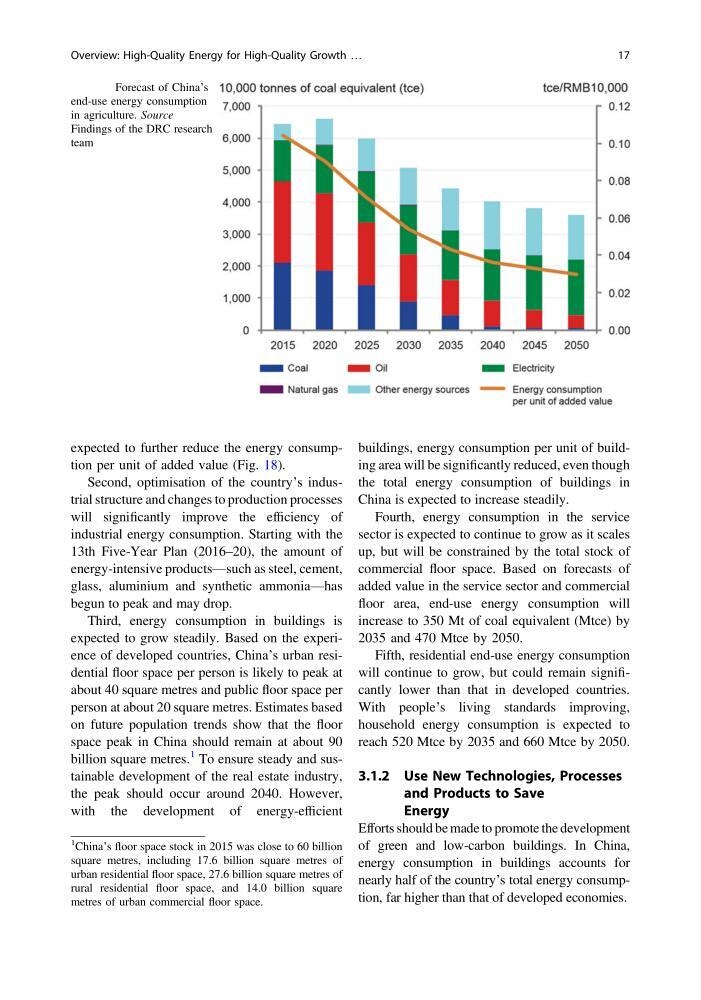
expected to further reduce the energy consumption per unit of added value (Fig. 18).
Second, optimisation of the country’s industrial structure and changes to production processes
will significantly improve the efficiency of
industrial energy consumption. Starting with the
13th Five-Year Plan (2016–20), the amount of
energy-intensive products—such as steel, cement,
glass, aluminium and synthetic ammonia—has
begun to peak and may drop.
Third, energy consumption in buildings is
expected to grow steadily. Based on the experience of developed countries, China’s urban residential floor space per person is likely to peak at
about 40 square metres and public floor space per
person at about 20 square metres. Estimates based
on future population trends show that the floor
space peak in China should remain at about 90
billion square metres.
1 To ensure steady and sustainable development of the real estate industry,
the peak should occur around 2040. However,
with the development of energy-efficient
buildings, energy consumption per unit of building area will be significantly reduced, even though
the total energy consumption of buildings in
China is expected to increase steadily.
Fourth, energy consumption in the service
sector is expected to continue to grow as it scales
up, but will be constrained by the total stock of
commercial floor space. Based on forecasts of
added value in the service sector and commercial
floor area, end-use energy consumption will
increase to 350 Mt of coal equivalent (Mtce) by
2035 and 470 Mtce by 2050.
Fifth, residential end-use energy consumption
will continue to grow, but could remain significantly lower than that in developed countries.
With people’s living standards improving,
household energy consumption is expected to
reach 520 Mtce by 2035 and 660 Mtce by 2050.
3.1.2 Use New Technologies, Processes
and Products to Save
Energy
Efforts should be made to promote the development
of green and low-carbon buildings. In China,
energy consumption in buildings accounts for
nearly half of the country’s total energy consumption, far higher than that of developed economies.
Fig. 18 Forecast of China’s
end-use energy consumption
in agriculture. Source
Findings of the DRC research
team
1
China’s floor space stock in 2015 was close to 60 billion
square metres, including 17.6 billion square metres of
urban residential floor space, 27.6 billion square metres of
rural residential floor space, and 14.0 billion square
metres of urban commercial floor space.
Overview: High-Quality Energy for High-Quality Growth …
17
Second, optimisation of the country’s industrial structure and changes to production processes
will significantly improve the efficiency of
industrial energy consumption. Starting with the
13th Five-Year Plan (2016–20), the amount of
energy-intensive products—such as steel, cement,
glass, aluminium and synthetic ammonia—has
begun to peak and may drop.
Third, energy consumption in buildings is
expected to grow steadily. Based on the experience of developed countries, China’s urban residential floor space per person is likely to peak at
about 40 square metres and public floor space per
person at about 20 square metres. Estimates based
on future population trends show that the floor
space peak in China should remain at about 90
billion square metres.
1 To ensure steady and sustainable development of the real estate industry,
the peak should occur around 2040. However,
with the development of energy-efficient
buildings, energy consumption per unit of building area will be significantly reduced, even though
the total energy consumption of buildings in
China is expected to increase steadily.
Fourth, energy consumption in the service
sector is expected to continue to grow as it scales
up, but will be constrained by the total stock of
commercial floor space. Based on forecasts of
added value in the service sector and commercial
floor area, end-use energy consumption will
increase to 350 Mt of coal equivalent (Mtce) by
2035 and 470 Mtce by 2050.
Fifth, residential end-use energy consumption
will continue to grow, but could remain significantly lower than that in developed countries.
With people’s living standards improving,
household energy consumption is expected to
reach 520 Mtce by 2035 and 660 Mtce by 2050.
3.1.2 Use New Technologies, Processes
and Products to Save
Energy
Efforts should be made to promote the development
of green and low-carbon buildings. In China,
energy consumption in buildings accounts for
nearly half of the country’s total energy consumption, far higher than that of developed economies.
Fig. 18 Forecast of China’s
end-use energy consumption
in agriculture. Source
Findings of the DRC research
team
1
China’s floor space stock in 2015 was close to 60 billion
square metres, including 17.6 billion square metres of
urban residential floor space, 27.6 billion square metres of
rural residential floor space, and 14.0 billion square
metres of urban commercial floor space.
Overview: High-Quality Energy for High-Quality Growth …
17